As the United States continues to seek ways to reduce environmentally harmful greenhouse gas, or GHG emissions, methanol is an attractive fuel alternative to diesel because it reduces carbon emissions. Methanol also reduces emissions of nitrogen oxides and sulfur oxides. In addition, methanol’s relatively high energy density makes it easier to store on marine vessels than gaseous fuels meaning it can be more easily integrated into overall existing engine design and operation.
Although methanol has many advantages, it is more difficult to ignite than diesel. Under the terms of the CRADA, ORNL researchers will work with Caterpillar over the next few years to identify, develop and test hardware configurations and operating strategies required to maximize use of methanol in engines retrofitted for methanol.
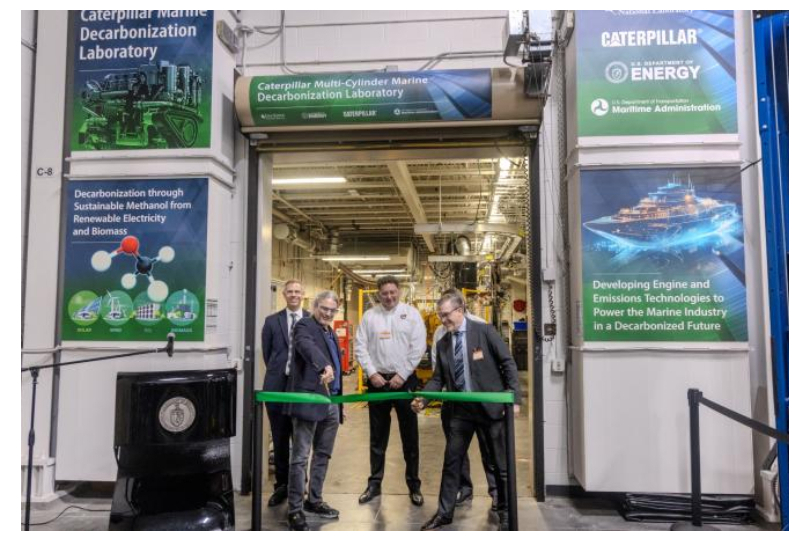
Research will be conducted on Caterpillar’s in-line 6-cylinder marine engine that has been modified for methanol use and installed at DOE’s National Transportation Research Center at ORNL. New engine designs will also be considered, and several engine combustion strategies will be explored including dual-fuel, dimethyl ether reforming and spark-ignited prechambers. Caterpillar will support ORNL by providing additional materials and research expertise to enable engine performance, efficiency and durability while reducing GHG and other emissions.
The project supports DOE’s Vehicle Technologies Office’s focus on reducing GHG emissions from off-road vehicles such as railway, aviation and heavy transportation vehicles used in agriculture, construction, mining and marine vessels. These sectors are significantly more challenging to decarbonize than on-road, light-duty transportation applications and require unique solutions.
In addition to DOE’s Vehicle Technologies Office, the collaboration is funded by the U.S. Department of Transportation Maritime Administration.
UT-Battelle manages ORNL for the Department of Energy’s Office of Science, the single largest supporter of basic research in the physical sciences in the United States. The Office of Science is working to address some of the most pressing challenges of our time.