Is Venezuela Now On A Fast Track to Seize Most of Guyana and Start a War?
Lead StoryConflict
News Analysis
On December 3, the citizens in Venezuela supposedly voted at landslide levels to approve a ballot measure claiming Essequibo, a region encompassing most of neighboring Guyana and rich in oil, minerals, and precious metals, belongs to Venezuela. However, Venezuela also claims not just the waters offshore Essequibo but all of the oil rich land near Guyana under the Caribbean.
The basis for that claim is that a decision by a special arbitration tribunal headed up by Britain and the United States over a century ago was fraudulent and prior to that Venezuela claimed the area. The reason for wanting the land back now is that it has only recently been proven to have access to substantial oil and mineral resources, but there may be another reason, and that is war.
The voters in Venezuela on Sunday also authorized taking the land and designating it as the new Venezuelan state of Guayana Esequiba, and opening it for new oil and mining exploration in the region.
They also allegedly approved the referendum despite what Venezuela’s Attorney-General Tarek William Saab said was a deliberate attempt by those connected with opposition candidate María Corina Machado to undermine the vote. Soon after the December 3 vote, Saab filed warrants for the arrest of 14 individuals linked to Machado, including former National Assembly leader Juan Guaidó, along with Julio Borges, Leopoldo López, David Smolanski, and Carlos Vecchio, all for actions which have not yet been disclosed publicly but which the Maduro administration says was designed to tilt the vote against taking the land from Guyana.
The arrest warrants were on charges of treason for interfering with the will of the Venezuelan people. Saab said that the 14 being charged were funded in their efforts with funds “laundered by international organizations and foreign companies like ExxonMobil.” The charges are probably correct, but don't amount to treason.
ExxonMobil is the current foreign enterprise, and a U.S.-owned one at that, which has the most to lose immediately if Venezuela is somehow able to get control of Essequibo. It is the company currently holding the rights to explore and exploit the oil and gas reserves offshore Essequibo, Guyana, for access to the estimated up to 8 billion barrels of oil off the Guyana coast. ExxonMobil reportedly is currently extracting approximately 120,000 barrels/day of crude from the region, with production expected to rise to 800,000 barrels/day by 2025.
After the vote was tallied Sunday and certified Monday, most expected President Nicolás Maduro to take some time consolidating his win. That did not happen. Instead, he surprised most of the world by moving quickly on almost every front possible since that time to complete his land grab.
In the less than four days since the vote was complete, Maduro has:
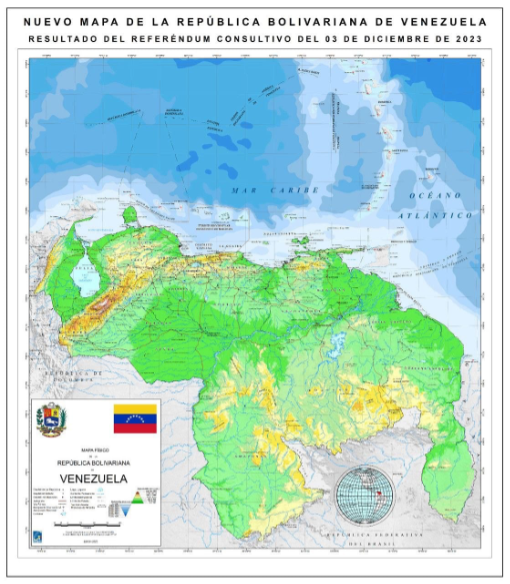
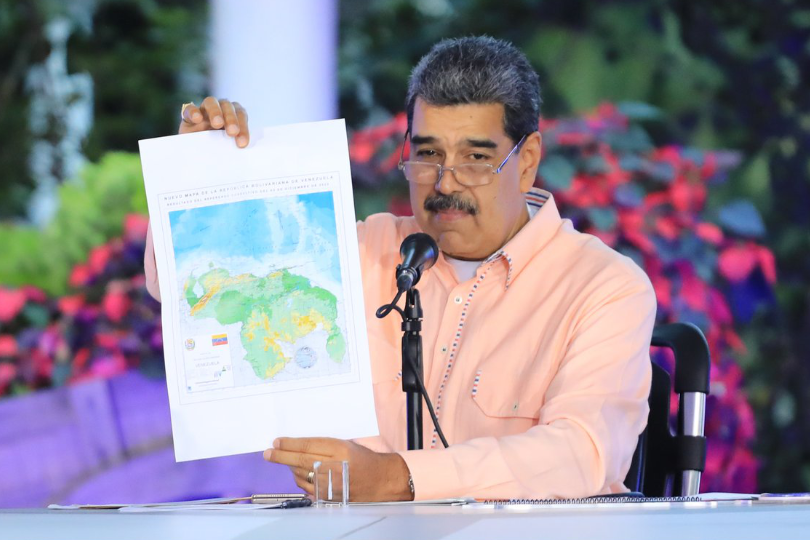
Commissioned and published a new map of Venezuela with its voter-approved new borders.
Quickly arranged a special summit held on Monday, December 4, between officials from the Maduro administration and what were alleged to be authorized representatives of the opposition Unity Platform group in Mexico City. The agreement signed there supposedly validated that the “official opposition” in Venezuela is fully in support of the referendum, and that the 14 individuals the Venezuelan attorney general plans to arrest for treason were just outliers.
Ordered foreign oil companies to withdraw from the area now claimed by Venezuela within 3 months.
Ordered Petróleos de Venezuela, S.A. (PDVSA), the state-owned oil company, to create business units covering the new territory. Maduro announced this on December 5, during the General Assembly of the Federal Council of Government with the participation of the Council of State and the Council of Defense of the Nation. There he instructed the government and PDVSA to formally enshrine the Venezuelan Corporation of Guayana (CVG) as a new legal entity, and to have PDVSA to set up a new CVG Essequibo Division.
Directed the new legal entities to “grant operating licenses for the exploration and exploitation of oil, gas and mines throughout the area of our Guyana Esequiba”.
At the same time as this was happening, Guyana not surprisingly raised a formal protest about what was already sounding like Venezuela would soon be invading its territory to secure the new borders of its country by marching its armies into Essequibo.
In a statement released on December 6, the government of Guyana issued its own formal statement saying that it “formally rejects” the referendum along with the agreement signed with the opposition party on December 4.
“That agreement is an overt threat to the sovereignty and territorial integrity of Guyana,” the Ministry of Foreign Affairs and International Cooperation continued.
“Guyana cannot be used as an altar of sacrifice for settlement of Venezuela’s internal political differences,” it continued. “While the government of Guyana welcomes domestic accord within Venezuela, an agreement defying international law and process is not a basis for mediating harmony.”
Guyana is appealing for help from the United Nations’ International Court of Justice, also known as the World Court, in attempt to keep Venezuela at bay for now. Its Foreign Affairs Ministry said that “the controversy…is properly before the International Court of Justice (ICJ) and will remain there for peaceful resolution”. However, the U.S. has made the issue a priority also before the UN Security Council, which will meet to discuss the issue today, Friday, 8 December.
Peacefully is about the only choice Guyana, a country with just 800,000 people, could muster on their own as a way to deflect a potential invasion by Venezuelan military to enforce the referendum. Its Guyana Defense Force (GDF) is relatively tiny, with just 3,400 active military personnel overall, including 3,000 in the Army, 200 in its Air Corps, and 200 in its Navy. It is ranked #137 out of 145 countries globally according to the Global Firepower Index (GFP).
By contrast, Venezuela, a country of just under 30 million, has around 63,000 military personnel, split between Army, Air, and Naval defense groups. Its military is ranked at #52 on the Global Firepower Index, but that is without taking into consideration the presence of Chinese military being used to keep Maduro in power.
Brazil responded to the threat posed by Venezuela by sending an unspecified number of troops into the region near Venezuela and Guyana. It said they were being sent to "guarantee the inviolability of the territory", but so far there has been no further information about its plans.
Brazil’s military moves are important because at present there is no easy way for Venezuela to invade Essequibo across the direct land border it shares with Guyana. The mountainous terrain there would make land movement difficult. That leaves the best invasion route heading southwards first onto Brazilian land, which Venezuela is not expected to want to try if Brazil has military forces present there.
Guyana has also appealed to the United States for help, but it didn't have to. ExxonMobil and the CIA that serves it were already prepared to react to the referendum . After U.S. Secretary of State Antony Blinken reaffirmed that it “stands with Guyana” and its rights to its current recognized international borders, it sent an unspecified number of its own military forces to Guyana to back up Blinken’s statements. In a show of force which it hopes might deter Venezuela from taking any further steps, the U.S. also began a series of U.S. Air Force exercises yesterday, on December 7.
So far, no cross-border military clashes have taken place during this dispute. A Guyana army helicopter which was flying near the Venezuelan border crashed on December 6, killing 7 onboard and giving rise to rumors that Venezuelan forces might have shot it down. It was one of only four aging helicopters that Guyana has. There were two survivors of the crash.
Omar Khan, the Guyanese Chief of Staff, was quick to quash that rumor. He told the press soon after that there was “no information suggesting Venezuela was involved”.
Publisher's Analysis
The reason that Maduro has made it an urgent priority to start this conflict may have nothing to do with Guyana's natural riches or Venezuela's elections next year. Venezuela already has the world's largest oil reserves and can't exploit what it is has. It also has substantial minerals, including gold that it could tap further if needed. Venezuela would be a very wealthy nation if it wasn't run by its most corrupt and inept politicians.
Maduro has enough support among Venezuela's poor and criminal class that he can continue to get away with the suppressing the opposition and remain in power. Annexing Guyana now makes no sense unless one looks at greater geo-political agendas.
While Maduro may not be a mental giant, he is not stupid and has advisors who all understand that annexing most of Guyana can only result in war. He would not go down that road without having the military support of China or Russia.
Maduro is closely aligned with China, Russia, Iran and Cuba. All would benefit from Maduro starting a war with the United States.
China needs the U.S. embroiled in yet another conflict that occupies and depletes its weapons and personnel so that when it takes Taiwan there will be little interference from the U.S. It needs to take Taiwan before its advanced computer chip factories are replicated in other countries. To date, China has lacked the technical expertise to manufacture the most advanced chips required for powerful AI systems. To dominate the globe it requires powerful AI and that means having plenty of advanced chips that the west and Taiwan won't sell it. The fact that Beijing put its China Aerospace Science and Industry Corp (CASIC) in charge of transporting Venezuelan oil to China indicates that it may been preparing for a war with the U.S. through Venezuela. CASIC not only runs China's space program but it also designs and builds advanced missiles, including hypersonic anti-ship missiles designed specifically to destroy American naval ships. Those missiles may already be in Venezuela, along with other advanced Chinese weapons.
Then there is the fact that Team-Biden is substantially influenced by China and has been working diligently to destroy the U.S. from within on behalf of its Chinese masters. It would likely step into any traps laid for it by China.
Russia has seen how Israel's genocide in Palestine has distracted the U.S. from Ukraine and diverted funding from the U.S./NATO war on Russia via Ukraine to the fascist Jews' war on Palestinians. Putin needs to end the Ukraine war and to do that he needs to divert the U.S. further and a war with Venezuela works perfectly. Russia knows that the White House won't hesitate to commit whatever it takes to keep Venezuela from booting ExxonMobil out of Guyana's rich oil fields. Russia also knows that if it supports Venezuela, or gets China to do so, the U.S. may be bogged down with the war for a long time and ultimately defeated once and for all. Much of the world would celebrate the defeat of the U.S., the most hated nation on Earth.
Iran would like to substantially weaken or put down Israel and for that it needs the U.S. fully occupied with a major war elsewhere. The U.S. claims that it has the resources to fight three wars simultaneously, but the reality is that it couldn't defeat even the Taliban after spending 20 years and $2 trillion. The aging and defective military hardware of the U.S. and its current crop of recruits is no match for the military of China. Even after expending much of its military might in Ukraine, Russia could likely defeat the U.S.
Cuba has been a victim of American covert war and terrorism for more than 60 years. It has supported the socialist regime in Venezuela from the time of Chavez and would likely support Venezuela in a conflict with the U.S. by providing intelligence, counterintelligence and some troops. Cuba has long infiltrated the U.S. government with agents, such as Victor Manuel Rocha, Ana Belén Montes and many others who remain unexposed.
Venezuela is already well armed and has Russia's S-300 air defense systems. The S-300VM is an effective mobile surface-to-air missile (SAM) and anti-ballistic missile (ABM) system with a maximum combat range of 200 km. This means that Venezuela can defend itself against American missiles. If it has Russian or Chinese hypersonic missiles it can take out most American ships and planes. Venezuela also has sufficient jungle ready combat troops to deter American troops on land.
The United States is already supporting Guyana's small military, but it is no match for Venezuela. The U.S. would have to substantially commit its own troops to have any impact.
The UN Security Council will hold its emergency meeting on the issue today and if a resolution is put forward and voted on that will give some indication of the intentions of Russia and China in the matter.