Molecular Quantum Entanglement Could Transform Fields of Computation and Communications
Lead StoryScience & Tech
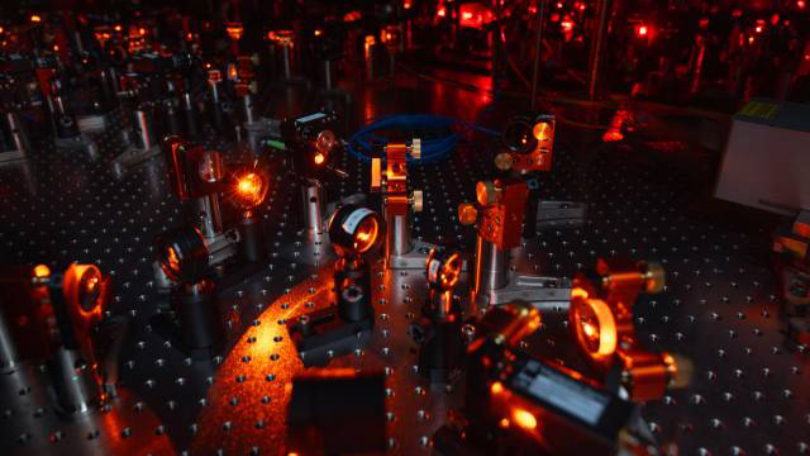
Until recently, only certain sub-atomic particles could be observed as entangled. Now, scientists have been able to entangle entire molecules.
This breakthrough could change the world of computing and communications forever.
In the view of conventional Newtonian physics, objects, particles, and molecules all exist separately from one another. They may exert forces such as gravitational pull or electrical fields which interact with each other, but they move about as independent entities which have no fundamental linkage to each other in terms of what they do.
On the subatomic “quantum” level, scientists years ago discovered a phenomenon which was predicted by science but to date something they could only observe and not make happen on itself.
That something, quantum entanglement, itself comes from the field of quantum mechanics in physics. The core idea behind quantum mechanics is that there are characteristics of particles such electrons, protons, neutrons, and many other subatomic elements which exist not in a continuum but in “quanta” – sometimes referred to as “lumps” of those characteristics.
One of the more common examples of thinking about quanta in practice involves how lasers work in generating what is known as “coherent” light versus conventional light generation sources such as, say, fluorescent or even light-emitting-diode sources.
In conventional sources, a filament, gas, or semiconductor material (in the case of LEDs) is heated, usually by electricity, to cause it to “glow” or otherwise emit light as a way of offloading some of the energy pushed into it via electrical power. That light consists of a broad spectrum of wavelengths of light, mixed to create the illusion to the eye that it is mostly one color, with different wavelengths emitting at different energy levels. The light flows out in all directions from the sources and each “wave” of light or “stream of photons”, the two ways of modeling how light propagates, have no connection to each other.
In laser systems, what happens is that a single element or pair of elements, such as in a helium-neon laser which is filled with helium and neon gas, is energized by electrodes similar to the way light is created in conventional light sources. This time, however, the light is pumped back on itself to amplify the energy within the elements. Those elements, partly out of their purity and partly out of how they are energized, are caused to be pushed into specific energy levels known as quanta. Those energy levels are not continuous and form as a result of the change in subatomic states of the atoms involved when energy is pumped into them. They are physically “stable” only at certain specific energy levels. In lasers, when sufficient energy is input to the materials in devices, eventually there is a build up of so much energy at a given “quantum’ level that the sub-atomic particles (and their associated quantum “waves”) begin to “fall” from higher quantum states of [energy] excitement to lower quantum states. When they do, they release light as the energy drops to the next lower quantum state.
They also release that energy in a way that all the energy is tightly “coherent”. What that means in physics, roughly, is that the wave energy released by the laser is all of one wave pattern, all aligned with each other "in phase" as waves, all moving in the same direction, and all at the same wavelength. Why that is useful is a much larger subject but this is why lasers are so intense and can create such unusual optical effects compared to conventional light.
In the field of quantum entanglement, scientists had first observed – then learned to create on their own – pairs (or larger numbers) of wave-particle systems like what exist in lasers, but with a key difference. Unlike the laser systems, where the energy waves whose propagation characteristics are described by quantum mechanics are aligned but not linked together (so that one wave influences another one), in quantum entanglement the wave-particle systems generated by splitting a single quantum entity were found to forever be connected to one another. If the “spin” characteristic of one particle was shifted “up”, for example, the change in the quantum characteristics of the first particle caused its quantumly entangled “partner” to shift its spin “down”.
That linkage could cause the two particle-wave systems to continue to quantumly “communicate”, for lack of a better word, even when separated by large distance. Another term often used to describe this connection is quantum correlation. Einstein called it "spooky action at a distance."
That quantum entanglement has been proven to function with particle-wave elements separated physically by miles. The key is that their quantum energy fields are linked, and only a small amount of maintenance of that energy is necessary to keep that entanglement functioning.
That connectivity, which happens more or less instantaneously, is a key to the concept of quantum computing and a reason why its speed is inherently so much faster – and often requiring far less energy – than conventional computing which involves at a subatomic level the actual movement of electrons, energy “holes”, or other changes within matter.
The breakthrough for the current research at Princeton, which was just published in the journal Science, is that for the first time scientists have figured out a way to link together the quantum wave characteristics of disparate particle-wave entities and create quantum entangled pairs “on demand”. Assuming the work can be readily duplicated, it could easily go down in history as the most important discoveries in physics in the 21st century.
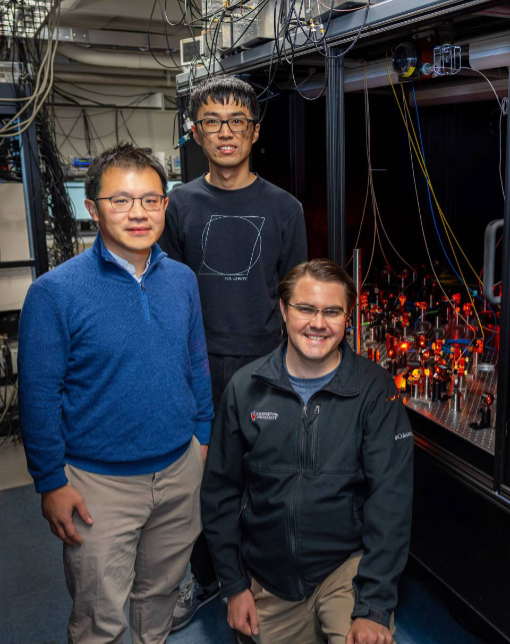
Laurence Cheuk, an assistant professor of physics at Princeton and the lead author on the paper, explained one key to what the researchers did was by connecting molecules rather than just individual atoms or even subatomic particles. That opens a world of applications well beyond just the first breakthrough of figuring out to quantumly entangle any kind of element together.
“This is a breakthrough in the world of molecules because of the fundamental importance of quantum entanglement,” Cheuk told reporters in a briefing this week. “But it is also a breakthrough for practical applications because entangled molecules can be the building blocks for many future applications.”
Co-author Connor Holland, a graduate student in Princeton’s physics department, explained the importance of the discovery in that when “you harness the laws of quantum mechanics, you can do a lot better in many areas.”
The scientists behind the paper explained further how the “quantum advantage” Holland was referring to works in practice. In conventional computer systems, for example, a single computer “bit” of information is registered in absolutes, as either a “1” or a “0”. In quantum computing, technologists leverage the parallel concepts of wave-structure superposition and quantum levels to create states where a computer bit can simultaneously be both a “1” and a “0”, with the overlay creating a range of states rather than simply the binary difference between them.
If one then adds in the concept of quantumly entangling two particles – or molecules in the current research – that provides a means of connection and communication between them which can completely transform the means by which information is transmitted.
It is a concept that even for the most brilliant of scientists it is hard to get one’s mind fully around the idea. Albert Einstein once described the phenomenon of quantum entanglement as “spooky action at a distance” for good reason.
In the experiments Cheuk, Holland, and the rest of the research team carried out, after considerable investigation they selected a special molecule as the focal point for the work. This particular molecule was polar (meaning there are different energic “poles” in the structure) and was constructed such that it could be brought down in temperatures to near absolute-zero temperatures where quantum mechanics takes over as dominant and other physical characteristics are less important.
This cooling process was carried out using lasers to pull heat away from the molecules. Once at the desired temperatures, a system of multiple precision-focused laser beams were used to create what the researchers described as a sort of “optical tweezers” which could move molecules around. These laser “tweezers” have the advantage that they can maneuver the molecules without changing their state the way a more conventional physical means of movement might have.
The next part of the process involved encoding “data” into the molecules as non-rotating and rotating states. This molecular qubit, as it was called, was coherent and remained stable as sort of “quantum memory” for the molecules.
The researchers then “quantumly entangled” the molecules together using microwave pulses to connect them on a quantum scale, while keeping them physically separated. The researchers were then able to demonstrate that the behavior and “state” of individual molecules linked in this manner remained linked together. They further complicated the experiment by creating quantumly entangled molecular arrays which also remained linked together, almost as a physical “society” of separable molecules.
These developments could pave the way to link molecular systems together to create much faster three-dimensional computing systems, remote sensing applications which work faster and with more precision, far more rapid and less energy-intensive communications, and to create emergent magnetic fields linking these molecules together. The Princeton group is already investigating the magnetic field quantum entanglement concept at a theoretical level and hopes to integrate that into physical demonstrations soon.
“Using molecules for quantum science is a new frontier and our demonstration of on-demand entanglement is a key step in demonstrating that molecules can be used as a viable platform for quantum science,” said Cheuk about what his team had uncovered.
Cheuk also revealed in his comments that a separate physics team directed by John Doyle and Kang-Kuen Ni at Harvard University and Wolfgang Ketterle at the Massachusetts Institute of Technology has already duplicated much of the basics of what the Princeton group discovered. That it could be readily duplicated is a critical step in enabling the rapid development of new technologies leading from this single discovery.
Full details of this work are described in the paper, “On-Demand Entanglement of Molecules in a Reconfigurable Optical Tweezer Array,” authored by Connor M. Holland Yukai Lu, and Lawrence W. Cheuk, published on December 8, 2023.