UN Approves Security Council Override by Overwhelming Margin, Demands Immediate Ceasefire in Gaza
Abe Goldstein Lead StoryConflict
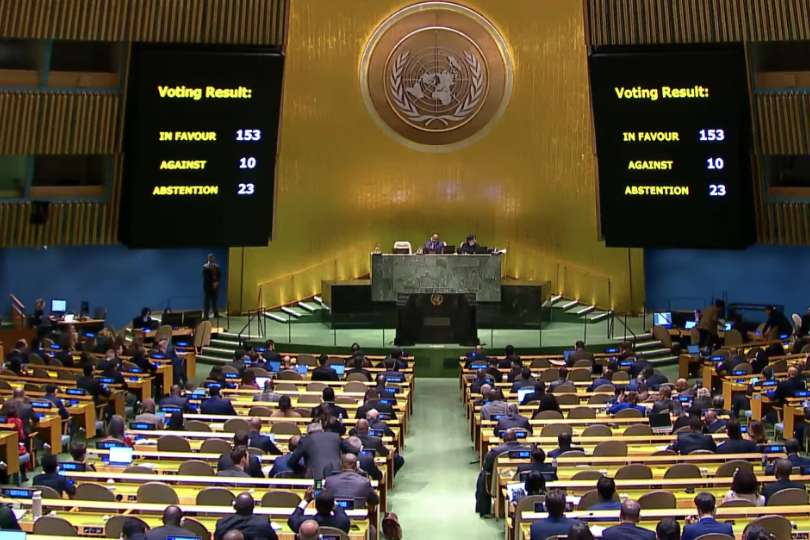
The UN held a historic special session yesterday, called for by the president of the United Nations after Egypt and Mauritania invoked Article 377A to seize control back from the UN Security Council to find a path to peace in Gaza.
It did so after the United States vetoed a second widely-backed proposal demanding a halt to Israel’s endless and senseless slaughter which has been underway – this time – since October 7.
The United Nations charter gives the UN Security Council, with its assemblage of five permanent members including the United States, China, the Russian Federation, France, and the United Kingdom, plus ten rotating members, “primary responsibility for the maintenance of international peace and security” according to UN documents. But when the Security Council fails to carry out that responsibility, often by deadlocking in a continuing series of vetoes, UN Article 377A provides the General Assembly with the power to override the Security Council on these matters. It also gives the General Assembly authority to enforce its decisions, by force if required.
In a public event which began at 3 PM EST on December 12, the UN General Assembly delivered on the first step in that override, as it seized control of the Gaza crisis as best it could. It drafted, debated, and ultimately voted in favor of a resolution entitled, “Protection of Civilians and Upholding Legal and Humanitarian Obligations”.
The resolution submitted by Egypt for review in the special session, which among other things calls for yet once again an immediate ceasefire in Gaza, passed the General Assembly by a vote of 153 nations in favor and 10 opposed. 23 countries chose to abstain.
Those opposing the resolution included the United States and Israel, who are partners in the destruction of Gaza. The eight others who voted against the resolution were the corrupted nations of Austria, the Czech Republic, Guatemala, Liberia, Micronesia, Nauru, Papua New Guinea, and Paraguay.
Of importance in this vote was that even some of the countries in Europe which had so far strongly supported Israel in its deadly mission in Gaza did vote to approve the measure. The United Kingdom, which was the sole abstention in the December 7 UN Security Council ceasefire resolution that the U.S. vetoed, chose this time to vote in favor of the ceasefire. So too did Germany and France.
As he opened the emergency meeting yesterday, UN General Assembly President Dennis Francis set the tone for what was about to happen.
“We have one singular priority – only one – to save lives,” he told the UN delegates.
He then went on to outline how the brutal attacks which Israel has brought down on the civilians in Gaza have left them with no reliable place to seek shelter, and with only the long-term certainty of mass deaths piling up around them.
“Even war has rules,” he said, “and it is imperative that we prevent any deviation from these principles and values [of saving lives] – the validity of which resides in their universal application.”
"Clearly, what we are witnessing is the unprecedented collapse of an already crumbling humanitarian system in real time," Francis continued. "No more time is left. The carnage must stop."
Soon after Egyptian Ambassador Osama Abdelkhalek took the floor to introduce the resolution for review by the UN members.
He began by levying a focused attack on what he called “a despicable sign of double standards” carried out “by a minority of states that are standing against international public opinion”. He accused those states as using the “pretext” that “of “saying that Israel has the right to defend itself” to justify supporting them in assemblies such as the Security Council, in public speeches, and by supplying them with the bombs, tanks, artillery, and other munitions to carry out the mass killings of innocent Palestinians.
He went on to declare that if Israel is allowed to continue its savage war in Gaza, “it will unfortunately mean that genocide will be used as a tool for war … and will lead the region to a full-fledged war.”
During the debate which followed, Austria proposed an amendment to the Egyptian proposal, asking for a clause to be added which would have identified the “hostages” referred to in the resolution as "held by Hamas and other groups". That was rejected as pointing at Hamas as the principal guilty party in what was happening in Gaza, with no mention of Israel’s dominant role.
Austria also asked for adding the word “ensuring” into a clause regarding a demand for immediate humanitarian access. If it had succeeded in that request, there would have been a statement in the final resolution which would have demanded “the immediate and unconditional release of all hostages held by Hamas and other groups, as well as ensuring immediate humanitarian access." That was defeated in a follow-up vote as watering down the language from emphasizing the “immediate” part of that latter clause.
The U.S. also proposed an amendment of its own to the resolution. It asked the General Assembly to add a paragraph which would have declared the UN “unequivocally rejects and condemns the heinous terrorist attacks by Hamas that took place in Israel starting 7 October 2023 and the taking of hostages."
U.S. Ambassador Linda Thomas-Greenfield attempted to argue the case for adding this language by beginning with a “high ground” kind of argument.
"We support speaking out with a voice to condemn Hamas for its terrorist actions on the seventh," she said. "Why is that so hard to say unequivocally that murdering babies and gunning down parents in front of their children is horrific? That burning down houses while families shelter inside and taking civilians hostage is abhorrent. It's why today the United States is proposing an amendment that unequivocally rejects and condemns these atrocities, and we urge all members to vote yes and declare that what happened on October 7th is intolerable. Period."
This too was also summarily rejected by the members present. A principal reason was likely that this was an inflammatory statement which would have called for the members to take sides in the war. It would also perhaps have required an even stronger statement condemning the atrocities Israel has committed in Gaza since that time.
Though the subject was avoided during the floor debate on the U.S. amendment, one other reason it may have been rejected could have been because of substantial evidence which has surfaced since the October 7 attack that many of those killed during that assault came from Israeli Defense Forces’ helicopters brought in to counter the airborne invasion by a relatively small Hamas contingent.
84 members voted in favor of the U.S.’s proposed wording changes, but it fell far short of the two-thirds majority required for it to be added.
As expected, when Israeli Ambassador Gilad Erdan had his chance to speak during the open debate period, he did not hold back in his disgust about the Egyptian proposal.
He referred to a vote for the ceasefire resolution as a vote of support for Hamas, which he called “a genocidal jihadi organization”. He said the ceasefire directive to be voted on was also meaningless anyway, since “Hamas does not respond to General Assembly resolutions.” He closed his case against the resolution by saying that “continuing Israeli operations in Gaza is the only way further hostages will be released.”
In the end, after the proposed amendments were rejected and the debate closed, the members entered their votes on the resolution. It passed with 82% of the 186 members present voting for the amendment. 10 voted against, 23 abstained, and 7 members were not present for the vote.
The full text of the UN resolution passed yesterday reads as follows:
Protection of Civilians and upholding Legal and Humanitarian Obligations
The General Assembly,
Reaffirming its strong commitment to the sovereignty, territorial integrity and political independence of all States in accordance with the Charter of the United Nations,
Reaffirming also the inadmissibility of the acquisition of territory by war and the need to work for a just and lasting peace in which every State in the area can live in security,
Reaffirming further the applicability of the Geneva Convention relative to the Protection of Civilian Persons in Time of War, of 12 August 1949, to the Occupied Palestinian Territory, including East Jerusalem, and other Arab territories occupied by Israel since 1967,
Stressing that the Fourth Geneva Convention as well as Additional Protocol I and Additional Protocol II thereto must be fully respected in all circumstances,
Recalling its resolution 66/80 of 9 December 2011 and all its relevant resolutions, including those adopted at its tenth emergency special session,
Recalling also the relevant resolutions of the Security Council, including resolutions 242 (1967) of 22 November 1967, 338 (1973) of 22 October 1973, 1397 (2002) of 12 March 2002, 1515 (2003) of 19 November 2003, 1850 (2008) of 16 December 2008, 1860 (2009) of 8 January 2009 and 2712 (2023) of 12 December 2023,
Recalling further the advisory opinion rendered on 9 July 2004 by the International Court of Justice on the Legal Consequences of the Construction of a Wall in the Occupied Palestinian Territory, and recalling also its resolutions ES-10/15 of 20 July 2004 and ES-10/17 of 15 December 2006,
Reaffirming the principle of the responsibility to protect populations from genocide, war crimes, ethnic cleansing and crimes against humanity,
Expressing grave concern at the escalation of violence and the deterioration of the situation in the Occupied Palestinian Territory, particularly in the Gaza Strip, since the beginning of the Israeli military operation on 7 October 2023, which has resulted in the killing and injury of thousands of civilians, including women and children, as well as the widespread destruction and damage of civilian infrastructure, including homes, schools, hospitals, water and sanitation facilities and vital economic assets,
Deploring the civilian casualties in Gaza and Israel, including the killing and injury of children, women and journalists, and expressing alarm at the humanitarian crisis and the shortages of food, fuel, water, medicine and medical supplies, and electricity, which are endangering the lives of hundreds of thousands of people,
Condemning all violence and hostilities directed against civilians and all acts of terrorism,
Condemning also the firing of rockets against Israeli civilian areas resulting in loss of life and injury,
Condemning further the excessive, disproportionate and indiscriminate use of force by the Israeli occupying forces against Palestinian civilians, which has resulted in the killing and injury of thousands of civilians and the destruction of civilian infrastructure throughout the Gaza Strip,
Condemning in particular the Israeli military actions in the Gaza Strip, which have targeted and destroyed United Nations schools, health facilities and other civilian infrastructure, and which have endangered the safety and well-being of United Nations personnel and humanitarian workers,
Expressing grave concern at the displacement of more than half a million Palestinians in the Gaza Strip, who have been forced to leave their homes and seek shelter in United Nations facilities and other places,
Expressing grave concern also at the impact of the Israeli military operation on the situation of Palestinian prisoners and detainees in Israeli jails, and calling for respect for their rights in accordance with international law,
Expressing grave concern further at the abduction and illegal detention of civilians, including United Nations staff, by Israel, the occupying Power, and demanding their immediate and unconditional release,
Stressing the urgency of achieving without delay an end to the Israeli occupation that began in 1967,
Affirming the right of the Palestinian people to self-determination and the right to an independent State of Palestine based on the pre-1967 borders,
Reaffirming its support for the Middle East peace process and the vision of two States, Israel and Palestine, living side by side in peace and security within recognized borders, based on the relevant United Nations resolutions, the terms of reference of the Madrid Conference, including the principle of land for peace, the Arab Peace Initiative and the Quartet road map to a permanent two-State solution to the Israeli-Palestinian conflict,
Welcoming the efforts of Egypt and other regional and international actors to facilitate the achievement of a ceasefire and to address the dire humanitarian situation in the Gaza Strip,
Commending the vital role played by the United Nations, particularly the United Nations Relief and Works Agency for Palestine Refugees in the Near East, as well as by other international and regional organizations and agencies, in providing emergency humanitarian assistance to the Palestinian civilian population in the Gaza Strip,
1. Demands the immediate, durable and fully respected cessation of hostilities leading to the full withdrawal of Israeli forces from the Gaza Strip;
2. Calls for the establishment of a mechanism to monitor and ensure the implementation of a durable ceasefire and cessation of hostilities, including the prevention of illicit trafficking in arms and ammunition into Gaza;
3. Demands the unimpeded provision and distribution throughout the Gaza Strip of humanitarian assistance, including food, fuel, water, medicine and medical supplies, and the reopening of border crossings consistent with Security Council resolution 1860 (2009);
4. Calls for the protection of civilians and the respect for the inviolability of United Nations premises, personnel and operations in the Occupied Palestinian Territory;
5. Urges the parties to respect the rules of international humanitarian law, to refrain from violence against the civilian population and to treat under their protection persons who are wounded or sick, as well as medical personnel, and to refrain from any act of violence against cultural property;
6. Emphasizes the need to ensure accountability for all violations of international humanitarian law and international human rights law in order to prevent impunity, ensure justice, deter further violations and promote peace;
7. Calls upon the international community, including the Secretary-General, to support efforts to achieve a comprehensive peace based on the vision of two democratic States, Palestine and Israel, living side by side in peace and security;
8. Requests the Secretary-General to report to the General Assembly, within 10 days, on the implementation of the present resolution, with a view to considering further action, if necessary, by the relevant United Nations organs and bodies;
9. Decides to remain seized of the matter.
Benjamin Netanyahu has not directly commented on the resolution other than to say he has no intent to change course on what he and his military are doing in Gaza.
Joe Biden has also avoided direct statements about the resolution. The closest he came was a comment after the vote that Israel is “starting to lose support by [its] indiscriminate bombing” of Palestinians in Gaza. Biden also said Israel “cannot say no [to a] Palestinian state”, something which Netanyahu summarily rejected on December 11 as he declared Israel would hold dominion and authority over Gaza indefinitely, even after the war was won.
Now the challenge is for the United Nations and Secretary-General Antonio Guterres to put some force behind the currently still "non-binding" resolution passed yesterday. Without that, the resolution has no meaning.