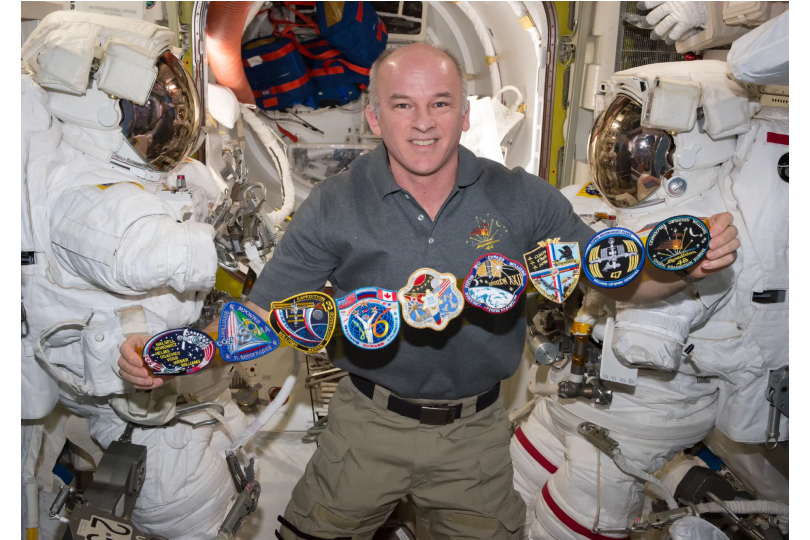
The two-time station commander spent 534 cumulative days in space spanning four trips to the space station. He spent nearly 32 hours outside of the orbital laboratory on five spacewalks.
In addition to his time in space, he tested and evaluated the space station’s U.S. laboratory module Destiny during its final assembly at NASA’s Marshall Space Flight Center in Huntsville, Alabama, led the development of a space shuttle cockpit upgrade, worked in legislative affairs at NASA Headquarters in Washington, commanded a nine-day NEEMO (NASA Extreme Environment Mission Operations) mission in the Aquarius undersea habitat off the coast of Florida, and worked extensively in spacewalk development.
Since 2017, he has been assistant director of Flight Operations at NASA’s Johnson Space Center in Houston. Among his many accomplishments, he served as chair of the Multinational Crew Operations Panel, responsible for International Space Station crew assignments, qualifications, and training. Most recently, he served on a review board overseeing development of lunar surface projects for the Moon to Mars architecture.
The Wisconsin native joined NASA Johnson on a four-year Army assignment supporting the Space Shuttle Program in 1987. He was selected to join the NASA astronaut class of 1996. His first mission was on the crew of STS-101, launching on space shuttle Atlantis for the third mission devoted to station construction. His first long duration mission was Expedition 13, launching in March 2006 on Soyuz TMA-8 and lasting six months as station construction resumed with the shuttle return-to-flight after the Columbia accident. For his third flight, Expeditions 21/22, Williams launched in October 2009 aboard Soyuz TMA-16 for another six-month stay – this time to integrate the station’s Tranquility module and its cupola to complete station construction. Williams’ final spaceflight launched in March 2016 on Soyuz TMA-20M for Expeditions 47/48 which saw the arrival of the station’s Bigelow Expandable Activity Module, the integration of an international docking adaptor for commercial crew spacecraft, and the continuation of science and technology demonstrations.
Overall, Williams lived and worked with 56 different individuals from eight different countries aboard the orbital outpost. His flights spanned 16 years of the space station’s assembly, construction, and emerging operational capability. He contributed to hundreds of scientific experiments and a broad spectrum of technology development projects.
Prior to becoming an astronaut, Williams attended the U.S. Military Academy at West Point, New York, where he earned a bachelor’s degree in Applied Science and Engineering, the U.S. Naval Postgraduate School in Monterey, California, where he earned a master’s degree in Aeronautical Engineering, and the U.S. Naval War College, Newport, Rhode Island, where he earned a master’s degree in National Security and Strategic Studies. He served in the 3rd Armored Division’s 503rd Aviation Battalion as an Army aviator in West Germany. He attended Naval Test Pilot School, graduating first in his class in 1992 and then served as an experimental test pilot before becoming an astronaut. He retired from Army active duty in 2007 with more than 27 years of military service and 3,100 hours in more than 50 different aircraft. His experience has spanned more than 47 years.