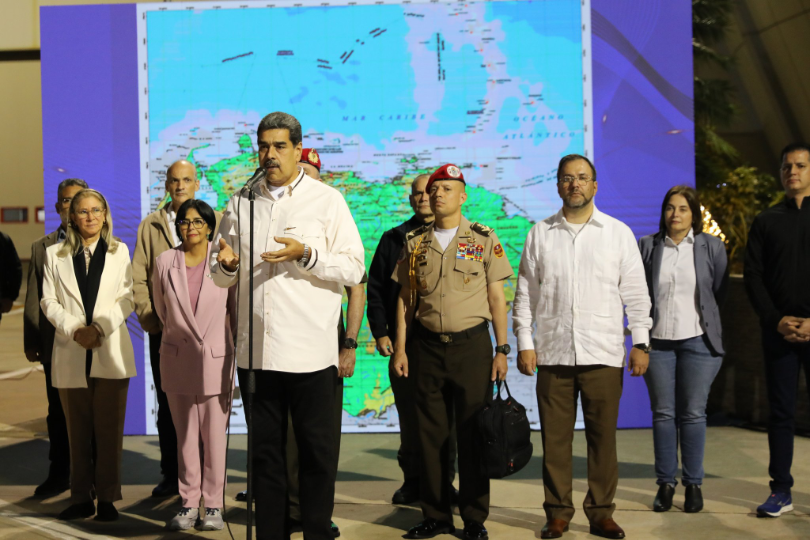
On December 3, Venezuelan President Nicolás Maduro staged a special referendum in which reportedly over 90% approved the seizure of two-thirds of the territory of Guyana. The actual voter turnout was not very high and there is no way to verify the actual vote tally, but it is true that most Venezuelans believe that the Essequibo region belongs to Venezuela, just as nearly all Guyanese believe that it belongs to them.
Maduro and his administration claimed it was a border dispute, dating back to just after Venezuela became independent over one hundred years ago, and never resolved since then.
The real reason for is that the Essequibo region of Guyana which is in dispute is filled with precious metals, minerals, and gemstones, and has within its offshore territorial waters access to an estimated 8 billion barrels of oil.
Maduro moved quickly to consolidate the December 3 victory. Within just four days after the referendum, his government held a meeting with the Unity opposition party which concluded with both sides apparently in agreement with the actions dictated by the referendum. In addition, Maduro also ordered all foreign oil companies trolling in Guyana waters to exit the region within three months, directed state-run Petróleos de Venezuela, S.A.to form new enterprises covering the mining and oil prospecting in what Venezuela is now calling the state of “Guayana Esequiba”, and gave instructions to these new legal entities to begin granting licenses for the exploitation of the reserves in that new state.
Within the same four days, Brazil had sent military forces closer to the border where Venezuelan troops would have to pass through to invade Essequibo. The United States began military exercises within Guyana, mostly by air, as a show of force but without any real strategy of what it would do if Venezuela did attempt to seize the land. Since the border between Venezuela and Essequibo is dense jungle and there are no roads, to access the region by land, Venezuelan troops would have to cross Brazilian territory first, which is why Brazil moved some troops to its border with Venezuela.
The United Nations Security Council also held an emergency closed-door meeting on the issue on December 8. No information was distributed afterwards about what happened then.
With the risk that this dispute could quickly explode into a war, Prime Minister Ralph Gonsalves of Saint Vincent and the Grenadines sent a letter to Maduro and President Irfaan Ali of Guyana, asking for the two leaders to do something to ease the growing tensions between them before it was too late.
Yesterday they did follow through on that request, at least symbolically. Maduro and his entourage and Ali and a handful of senior officials of his country flew to the city of Kingstown in Saint Vincent and the Grenadines. There they met for two hours of discussions, with representatives also present from CARICOM, the Community of Latin American and Caribbean States (CELAC), Brazil, Colombia, and the United Nations.
Though not described by anyone afterwards, it is believed those delegates from other countries were there to witness and to attempt to steer Maduro away from immediate military actions as his next step.
At the conclusion of the meeting, Maduro and Ali approved the release of the eleven-point "Joint Declaration of Argyle for Peace between Guyana and Venezuela".
In it the two parties agreed not to "threaten or use force against one another in any circumstances", and that "any controversies between the two states shall be resolves in accordance with international law, including the Geneva agreement dated February 17, 1966." While that may sound good to an outsider, the Geneva agreement referred to here was a document signed just before Guyana was granted independence from the United Kingdom, and which avoids directly addressing the border dispute issue. Venezuela included the Geneva Agreement because it questions the legitimacy of the rigged 1899 tribunal that granted the region to Britain.
The Joint Declaration also puts in writing, in item 4 of the agreement, yet another point of dispute between the parties. It notes there that Guyana is committed to use the International Court of Justice to resolve the controversy, but simultaneously notes "Venezuela’s assertion of its lack of consent and lack of recognition of the International Court of Justice and its jurisdiction" in the matter.
What those points add up to in summary is that neither side wants to turn into a war, but there is no agreement as to how the dispute over Essequibo will be resolved.
Prime Minister Ralph Gonsalves of Saint Vincent, who read the agreement aloud to the press, attempted to salvage what most would argue was not a very successful session by at least praising the two visiting leaders for making the trip to Kingstown.
He said that the governments of Caracas and Georgetown had "committed to the pursuance of good neighborliness, peaceful coexistence and the unity of Latin America and the Caribbean."
Shortly afterwards, Ali attempted to clarify Guyana’s position in his own public statement before reporters.
“I made it clear that the controversy must be resolved at the ICJ and we are unwavering and resolute in ensuring that Guyana’s case is presented and defended and that the ICJ will issue its decision on the merits of the case which of course is binding on all the parties,” Ali said.
“Guyana has all the right … to facilitate any investment, any partnership … the issuing of any license and the granting of any concession in our sovereign space,” Ali continued.
Maduro said little in Kingstown publicly about the session after the parties signed what was basically an agreement not to fight but not much else.
He waited instead until he had returned to Caracas to make a statement to his local press about what had happened.
In a post he published on the social media platform X yesterday summarizing the event, he mentioned the signing of the "Joint Declaration ... for Peace" as an important result.
"It was a meeting of frank conversation, with truths and respect as it should be, within the framework of the Peace Zone, such as Latin America and the Caribbean," he wrote. "A great victory for our people who love La Paz!"
“Excellent day of dialogue!” he continued, in a separate post. “We did it!”
The two parties have agreed to continue discussions about Venezuela’s claim to Essequibo.
What the agreement does for Maduro is to strengthen his popularity while keeping the U.S. from attacking overtly. It also buys him time to solidify the annexation and negotiate with foreign oil companies. He has not backed down on the annexation, just agreed to keep talking about while not using military force.
For Ali, it buys him time to strengthen his own military and allow the U.S. to possibly apply more sanctions on the Maduro regime while increasing covert efforts to unseat him.
For the foreign oil companies tapping Guyana oil, it provides no certainty. They aren't about to leave the lucrative oil fields.
For the International Court of Justice, which has had the dispute since 2018, it applies more pressure on it to reach a decision. So far, it has done little. It took it until the end of 2020 to decide that it had jurisdiction in the matter. Venezuela rejected the courts jurisdiction and it took the court until April 2023 to respond that it did indeed have jurisdiction. Other than addressing the issue of jurisdiction, it appears that the court has done nothing else to resolve the dispute. It last action was to request that "both Parties shall refrain from any action which might aggravate or extend the
dispute before the Court or make it more difficult to resolve."
If one considers the dispute between Hungary and Slovakia regarding the Gabčíkovo-Nagymaros Project, which has been before the court since 1993, it could be decades before the ICJ makes any decisions in regards to the Essequibo dispute.
Legally, the ICJ is the venue to decide the issue and if it considers the historic ownership of the region and the fairness of the 1899 tribunal, it should decide in Venezuela's favor. But, as part of the UN and clearly demonstrated by the blatant corruption of the International Criminal Court (ICC), the ICJ is potentially corrupt and may be influenced by third parties.
Venezuela does not need Essequibo, but Guyana does. Venezuela can't effectively extract its own oil or govern the territory it already has and few foreign partners want to work with it. Guyana has proven itself a reliable partner for the foreign criminal corporations looting its resources.
For ExxonMobil, one of the most powerful criminal corporations on Earth, there are billions in potential profits at stake so it will do whatever it can to protect its investment and future profits.
The two Presidents have agreed to meet in Brazil sometime in the first quarter of 2024.