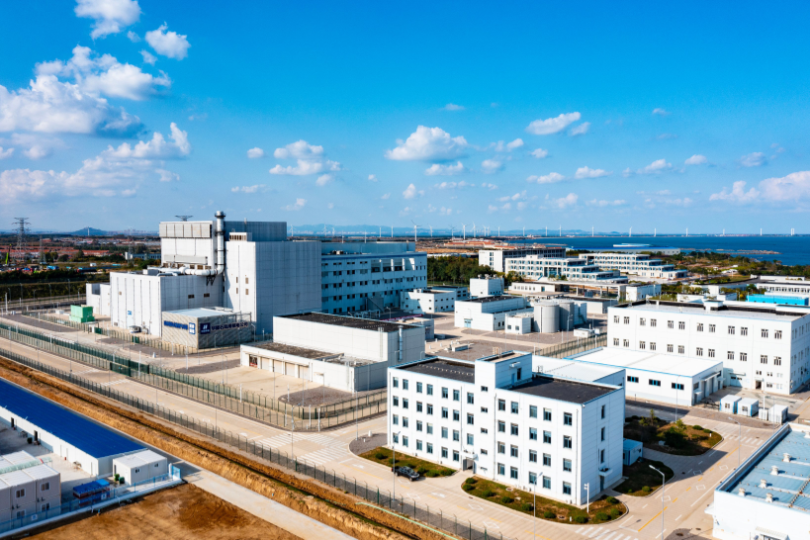
It is a reactor with technology which will change how and where nuclear power will be used just about anywhere on the world, forever.
As most nations of the world were arguing unsuccessfully over how to jump-start renewable energy solutions (again) and setting targets for reduced emissions (again) at the United Nations Climate Change COP28 conference in Dubai, the People’s Republic of China was quietly leapfrogging most of them in a field of energy-generation technology most had slowed investments in going back decades.
That technological achievement, which shocked much of the world as news broke about it this past week, showed up when China announced that its Shidaowan nuclear power plant was fully operational and already providing power commercially as of December 6.
Theoretically at least, nuclear power has offered countries the opportunity to generate electrical power without all the greenhouse gas emissions fossil fuel plants deliver. However, up to this point they have been extremely expensive to build and operate and produce enormous amounts of highly toxic waste that remains hazardous for up to 250,000 years. And of course they have the potential to cause massive harm if there is a melt-down or explosion.
The U.S. boasts the largest number of nuclear reactors in the world, at 92 currently spread across the country. France is second, with 58. China, Japan, and Russia fill out the rest of the top-five users of nuclear power.
Up until now, a major limitation in deploying nuclear power as an alternative to other sources of energy is that they have typically required access to plenty of water to keep the reactors always cool enough. That meant they were limited either to use on coastal regions or around large rivers. The climate crisis has also added to the complexity of placing these reactors, as riverbeds have begun to run dry in many regions of the world, with widespread drought often drying up waterways which might have allowed a third-generation nuclear reactor to operate successfully.
That is where the Chinese fourth-generation nuclear reactor’s unique technological innovations come in. Instead of relying on water to cool the plants, they rely solely on helium gas to keep reactor temperatures in check. That means they can be placed virtually anywhere. Also, without the need for water for cooling, rivers whose waters might have been utilized heavily for reactor use are now available for agricultural and other purposes.
Further, as was noted by Zhang Zuoyi, chief designer of the new Shidaowan reactor, also dean of the Tsinghua University Institute of Nuclear and New Energy Technology, during an interview about the new development, this allows for two additional big advantages for the new plants. Because of the new cooling systems, these fourth-generation plants can conceivably run at even higher temperatures than before, which will result in far more electrical power being produced than in previous-generation plants of comparable size and cost. They can also do that, principal plant developer Tsinghua said in a press release when the plant went operational, in an “inherently safe” manner because the reactor “core will not melt”.
Because of all these factors, these new high-temperature gas reactors, or HGTRs, are expected to become the standard for many nuclear installations in China and beyond.
Tsinghua, the Chinese National Nuclear Corporation (CNNC), and Chinese-owned Huaneng Group cooperated on the design of the current plant. They are the team managing joint operations at the plant as it begins supplying power throughout the region.
The other advantage of the fourth-generation nuclear reactor design is that the outputs of the new plants have been deliberately configured to produce more than just heat and power. They also produce hydrogen.
The plants provide a means of capturing that hydrogen for eventually reuse in a range of hydrogen-powered applications. Though all the applications China has planned for it are not yet known, it is already in use to power autos and trucks, short-haul commercial aircraft, and in shipping. Even the Danish shipping giant Maersk recently put its first hydrogen-powered shipping container cargo carrier into service for inland shipping operations within the Netherlands.
With the Chinese category of fourth-generation nuclear reactors generating this hydrogen by breaking down water rather than through more conventional means which produce some carbon emissions in the process, these plants also have the potential for being genuine “net zero” energy producers in operational use, according to Tsinghua’s Zhang Zuoyi.
This new category of nuclear power plants therefore ticks off real-world solutions to most of the requirements set for fourth-generation reactors by the Gen IV International Forum (GIF). Those metrics include minimizing water use requirements, lowering the risk of nuclear meltdowns, and avoiding other forms of environmental impact in the design, construction, and operations of the plants. A further design factor is building into the design a means of limiting the risk of nuclear proliferation in distributing fuel to the plants and securing that fuel once in use.
The GIF is a cooperative guiding group for nuclear power plant development bringing together the 13 nations which currently develop this category of power-generation systems. That group is current comprised of the United States, China, France, Japan, and Russia, and members of the European Union.
The cooling design approach used in the Shidaowan plant is just one of several approaches being researched and built into actual nuclear plants elsewhere in the world. Others being investigated use molten-salt, lead, or sodium as a means of drawing heat away from the reactor cores.
China is currently building a second fourth-generation reactor in its Fujian province, in the southeast part of the country, using the sodium-cooled approach instead of the helium one. The Xiapu reactor, built by state-run Chinese National Nuclear Corporation (CNNC), it was designed and built in parallel with the Tsinghua one as a means of testing out this configuration as a possible prototype for yet another solutions category.
This category of reactor is considered especially interesting, as it provides a means of recycling uranium which the reactor had already “used up”. By running it through offline processes and because of how the sodium-cooling interacts with the uranium versus the helium approach, this means even less uranium waste produced long term by this type of solution, long term.
The current fourth-generation plant structure in Shidaowan, began construction over eleven years ago, in 2012, consists of two 250 megawatt thermal nuclear reactors. They are connected to a steam generator system with a total planned output capacity of 200 megawatts.
Other countries within the Gen IV International Forum nuclear group are reportedly beginning construction of, or in the latter stages of design for, fourth-generation reactors of their own. None are expected to become operational until 2030 or even later.
The new Shidaowan plant will join a family of nuclear reactors China currently has in operation which consists of 55 reactors with a new output power capacity of 57 GW. China Nuclear Energy Association (CNEA) spokesperson Wang Binghua says there are another 24 units of various designs currently under construction. Those will add another 27.8 GW to its power output when complete.
China currently relies on nuclear power for only about 5% of its total electrical power generation. It expects to raise this to 10% by 2035 and 18% by 2060.
Fourth-generation designs like the one at Shidaowan which just began generating commercial power will likely be a key part of the near-term doubling of nuclear-power electrical power generation capacity over the next decade. This will enable China to supplement its growing solar and wind energy generation when they aren't producing enough.
The question remains what China will do with its nuclear waste. Will it keep it safely stored for many eons into the future or will it convert it into something else? Cold-fusion promoter Hal Fox and nuclear physicist Dr. Gilbert Jordan believed that it was possible to convert nuclear waste into gold using a tuned plasma but were threatened with imprisonment when they presented the data to support the concept to the U.S. Dept. of Energy.