The briefing document published on December 19 begins by calling attention to the fact that, unlike in the past when there would be scattered leaked reports of ballistic missile engine tests and warheads emerging sporadically from North Korea, the news from Pyongyang, the country’s capital, currently demonstrates a more methodical approach to those developments, with ever-improving capabilities. Those capabilities are evolving faster every year, with ongoing improvements not just in range and accuracy, but also in the perceived ability of those weapons to evade the base level of conventional anti-missile defense systems.
Up until this point, the United States and the Asia-Pacific region of nations allied with the U.S. there, such as Japan and South Korea, have relied heavily on outdated agencies such as the United Nations Security Council to put pressure on North Korea. Demands for denuclearization, threats and attempts to lure North Korea “back from the brink” of nuclear war with promises of trade, humanitarian aid only drove North Korea further into a defensive position.
Threats of a rapid counterattack by the U.S. in the event North Korea might attack an American warship or one of its allies have also proven useless, the report goes on. As a point of reference, it notes that in the 2023 Annual Threat Assessment (ATA) released by America’s intelligence agencies, those organizations believe North Korean leader Kim Jon-un believes having a viable nuclear-weapons and intercontinental ballistic missiles (ICBM) capability is “the ultimate guarantor of his autocratic rule and has no intention of abandoning those programs, believing that over time he will gain international acceptance as a nuclear power.”
As background support for this, the report goes on to cite some of the latest publicly available metrics on just how far ahead North Korea has become as a potential threat.
Nuclear Testing. Since 2006 North Korea has completed verified tests on nuclear explosive devices a total of six times. The last of those happened on September 3, 2017, which North Korea said involved setting off a hydrogen bomb, another name for a two-stage thermonuclear warhead). North Korea agencies said they were done for now on those tests as they believed they had already proven success. They supposedly have been focusing instead on ICBM development as their primary weapons objective. There is evidence they are rebuilding their underground nuclear warhead test tunnels, however, raising the possibility they may restart nuclear tests soon.
Nuclear Materials Production. North Korea continues to advance and enhance its ability to make produce fission-grade material (plutonium and highly enriched uranium). It has been “operating centrifuge uranium enrichment plants at the Yongbyon nuclear complex and possibly at Kangson”, the report notes, since 2009 when the country withdrew from a global agreement to halt further nuclear proliferation efforts. Those efforts expanded this year. According to the IAEA, in March 2023 North Korea launched new construction actions at the uranium centrifuge enrichment plant in Yongbyon, along with its associated Radiochemical Laboratory plant and Experimental Light Water 5MW(e) Reactor.
Nuclear Warheads Stockpiles. Although this is one of the most sensitive areas of all information about North Korea’s nuclear programs, external experts who have been monitoring North Korea’s capabilities believe the country currently has access to between 20 and 60 deployable nuclear warheads. The U.S. Defense Intelligence Agency in 2017 reported a more serious development than just having a given quantity of warheads, that North Korea had managed to miniaturize some fraction of those warheads small enough to make it possible for its ICBMs to carry the warheads much closer to the shores of Japanese and U.S. targets after launch from North Korea. Indications that the creation of warheads was continuing to be important came further when, on January 1, 2023, Kim Jon-un said his country would be investing heavily last year in the mass production of tactical nuclear weapons.
Missile Testing. Along with development of the missiles and the payloads to go on them, North Korea has also rapidly expanded its missile test program just in the last few years. According to U.S. security agency data, North Korea has launched at least 80 separate missile tests. Once again those are happening in violation of UN Security Council resolutions, but as was noted earlier the UNSC has proven mostly useless as a means of putting direct pressure on any nation posing a military threat to others. Data discovered regarding the most recent of North Korea’s missile tests demonstrate the country has also made major strides in improving their missiles’ “mobility, reliability, potency, precision, and survivability”, the report continues.
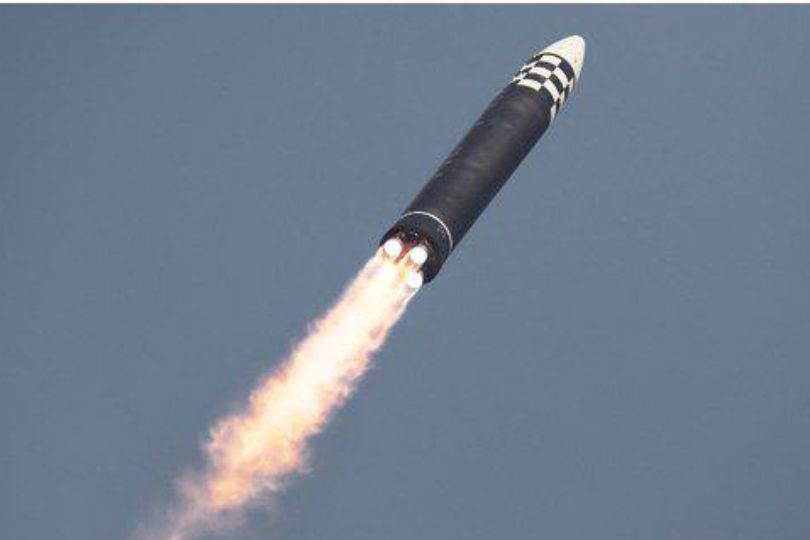
Intercontinental Ballistic Missiles. Even more than just advancing the power and miniaturization of the country’s nuclear warheads and the ability of its missiles to survive, recent developments say North Korea is getting closer to being able to launch nuclear ICBMs with the range, accuracy, and stability to reach targets as far away as the continental United States, and with multiple warheads of advanced design. The report’s author noted specifically the Hawsong-14 and Hwasong-15 as missiles with increased range as of special concern. Its much bigger Hwasong-17 ICBM is also worrisome, as the Defense Intelligence Agency believes its size and apparent carrying capacity suggests it was “probably designed to deliver multiple warheads”. Tests of a new solid-state propellant rocket motor began in December 2022 and continued in three separate tests this year, on April 13, July 12, and December 17, using the Hwasong-18 as its missile base.
Short- and Medium-Range Missiles. North Korea has also made significant enhancements in its short-to-medium range missile arsenal. These include the Pukguksong-2 (KN-15) dual-capable (nuclear or conventional) warhead launch vehicle, which can be reoriented more easily after launch making prelaunch targeting a challenge; the KN-23 SRBM which several years ago had already demonstrated a capability of quickly adjusting its trajectory angle during flight; and the KN-24 and KN-25 advanced tactical missiles which have substantially improved in-flight maneuverability en route to targets. Further advancements of concern are the country’s ability to rapidly launch multiple of each of the missiles at intervals as short as twenty seconds, and deployed on tracks which makes positioning them for use much easier – and far less easy to detect in advance – than in the past. As the recent Advanced Threat Assessment about these advances noted, North Korea continues to develop advancements in each of these areas, with the goal “to validate technical objectives, reinforce deterrence, and normalize Pyongyang’s missile testing.”
Other developments cited in the report point to North Korea also investing in recent years in the ability to track and destroy incoming warheads launched against it more easily than just a few years ago. The nation is also spending considerable time and funds on missiles capable of being “immediately” cold-launched, from the ground and from submarine-based launchers.
Overall, the summary says North Korea is no longer an easily-dismissed adversary in the area of conventional and nuclear ballistics missile development. American forces and those of their allies should take notice and adjust strategic approaches accordingly.
What the report didn't cover is the fact that the American approach to North Korea is the primary driver of its hostile behavior and that it all stems from the war waged on Korea back in the 1950s in which the U.S. brutally killed some 25% of the population of North Korea and destroyed most of its infrastructure. The war trauma became part of the country's DNA and was sustained by repeated war simulations designed to trigger mass PTSD. North Korea responded with its own threats and the concerted development of ever more destructive weapons. Now, North Korea is a significant nuclear power capable of wiping out tens of millions of people.
The U.S. could have taken a different approach that would have resulted in peace and reunification of the two Koreas, which would have served the interests of humanity, instead of American war industry profits.
Donald Trump had the opportunity to make lasting peace with North Korea when "he fell in love" with its dictator, Kim Jong Un. All that would have been required was a sincere unconditional apology for what the U.S. did when it slaughtered millions of Koreans and an end to the incessant war simulations. However, as a grandiose flaming narcissist, Trump can never apologize for anything, even for events he was not party to.
And as the Commander in Chief of the U.S. armed forces, a U.S. President no longer actually has the power to bring peace. The occupants of the White House are all heavily controlled by a hidden hand that is ultimately controlled by the oligarchs that profit immensely from the Euro-American war industry.