Venezuela-U.S. Prisoner Swap to Exchange Alex Saab With Navy Fraudster Fat Leonard
Lead StoryGovernment
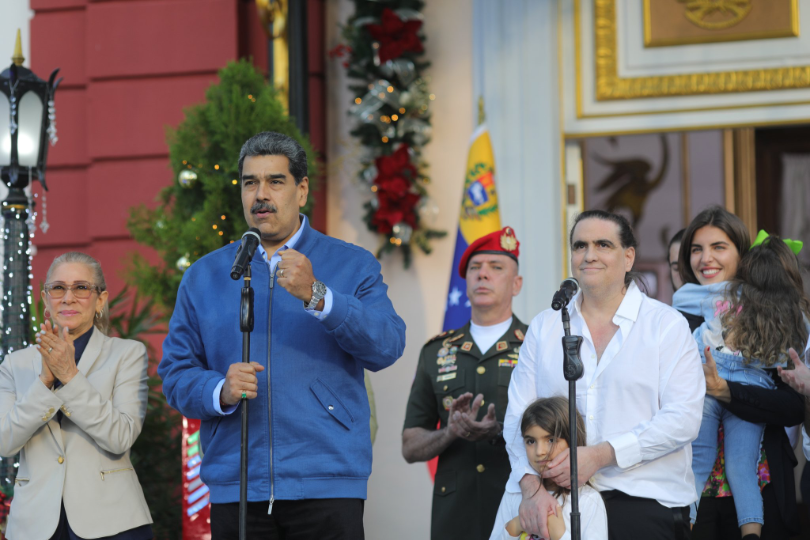
On the U.S. side, Washington released Alex Saab, a Colombian-born former businessman who helped the Maduro regime evade U.S. sanctions and skim money from various contracts.
Alex Nain Saab Morán had been wanted by the U.S. because he had helped Venezuela bypass some of the economic sanctions put on it by Washington, however, he had been under investigation by Colombia's corrupt government since 2004. On 8 May 2019, Colombia indicted Saab for money laundering, concert to commit crimes, illicit enrichment, fictitious exports and imports, and aggravated fraud. An Interpol Red Notice was issued and during a refueling stop from Venezuela to Iran, Saab was arrested in Cape Verde on 12 June 2020. He was extradited to the United States on 16 October 2021 where he faced eight counts of money laundering, transferring $350 million out of Venezuela and falsifying documents to obtain contracts for the construction of affordable housing. In the U.S. he faced up to 20 years in prison.
The U.S. claimed that Saab had been working as an informant for the DEA, which may or may not have been a psyop aimed at Maduro.
While in prison in the U.S., Saab claimed as part of his defense that was eligible for diplomatic immunity on the grounds that he was a “special envoy” representing the Venezuelan government. As proof of that, Saab’s lawyers had provided passports and other diplomatic documents which made it look like he was exactly what he described himself to be, a special representative working for Maduro. That defense fell apart when the prosecution was able to show that these documents were just a few of many which had been forged on Saab’s behalf to assist him in his criminal conduct.
That crime took an unusual twist when it was revealed, during interrogation and review of discovery materials in the case, that even while Saab was reportedly being hunted down by the U.S. Department of Justice, that the U.S. Drug and Enforcement Agency had hired Saab in 2018 to turn snitch on the Venezuelan government. The DEA had paid Saab off, even as he continued his other criminal activities, to provide information about illegal bribes paid to Venezuelan government officials.
Even with that discovery, the trial of Saab continued to go through after his extradition to the U.S. He was eventually sent to prison in Miami to serve out his sentence.
Trump had pursued Saab at such great expense not so much because of the criminal he was but because he was a long-time ally of Venezuela President Nicolás Maduro. Trump, who hoped to oust Maduro from power and replace the corrupt socialist leader with a more right-wing one which Washington could bend to its will, thought snatching Saab would creating such a significant political wound for Maduro that it might weaken him politically. It would also have resulted in revealing the bribes the DEA had hired Saab to disclose which high-level officials working for Maduro had received. That tactic failed but having Saab in prison in the U.S. did provide America with the potential for future political leverage with the South American nation, leverage which only now has come into play.
While Saab was held in prison, the Maduro government continued to complain about what it described as the man’s horrific treatment as a captive of the United States government. Maduro’s officials described Saab’s time in prison as a “kidnapping in complicity with the authorities of Cape Verde, who tortured him and arbitrarily kept him prisoner for 491 days, without an arrest warrant or due process.”
Securing Saab’s release is considered a major diplomatic win for Maduro, justifying his government’s long-term complaints about Saab’s supposedly wrongful arrest and conviction.
In return for returning Maduro’s friend, the Biden administration will finally get back into its clutches the notorious Malaysian criminal Leonard Glenn Francis, also known by his nickname Fat Leonard.
Francis ran a ship support company called Glenn Defense Marine Asia (GDMA), which was a Thai subsidiary of the Singapore based Glenn Marine Group, founded in Malaysia just after the end of WWII back in 1946. He got the nickname Fat Leonard because at one time he weighed 350 pounds, although he is also well over 6 feet tall.
From the Secretary of the Navy and Admirals on down, Francis bribed various people within the Navy and its Seventh Fleet and even the Naval Criminal Investigative Service (NCIS) with prostitutes, Cuban cigars, financial incentives and other perks to provide his company with contracts at inflated prices, classified information and to cover up the whole thing. The affair only cost taxpayers $35 million in over-payments, which is a pittance when it comes to military fraud, but It was a massive embarrassment to the Navy and U.S. government that so many in positions of power could be corrupted so easily.
Francis was lured to the United States and arrested in 2013 after a three-year investigation. He pleaded guilty and confessed with an agreement to help convict others connected with the case, in exchange for a more lenient sentence. So far 33 people have been convicted in the same investigation.
Despite Francis having been arrested and cut a plea deal for his crimes, he was given an early medical release in 2018 after a diagnosis with kidney cancer. He was supposed to be held under house arrest following that release, with an ankle bracelet marking where he was staying – in a $7,000 -a-month mansion where he lived a luxurious life with his family and personal bodyguards. He was scheduled to receive final sentencing in 2022.
The sentencing never happened. In September of 2022 Francis cut off his ankle bracelet. He escaped the house and found his way to the Mexican border, which he crossed easily. His travels eventually brought him to Venezuela, where he was arrested by authorities based on an Interpol Red Notice. Venezuela offered him to the U.S. but they failed to respond. Knowing that he might have some value, Venezuela kept him in prison.
There he remained to this month, with the U.S. somehow never formally requesting his extradition, perhaps on the grounds that in an extradition hearing Francis might say too much about the things he knew about the high-level bribes in the U.S. government associated with his own crimes.
In the background, however, the U.S. wanted Francis back badly. It even sent a covert CIA aircraft carrying U.S. negotiator Roger Carstens under cover into Caracas on June 19, 2023, to negotiate Francis’ release without a formal extradition process. Maduro did not let him go at that time, most likely because he saw even then how valuable an asset Francis was for him in a bilateral prisoner swap sometime in the future.
The releases of Francis and Saab are tied to a broader deal which the Biden administration agreed to just two months ago, in late October 2023. That arrangement provided for the easing of some of the many financial sanctions put in place against the Maduro administration by the Trump gang and, later, the current White House, in return for release of a then-unspecified number of prisoners to be release on the Venezuelan side.
Another part of the deal was Venezuela’s commitment to conducting fairer elections in the South American nation as the next presidential election race was approaching there by mid-2024.
What Venezuela was to receive in return was an easing not just of sanctions but allowance for the restart of oil and gold exports from Venezuela to the United States. Those exports would be managed for the most part by the state-owned oil company Petróleos de Venezuela, S.A.
According to White House staffers who have requested anonymity about their statements in the matter, the current hostage swap will result in the release of 10 Americans currently held in Venezuela custody. They will be turned over to the U.S. in addition to Fat Leonard.
Besides the American releases, the current deal also provides for Venezuela to release 21 Venezuelans who the U.S. says were detained illegally. One of those 21 is a close colleague of Venezuelan political opposition leader María Corina Machado.
Machado won the October 22 primary to choose what would have been the principal candidate to run against Nicolás Maduro in the 2024 elections. Though Machado, the right-wing leader of the Vente Venezuela party, won that race by a landslide, the country’s Supreme Justice Tribunal quickly moved to throw out the results of that election principally on the grounds that Machado had been ruled ineligible to run for president some years before, though that decision had also been previously set aside.
The Tribunal ruling, which came down on October 30, is considered by many as a violation of the U.S.-Venezuelan deal for those “free and fair elections” announced only weeks before Machado’s win. It is also understood to have been crafted under the direction of Maduro himself and his cronies.
Machado has so far said nothing of the prisoner swap or to talk up her attempts to protest the Tribunal decision. It seems a wise move with an ally of hers about to be released under the current prisoner swap plan.
As to the progress on the current prisoner swap, Alex Saab has already arrived in Venezuela, to great fanfare and with much positive publicity for Nicolás Maduro in arranging it.
In a public statement made with Saab standing at a microphone at Maduro’s side, Maduro thanked, among others, “the government of Qatar, the Free Alex Saab Movement, who have led this entire process of brilliant rapprochement and dialogue with the Government of the United States of America”.
“This exchange and rescue, healthy, alive and free,” Marduro continued, “has shown that hatred, violence and persecution could not [continue].”
It is an interesting note that Qatar, the same Arab nation which has been in the middle of potential truce negotiations between Israel and the U.S. on one side, and Hamas and the Palestinian peoples on the other, was at least according to Maduro behind some of the negotiations which brought Saab back to Venezuela.
Leonard Glenn Francis is also supposedly already in U.S. hands on American soil.
The remaining American prisoners to be released in Venezuela will be turned over to American authorities shortly. The Venezuela prisoners which the U.S. asked to be released “in country” will also be let out soon.
Amidst all of the celebration of a successful prisoner swap, the topic of Maduro's annexation of 2/3 of neighboring Guyana has been set aside, for now.