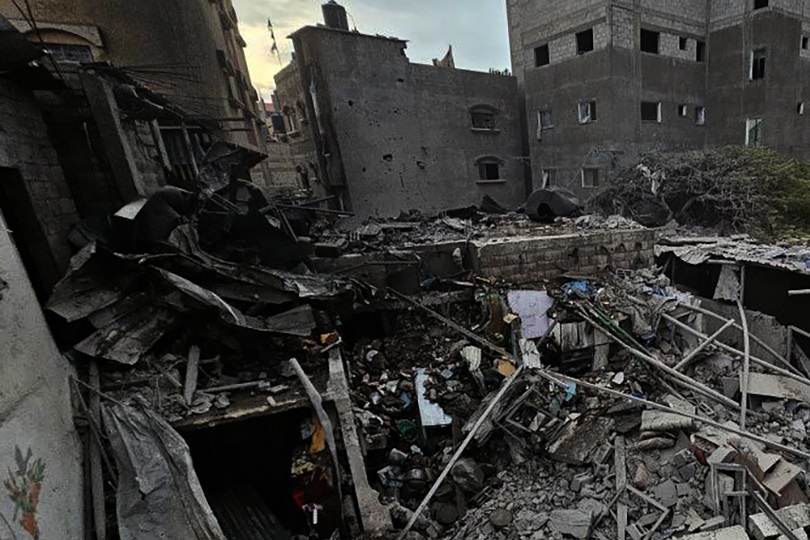
Managing media responses to a war is something all governments do as a matter of course, to support pleading their case for why they are fighting it and why the other side is at fault. It is part of psychological warfare and something that Israel has long invested heavily in.
But it was not until the current bloodbath Israel has inflicted on the Palestinian people in Gaza and on the West Bank that killing all journalists not under the direct control of Israel's military became a key part of the “management of the media”.
That is the conclusion of a new analysis by the Committee to Protect Journalists (CPJ), a non-governmental organization championing the lives of journalists, who risk their lives for the world daily to get the truth out about what is happening in the often deadly and unstable world around us.
“The Israel-Gaza war is the most dangerous situation for journalists we have ever seen, and these figures show that clearly,” said Sherif Mansour, CPJ’s Middle East and North Africa program coordinator.
“The Israeli army has killed more journalists in 10 weeks than any other army or entity has in any single year,” said Sherif Monsour, the CPJ’s Middle East and North Africa program coordinator about the new data. “And with every journalist killed, the war becomes harder to document and to understand.”
“The Israel-Gaza war is the most dangerous situation for journalists we have ever seen, and these figures show that clearly.”
Using the word dangerous to describe what is happening to journalists is a gross understatement for how bad the situation for reporters has become in Gaza.
According to the report, in the period between October 7, 2023, the start of the current conflict, and December 21, 68 journalists and media workers have been “confirmed dead”. 61 of those were Palestinian, 4 were Israeli, and 3 were from Lebanon.
Those were not the only journalist casualties during this period. In the same roughly ten weeks, 15 journalists were officially reported injured, 3 have been reported missing, and 20 were arrested by Israeli forces.
Many others said they had been assaulted and beaten, many were the subject of direct threats against them and collective threats against all journalists attempting to document the genocide in Gaza, others were censored, some were subjected to cyberattacks, and others saw their family members gunned down, blown up, or otherwise murdered when the places they were staying to seek shelter collapsed around them.
These numbers contrast sharply with the total number of journalists who died during the coverage of other wars.
In the six years of World War II, for example, the most catastrophic war in history in terms of total deaths of all kinds, 19 journalists were reported as having died in battle. In the same war, a total of 61 million other people died, both in the military and among civilians.
In the 20 years the Vietnam War raged on, from 1955 to 1975, 63 journalists were killed, mostly by Americans, with many others who went missing also assumed part of the full death toll.
More recently, even after the bloody and unnecessary battles the U.S. launched in Iraq after 9/11, based on falsified evidence that Saddam Hussein’s administration had “weapons of mass destruction”, destabilized the country, that country logged “just” a maximum of 56 journalist being killed during the 365 days of warfare in 2006.
Beyond that, with the exception of a massacre inflicted by CIA-backed ISIS-related attacks which killed 33 journalists in a single day in the Philippines in 2009 in its southern province of Mindanao, the largest numbers of journalists killed in a given year since then in the 21st century were in Syria, with 32 dead in 2012; 15 killed in Afghanistan in 2018, all of which were found under investigation to have been tied to their work as journalists; 13 journalists lost in 2022 in Ukraine; and 12 in Somalia in 2012.
By comparison to these and other conflicts, “more journalists have been killed in the first 10 weeks of the Israel-Gaza war than have ever been killed in a single country over an entire year,” the Committee to Protect Journalists summarized.
37 of the journalists who died in Gaza during the current conflict, or over half the total who have been killed so far there, lost their lives during the first month of battles.
One could argue that this is just one more example of what Israel would like to claim is inadvertent collateral damage in the war in Gaza. The Jerusalem government continues to insist that the now estimated over 20,000 its Israeli Defense Forces have killed, over 8,000 of which are children, are either the fault of Hamas for using Palestinian civilians as human shields, or for the Palestinians having supported Hamas. However absurd that logic is, especially from a country whose forces have continued carpet-bombed the Gaza strip incessantly since October 7, flooded the tunnels which Israel itself built under some of the Gaza cities with seawater, shut off access to fuel, water, food, medical care, and humanitarian supplies except for less than a week starting November 25 when a brief hiatus in the slaughter occurred, it might sound plausible to the unintelligent that Israel is right about the fate of journalists in Gaza.
The facts say otherwise, however. The numbers alone stretch the boundaries of credibility for so many journalists to have been killed so efficiently and surgically, in such a short time, unless the acts were deliberate.
“CPJ is particularly concerned about an apparent pattern of targeting of journalists and their families by the Israeli military,” it said in its analysis. “In at least one case, a journalist was killed while clearly wearing press insignia in a location where no fighting was taking place. In at least two other cases, journalists reported receiving threats from Israeli officials and IDF officers before their family members were killed.”
Reporters Without Borders, a separate NGO based in Paris which works to defend the rights of journalists, said in its own findings that “journalism is in the process of being eradicated in the Gaza Strip as a result of Israel’s refusal to heed calls to protect media personnel”.
“Reporters there have no safe refuge and no way of leaving,” the organization continued. “They are being killed one after another. Since 7 October, the Palestinian territory has been subjected to a veritable eradication of journalism.”
The CPJ echoed that and more with its comments. It said there is a clear “pattern of journalists in Gaza reporting receiving threats, and subsequently, their family members being killed”.
As an example of that, it cited the example of Anas Al-Sharif, a journalist working for the publication Al Jazeera in Gaza who had been identified by Israeli Defense Force officers as covering the war in Gaza in a way supportive of the Palestinian cause. The IDF directed him to shut down his coverage immediately. They also sent him messages on his WhatsApp account, a social media service run by Meta, which itself has been charged in a separate report by Human Rights Watch with aiding Israel by blocking pro-Palestinian posts by people writing on its Instagram or Facebook accounts.
Soon after he was targeted, Al-Sharif’s 90-year-old father was killed in an IDF airstrike on his home.
In another report, the CPJ reported that the IDF had run a separate airstrike on the home of photojournalist Yasser Qudih. It happened not long after HonestReporting, a pro-Israel reporting organization, published information suggesting Qudih and three other named Gaza journalists had supposedly known in advance about the planned Hamas attack on Israel which happened October 7. The IDF airstrike murdered eight members of Quidih’s family.
The IDF also reposted an unverified photo sent out by an Israeli entrepreneur on November 9 which purportedly showed international journalists seen alongside Hamas on October 7. The caption read: “Breaking: AP, CNN, NY Times, and Reuters had journalists embedded with Hamas terrorists on October 7th massacre.” Responses to that post included names of some of those journalists alleged to have been there, enabling their targeting.
As a result of that post, which appeared on the social media platform X, Danny Danon, a current member of the Israeli parliament and the country’s former ambassador to the United Nations, sent out his own post calling for the “elimination” of the journalists identified.
HonestReporting, the same group which had implicated Yasser Qudih, piled on to say they had looked at the evidence and that the news organizations named were involved.
All the organizations identified in that post quickly denied the accuracy of the photo and its relationship to the October 7 event. The pressure for the pro-Israel HonestReporting group to prove the accuracy of its claims grew so strong that within days it pulled its comments on this from all social media. But the damage to the journalists and their safety was already done.
“HonestReporting subsequently withdrew the accusations,”, the CPJ said about this afterwards, “but its report prompted the Israeli prime minister’s office to tweet that the photographers were accomplices in ‘crimes against humanity’, and Israeli war cabinet member Benny Gantz to say they should be treated as terrorists.”
In May, long before the October 7 phase of the conflict with Gaza began, the CPJ published a separate report which already demonstrated there was a “deadly pattern” in Israel’s track record in killing journalists, especially in Palestinian settlements. The CPJ reporters looked into the cases of 20 different journalists murdered by Israel over the past twenty years to understand what was behind those killings.
Then they had already “found a pattern of Israeli response that appears designed to evade responsibility”. They also noted in that report that, Israel has never put a soldier on trial” for killing any journalists.
In summarizing the terrifying implications of their just-published report, the President of the Committee to Protect Journalists, Jodie Ginsburg, said it is time for Israel to be open about directives given to its soldiers about targeting journalists for threats and death.
“It’s hard for us to really understand Israel’s attitude,” she said. “It says that it doesn’t target journalists yet we have this deadly pattern. Because they will not release their rules of engagement, it’s hard for us to know what the terms are in which they’re viewing journalists who are obviously civilians and should never be targeted in war.”
Publisher's Commentary
For normal intelligent people, it is not hard to really understand Israel's attitude. Israel is a Jewish state. Jews are taught from an early age to hate and abuse non-Jews. It is a requirement of their religion based on the Talmud. The Talmud is widely recognized as the foundation for rabbinical law and the source for Jewish culture. The Talmud is disgusting hate speech that considers non-Jews to be less than human and from Satan. It requires their abuse and encourages their murder.
Israel's criminal insanity is a manifestation of the criminal insanity of Judaism and that is the core issue that must be addressed. Judaism must be exposed for what it is and reformed or contained. Jews must NOT be given a free pass to harbor hatred for non-Jews just because it is their religion and not all Jews go around killing goyim.
The CPJ should use its investigative journalistic powers to come to the same obvious conclusion.