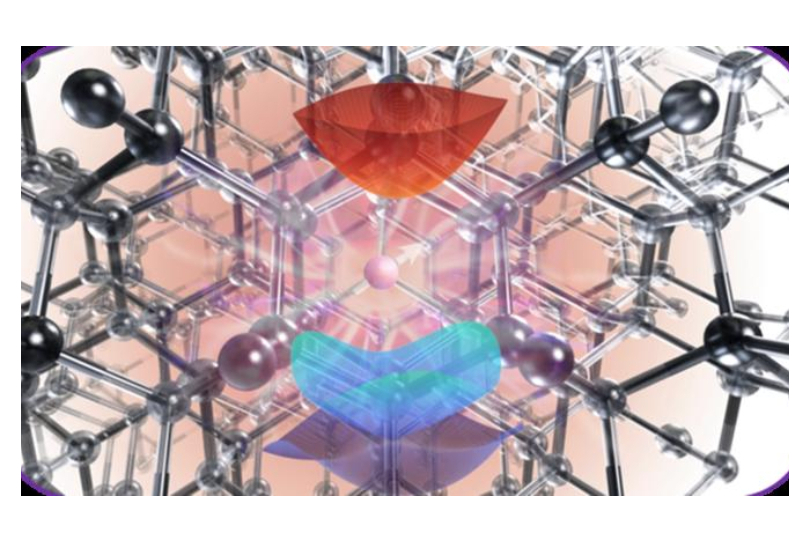
The tool will be released as part of the open-source software package WEST, developed within the Midwest Integrated Center for Computational Materials (MICCoM) by a team led by Prof. Marco Govoni, and it helps scientists better understand and engineer new materials for quantum technologies.
Galli’s group showed the accuracy of the tool, known as WEST-TDDFT (Without Empty States - Time-Dependent Density Functional Theory), in studying three different semiconductor-based materials but said it can be applied to a wide range of related materials and the software that has been developed can run at scale on multiple high-performance architectures.
The building blocks of quantum information
The fundamental units of information underlying new, powerful quantum technologies are qubits. Unlike the bits used in classical computing, which use only 0s and 1s to encode data, qubits can also exist in states of superposition, representing both 0 and 1 simultaneously.
Miniscule defects within materials — such as a missing or substituted atom in the structured lattice of a crystal — can take on quantum states and be used as qubits. These qubits are extremely sensitive to the electric, optical, and magnetic properties of their surroundings, giving them the ability to be used as sensors. Understanding exactly how these “point defects” interact with photons of light to change their energy states can let researchers better manipulate them or design materials that use the qubits as sensors or data-storage units.
Until now, researchers could predict both the absorption and the emission of light by point defects, but could not fully explain some of the atomic processes that happened within the material while in its excited state, especially in the case of large and complex systems.
Streamlining complex calculations
The quantum mechanical equations that must be solved to determine the atomic properties of materials are incredibly complex and require a large amount of computing power. In the new work, Galli’s team encoded a new way of solving such equations more efficiently than in the past while proving that they were still accurate. The increased speed and efficiency at which the equations can now be solved means that they can be applied more easily to larger systems — in the past, the computing time and power required to analyze these systems made it unfeasible.
“With these methods, we can study the interaction of light with materials in systems that are quite large, meaning that these systems are closer to the experimental systems actually being used in the laboratory,” said graduate student Yu Jin, the first author of the new paper.
The efficient approach developed by the team can run on two different computer architectures — central processing units (CPUs) and graphics processing units (GPUs). The researchers used it to study the excited state properties of point defects within three materials: diamond, 4H silicon carbide, and magnesium oxide. They found that the tool could effectively calculate the properties of these systems even when they had hundreds or thousands of atoms.
A broader goal
The MICCoM team developing WESTincludes Dr. Victor Yu, Yu Jin, and Prof. Marco Govoni. The group is continuing to apply and finetune the algorithms available in the package, including WEST-TDDFT, to study broad classes of materials, not only for quantum technologies but also for low power and energy applications.
The new tool fits with the broader goal of the Galli lab to study and design new quantum materials. Also, this month, they published new results showing how spin defects close to the surface of a material behave differently than those deeper within a material, depending on how the surface is terminated. Their results have implications for the design of quantum sensors that rely on spin defects.
The team also had a recent paper, published December 9 in npj computational materials, examining the properties of ferroelectric materials being used in neuromorphic computing.