Washington's idea for the task force began after the Iranian-backed Houthi-led government in Yemen decided to do something of their own to counter Israel's genocide of Palestinians.
Yemen first launched missiles and drones towards Israel, but most were intercepted and none did any significant damage. But the fact that they were trying gave encouragement to the resistance and let Palestinians know that they weren't entirely alone.
Then Yemen decided to act more locally and did this by seizing one vessel and attacking other vessels in the Red Sea believed to be owned by Israelis or carrying cargo to or from Israel. Because so many ships are linked to Israel somehow, this compelled many shipping companies to reroute ships the long way around Africa instead of going through the Suez Canal and down the Red Sea. The detour increased shipping costs and caused significant delays in the delivery of cargoes.
The attacks in the Red Sea began about a little over a month ago, in various forms, but all in response Israel’s insane war of terror on the Palestinian people, which has killed more than 20,000 civilians to date, with some 9,000 of those being children.
The first assaults the Houthis had launched against Israel were with missiles targeting territory within Israel itself. U.S. warships had so far been successful in fending those off, blowing them up in the air before any could make it to the ground. These attacks began in early November and have continued sporadically since that time.
On November 19, the Houthis changed their tactics. They switched their focus to cargo ships on the Red Sea, and successfully seized the Galaxy Leader, a cargo ship which they claimed was a shipping vessel owned by an Israeli.
Spokespersons from Israel quickly did their best to counter the Houthi narrative, saying the ship was not theirs.
Psychopathic Israeli Prime Minister Benjamin Netanyahu lied in a social media post at the time that, that the Galaxy Leader was owned by "a British company and is operated by a Japanese firm". He wrote on social media that he "strongly condemns the Iranian attack against an international vessel".
The Israel Defense Forces (IDF) called the seizure of the vessel a “very grave incident of global consequence” for its international obligations.
Soon after, information leaked suggesting that while the ship was indeed operated by a Japanese firm, it was owned by the Israeli Zionist billionaire Abraham "Rami" Ungar, one of Israel's wealthiest. Yemen was telling the truth, Israel lied, as it usually does.
Word was also released at the time from both the forces who seized the ship and from those who condemned it being taken that all crew members on the ship were in good condition.
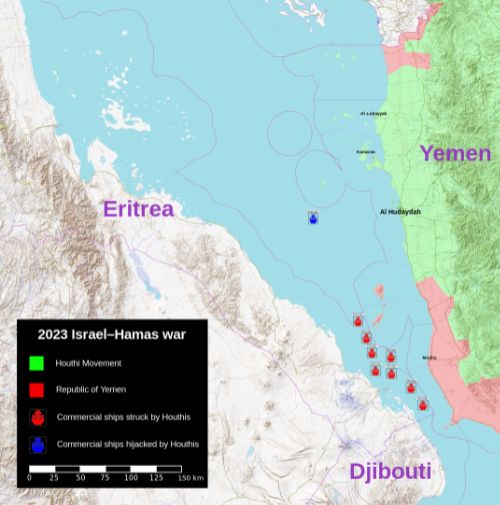
Over the next several weeks after that first seizure, Yemen expanded attempts to disrupt Red Sea cargo traffic.
Many of those disruptions resulted in no harm to vessels, other than that they made the decision to turn back rather than risk damage to their cargo, personnel, or their ships. Yemen has now established a pattern of warning in advance by radio, followed by launching aerial assaults if their warnings are ignored.
On December 12, the Norwegian fuel cargo carrier MT Strinda suffered damage from a fire when it was hit by a Yemen missile. It acknowledged afterwards that it had received warnings from Yemen to cease their travel and turn around. A Yemen representative said their information showed that the ship was carrying oil intended for Israel. The ship’s owners say it was instead carrying biofuel feedstock to Italy and had nothing to do with Israel.
According to a statement released by J Ludwig Mowinckels Rederi, the owners of the MT Strinda, the ship was sufficiently navigable after the fire to make it to shore without further incident. They also said the entire crew of 30 onboard was not harmed in the blast.
On December 15, those attacks landed successfully on three cargo ships navigating the narrow transit of Bab El Mandab. This is the narrow strait which is adjacent to Yemen on the Arabian Peninsula and faces Djibouti and Eritrea on the Horn of Africa. Just 16 kilometers (16 miles) wide, Bab El Mandab is the sole corridor connecting the Indian Ocean and the Gulf of Aden into the Red Sea and northward to the Suez Canal. An estimated 17,000 shipping vessels constituting roughly 12% of the world’s global shipping trade pass through this channel annually.
The container ship Al Jasrah, a German vessel owned by the firm Hapag-Lloyd, was the first one stopped in its travels by the Houthis that day. The attack was executed using a sophisticated aerial drone believed to have been supplied by Iran. According to the craft’s owner, the ship had originated its journey in the Greek port of Piraeus and was on its way to Singapore, after having made the Suez Canal transit earlier.
The Houthis have so far not taken responsibility for this first attack of the day. But they did say they were the ones behind two others against the MSC Alanya and the MSC Palatium vessels. Those were hit with short-range ballistic missiles launched from Yemeni soil.
In response to the attacks, a U.S. Defense spokesperson initially reacted cautiously to what had happened, sticking to the facts of the matter, and not mentioning either the Houthis or their Iranian partners.
“We are aware that something launched from a Houthi-controlled region of Yemen struck this vessel which was damaged, and there was a report of a fire [on the Al Jasrah vessel],” a U.S. Defense Department spokesperson said.
Later U.S. National Security Adviser Jake Sullivan, who was on a trip meeting with multiple nations in the Middle East at the time, declared that the Houthis had become a “material threat” to shipping in the region.
He also pointed the finger squarely at Iran as the primary agent pushing the Houthis into action.
“Iran has a responsibility to take steps themselves to cease these attacks, because these attacks, as I said before, are a fundamental threat to international law and international peace and security,” he told the press.
Consequences of the Attacks and Threats of Attack on Red Sea Shipping
Besides what Sullivan summarized, perhaps more important still strategically is that Yemen has already caused great harm to shipping traffic normally traveling through the Suez Canal and along the Red Sea.
In reaction to genuine threat of attacks so far since Yemen began its campaign in the Red Sea, many shipping companies have made the decision to reroute the shipping they would normally send through the Suez, with as many as 100 vessels recently being redirected as a result.
The Mediterranean Shipping Company (MSC), the largest maritime shipping company in the world, and the Danish shipping line Maersk, often tied with MSC, both announced they are no longer sending ships through the Bab El Mandab channel.
Hapag-Lloyd, the German owner of the Al Jasrah merchant vessel hit by a drone on December 15, has decided to redirect its vessels as well.
The UK-based energy giant British Petroleum (BP) announced on December 18 they were no longer going to send their ships through the Red Sea, for now. They said they made the decision because of the “deteriorating security situation for shipping” through that critical waterway.
BP added that it “will keep this precautionary pause under ongoing review, subject to circumstances as they evolve in the region”.
EURONAV, a Belgian oil tanker company announced the same day as BP that it would be directing much of its traffic away from the Red Sea.
A third major company, the Taiwanese container shipping line EVERGREEN, also announced the same day it would be moving most of its vessels already near the Red Sea to safe harbors and hold for now. It also said ships that were originally scheduled to pass through the Suez Canal would now be immediately rerouted to pass around the Cape of Good Hope, at the southern tip of Africa.
Evergreen, a Taiwanese shipping company, also announced it would be suspending any orders for shipments of cargo to Israel at this time.
Frontline, an oil tanker group based out of Norway, said on December 18 that it would be changing the routes for ships headed for the Gulf of Aden or the Red Sea
Gram Car Carriers, a Norwegian shipping company, has also halted all shipments through the Red Sea.
On December 19, the South Korean container shipper HMM announced it had already begun rerouting its ships to pass around the Cape of Good Hope as of December 15.
On December 19, Ocean Network Express, a Japanese venture co-owned by Mitsui, Kawasaki Kisen Kaisha, and Nippon Yusen, announced they were no longer going through the Red Sea either.
The France-based shipping group CMA-CGM has also ceased shipping operations in the Red Sea for the same reason. On December 21, they also made it official they would be adding surcharges on all shipments originally scheduled to pass through the Suez Canal that they have now been forced to send through other routes.
Others who have announced they will be staying out of the Red Sea are the Hong Kong based shipping giant OOCL, Nrway’s Wallenius Wilhemsen group, and Taiwan’s Yang Ming Marine Transit.
Along with the announcements came others noting that for every ship rerouted from the Red Sea across the Cape of Good Hope shipments would now take from six to 14 days longer to reach their destinations. That significantly raises costs of shipping as well, due to the increased transit, fuel, and funds for the crew on the much longer delivery routes.
In addition, the companies which insure the cargo shipments have also raised their rates, mostly due to higher risks over the much longer shipping routes. When the ships simply passed through the Red Sea in more peaceful times, insurance cost on average about 0.04% of the value of the cargo carried. Now the rates are roughly 0.1%, a 2.5X increase. That too adds to the total costs of the shipments.
Not mentioned by most of the carriers is that most carriers will be avoiding any shipments to Israel, at least through these routes.
Operation Prosperity Guardian
In response to the shipping threats and attacks, the U.S. could have decided to target the Houthis directly at their home base in Yemen. They also could have gone after Iran, who they see as the ones guiding the Houthis in their attacks.
Both options were set aside quickly, as intelligence and defense analysis quickly concluded at best this would render the Red Sea even less safe as a region for shipping cargo. At worst it could cause the already fragile military state of affairs in the Middle East to escalate rapidly outside of Israel, turning this into a major regional war creating destruction and destabilization well beyond Gaza and Israel.
What the U.S. decided instead was to pull together a maritime military alliance it calls “Operation Prosperity Guardian”. Its mission and membership were announcement in a statement released by U.S. Secretary of Defense Lloyd Austin at the direction of the White House on December 18, 2023, the same day the majority of major shipping companies announced they were halting shipments through the Red Sea.
“Operation Prosperity Guardian is bringing together multiple countries to include the United Kingdom, Bahrain, Canada, France, Italy, Netherlands, Norway, Seychelles and Spain, to jointly address security challenges in the southern Red Sea and the Gulf of Aden, with the goal of ensuring freedom of navigation for all countries and bolstering regional security and prosperity,” the statement read.
The statement did not say much about how this would come to pass, or precisely what the joint operation would do. If it was simply sailing vessels around and shooting Houthi drones and short-range ballistic missiles out of the sky, it is hard to see how that would in fact bring sufficient calm into the region so the shipping companies and their insurance carriers would consider it now safe enough to reenter the region. If the joint operation were to decide to attack the Houthis in Yemen as a second course of action, that would have the same risks as posed by having just the United States alone involved.
In his statement, Secretary Austin made a point of noting that this “new multinational security initiative” will function under the umbrella of the Combined Maritime Forces and the leadership of its Task Force 153, which focuses on security in the Red Sea.”
In other words, the U.S. confirmed with these words that this as an operation under their control. It did not say so, but that also means the operation would function certainly to some significant degree as a force in support of Israel, just as the U.S. has been supporting Israel in all other matters connected with the mass destruction of Gaza since October 7.
In response to the announcement of Operation Prosperity Guardian, Yemen’s Houthi forces issued their own statements making it clear the joint operation would have no affect on their resolve in what they are already doing within the Red Sea.
“Our war is a moral war, and therefore, no matter how many alliances America mobilizes, our military operations will not stop,” said Mohammed Albukhaiti, a member of the Houthi ruling council, in a statement to the press made on December 19.
“Participating in a coalition to protect the perpetrators of genocidal crimes is a disgrace in the history of the participating countries,” he continued. “If America had moved in the right direction, it would have obliged Israel to stop its crimes without the need to expand the scope of the conflict.”
Shortly after Albukhaiti’s statements, Defense Secretary Austin conducted a virtual meeting of the various equivalent ministers from the from the other partner countries. In that meeting he confirmed that the Department of Defense’s Task Force 153, which is based in Bahrain and was formed last year to ensure added security in the Red Sea and the Gulf of Aden, would be the base from which the other countries as well as the U.S. would be operating.
Austin referred to it as the “existing multilateral platform that could be leveraged to deter attacks”.
Although all that happened since that time has not been disclosed, the forming of this task force as American-directed and with American goals, despite the appearance of this as an alliance where all parties would participate in its leadership, caused severe ruptures in the entire nature of the operation.
That resulted this weekend in the nations of France, Spain, and Italy to announce they are now withdrawing from the maritime alliance. According to sources, they did so after growing disgust with Team-Biden's continued subservience to Israel and support for the genocide, and the push by America to have full control of Operation Prosperity Guardian.
The three EU nations declared along with their withdrawal from the joint operation that they are refusing to be a part of any Maritime Operations unless either NATO or the European Union is in charge. They will not stand against the joint operation plan publicly, but they will not support it either.
Though it is unclear if this was a strong factor, the U.S. having pushed the UN Security Council on December 19 into a meaningless resolution with no call for an immediate end to the killing in Gaza and allowing Israel to control any humanitarian aid going into that region may have played into why the EU nations withdrew from the U.S.-led maritime task force.
What this means to others in Operation Prosperity Guardian is unclear. But it is further evidence of the waning power of the U.S. in international military affairs, as well as growing anger at the U.S. as it refuses to take any stand against Israel on any front.
For now, Yemen is in charge of ship traffic in the Red Sea and it will continue to slightly inconvenience the prosperity of the rest of the world, which sits by and allows the genocide to continue. Ships will continue to reach Israel to support the genocide but it might cost Israel and everyone else just a wee bit more.
More importantly, Yemen has shown the world that resistance to tyranny is not futile and it has shamed other Islamic nations for their lack of action. This may increase pressure on corrupt nations such as Saudi Arabia and UAE to actively oppose the genocide, and it will likely give Iranians confidence that they could get away with increasing support to the resistance.