Zapatistas to Begin Caravans Honoring 30th Anniversary of Armed Uprising Against Mexican Government
Lead StoryRebellion-Transformation
The Ejército Zapatista de Liberación Nacional, known outside Mexico either by its initials ELZN or as the Zapatista Army of National Liberation, the English translation of the name, was founded forty years ago.
It was an offshoot of the National Liberation Forces (FLN), a clandestine loose-knit paramilitary organization, which itself was founded in August 1969 as a left-wing Indigenous group having the objective overthrowing the Institutional Revolutionary Party (PRI) which up to that point had held the reins of power in Mexico for sixty years. The FLN believed the PRI was an authoritarian regime which often teetered towards a dictatorial political model, and cared little for the needs and interests of the common man in the country.
Five years after the FLN was founded, a brutal confrontation took place in San Miguel Nepantia between the FLN and the PRI, in February 1974. The PRI won the confrontation after a series of battles and skirmishes which left key members of the FLN dead; many beaten, shot, or tortured; and those still alive demoralized.
The FLN dissolved not long after that. For nearly ten years the embers of what was the FLN cooled but still simmered, as the desire for liberation from the now even more brutal PRI continued to fester despite not having the political organizational structure to provide it with structure and a voice. Out of that smoldering a new group was founded to replace the FLN. That group, which began its formal existence on November 17, 1983, was the Zapatista Army of National Liberation.
The ELZN was founded by an odd but inherently stronger mix of left-wing influences than the original FLN. The part which came from the FLN were non-Indigenous people, mostly from the northern part of Mexico. Then there were the Indigenous members, this time a group calling Las Cañadas and Selva Lacandona in eastern Chiapas home; most of them came from much smaller loosely related rebel groups in that state.
The ELZN was also formed on a broader ideology than the FLN. It elected to drop the Marxist-Leninist tilt of the original FLN group and replaced it with a libertarian socialist political vision.
With that background, the ELZN grew in geographical scope, though still mostly headquartered in Chiapas in southern Mexico. It also began to gain popularity and an organizational vision deriving its clarity and power from the native Indigenous, who found themselves more threatened every day by the continuing power of the PRI-based government and the deals that government was signing off with other nations, with what the ELZN felt was little consideration for the people of Mexico.
After the ELZN gained strength as a distinct and powerful minority player in Mexican politics, eventually there had to be a point at which the ELZN would have to choose between easing pressures it was putting on the elected central government of Mexico and taking a major leap forward to fight for the rights of the rebels and the Indigenous who made up its base. It took the power path, joining forces with the Rural Collective Interest Association.
On January 1, 1994, the Zapatistas, known at that point either by the ELZN and sometimes the Zapatista Army, chose to take on their biggest target yet. That is when they issued their First Declaration and Revolutionary Laws declaring what they hoped at the time might result in their independence from the Mexican government, which they said did not represent their interests. The Zapatistas chose that date as a rallying point because it was on that day that the North American Free Trade Agreement, or NAFTA, took effect, uniting Canada and Mexico with the United States in a trade agreement which the Zapatistas said did not represent the interests of either the Indigenous or the rebels which made up their group.
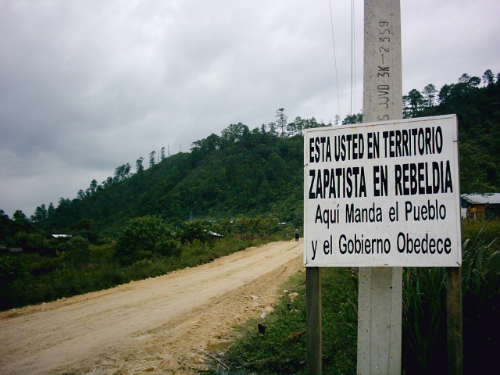
On the day NAFTA took effect, a group of approximately 3,000 armed Zapatista rebels took over six cities and villages located in the highlands of the state of Chiapas. It was from there that they marked their territory as their own and not subject to the laws of the official government of Mexico. They also notified the official government of demands they had for the main government to support the Indigenous peoples there. Those demands incorporated issues such as the availability and protection of the workforce from what they saw as the edicts imposed without representation in NAFTA, along with other considerations such as housing, food, and healthcare; rights for adequate education; and a revisioning of the meaning of democracy, justice, and peace for all.
The uprising which began as the year 1994 started lasted less than two weeks. It began with a call to arms and resulted in multiple military confrontations with the central government. As the days went on, after some initial gains of territory, it became clear, as multiple ELZN leaders were arrested, captured, or killed, that the Zapatistas lacked sufficient strength of numbers and backing to continue its movement without the cause being totally being snuffed out in what could have been a far more devastating blood war between the Zapatistas and main government forces.
The Zapatistas laid down their arms in a mutual ceasefire with the central government on January 12, 1994. Peace talks followed afterwards, resulting in some gains regarding many important issues the Zapatistas raised.
Since that time, the Zapatista movement still lives on, having restructured, and morphed as a people’s political rights movement which stands against the central government to this day, albeit peacefully over the last three decades.
On December 25, 2023, the Zapatista Army of National Liberation launched the first of a salvo of international and national caravans honoring the 30th anniversary of that January 1, 1994, armed uprising of the Zapatistas. The caravans will travel towards the Zapatista heartlands located south of Chiapas, eventually following a route which will take them through 19 states within the country and into 20 nations outside Mexico.
A collective of 600 people is leading this “caravan of caravans”, as they refer to the special gatherings which will honor the history of those who founded the movement and risked their lives to keep its vision alive since that fateful day 30 year ago
The Zapatistas have asked that the Chiapas and national government armed forces do not attempt to block the movement of the caravans, or the related gatherings which will take place at each stop.
The group will be aided in coordinating security measures associated with the caravans courtesy of the well-known Fray Bartolomé de las Casas Human Rights Center. Fray Bartolomé and the human rights group will act as a buffering force while also ensuring human rights of all are protected as the caravans moved forward on their journey.