Samsung Delays Construction Start for Texas Chip Plant Built Under the CHIPS Act
Lead StoryBusiness
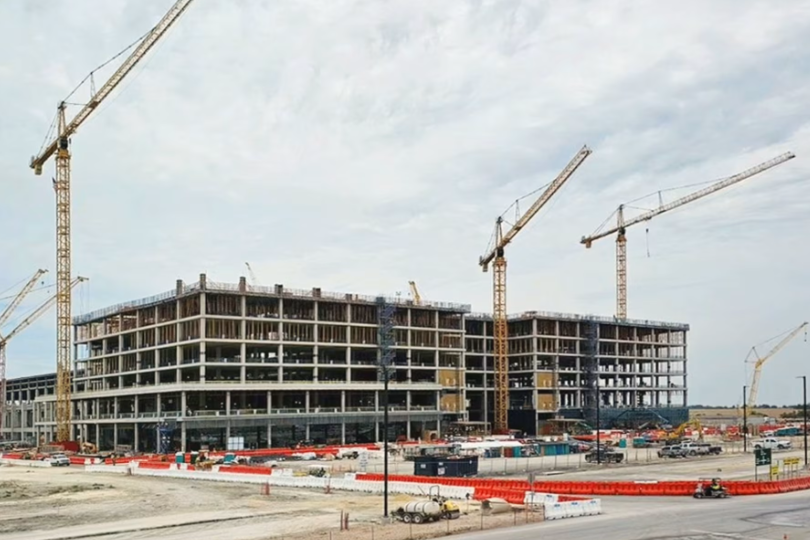
The decision to delay opening of the new plant until 2025 was announced by Choi Si-young, the president of Samsung’s foundry business, during a semiconductor industry event held in San Francisco.
Samsung’s new $17 billion chip fabrication plant is one of the flagship semiconductor plants lured to the United States under the Biden regime's 2022 Chips and Science Act that is supposed to provide $52 billion in taxpayer handouts for semiconductor manufacturing and research. $39 billion of that is earmarked to subsidize building factories, $13 billion in total grants for training of the general workforce to be hired and research staff, and a 25% investment tax credit for purchases of manufacturing equipment. It claims to further provides for a related $174 billion in related science and technology research in the business ecosystem of which semiconductor manufacturing is a part, but that aspect of the Act is a bit fuzzy.
According to information researched by South Korean business media, Samsung is delaying the start of production at its plant largely because of delays in the U.S. making good on its promise to deliver the subsidy funds promised for Samsung. Those delays now represent their own form of supply chain throttling for this industry, with just $35 million out of the over $52 billion that was promised having been paid out to any firm to date.
At present, most advanced processors are made outside the U.S., with the lion's share made in Taiwan. The U.S. attempts to prevent the sale of those chips to China. The U.S. economy and war industry is reliant on those foreign made chips and the supply vulnerable to disruption if China takes control over Taiwan as it keeps promising to do.
Chips are made in Taiwan instead of the U.S. because it costs half as much there as it would in the U.S. due to higher labor cost, taxes, logistics and red tape. The Taiwanese culture and government support high-tech manufacturing, while the U.S. obstructs it.
The initial fab installation Samsung built at Taylor, Texas, if completed, will produce up to 5,000 of its state-of-the-art 4 nanometer wafers per month. That is equivalent to about one-sixth of the total production Samsung already makes at its home-based flagship semiconductor facility in Pyeongtaek, South Korea.
The Taylor site has room for ten more fab facilities of equivalent size as the one Samsung has already being built.
Team-Biden has not paid out the money to chip manufacturers that it promised, but did manage to give $35 million to the U.S. subsidiary of BAE Systems PLC, a British military manufacturer.
Samsung is also frustrated about what seems to be built-in biases by the U.S. government in favor of Intel receiving its money under the Act first. Information uncovered by The Wall Street Journal says the U.S.-based semiconductor giant might receive its first $4 billion in grants under the CHIPS Act long before any of its foreign rivals receive anything.
Samsung has even had to hire its own government lobbyists to get some of the money promised for them to be released in a timely manner to support completion of the factory, training, and initial ramping up of operations.
A further factor which is worrying Samsung is how a global business decline in 2024 and 2025 might affect demand for the chips produced by the new factory. While it is apparently convinced the U.S. economy will simply slow rather than retrench, Samsung’s leadership remembers all too well recent declines in demand for its dynamic random-access and solid-state drive components, which resulted in lower prices and reduced profitability for the company in recent years.
The Samsung decision is a major blow to the White House, which has been promoting the CHIPS Act as one of the stellar accomplishments of its current term.
It also follows a similar blow to the momentum of the benefits the Act was supposed to provide which happened only a short time ago. That came when Taiwan Semiconductor Manufacturing Company (TSMC), the largest custom semiconductor manufacturer in the world, announced it too would be delaying opening of its new plant built in the U.S. thanks to the CHIPS Act. That facility, built in Arizona, is being put on hold also because of the lack of skilled technicians and construction workers needed to complete setting up the facility.
Both the Samsung and TSMC facilities may not end up running at full capacity until well into 2025, if then. Giving China more time to complete its potential takeover of Taiwan and the ability to cut off the supply of advanced chips to the U.S.
Publisher's Commentary
The race to develop advanced AI requires a steady supply of the most powerful processors and whoever develops and deploys it first, could rule the world. A delay of six months or a year may make all the difference because the power of advanced AI unleashed may be able to prevent other nations from developing their own.
Documents prove that the Biden crime family has taken many millions of dollars from China for influence. In addition to the bribes, it is a certainty that China also has material to blackmail at least some family members. Therefore, some believe that Joe Biden is an agent of China, as evidenced by his actions which have been very destructive to the U.S. Delaying the new chip manufacturing plants is just one of those destructive actions that benefits China and hinders the U.S., but it may be the most destructive.
Without an assured supply of advanced computer processors, the U.S. will fall further behind militarily and economically. It will be more vulnerable also to AI-driven cyberattacks, shaping of public opinion and manipulation of financial markets.
At present, China is rapidly improving its own chip manufacturing and it is only a matter of time before it overcomes its cultural barriers to producing the most advanced processors, or it seizes factories in Taiwan. It is already investing vastly more in AI than the U.S. and may be farther along.
If the U.S. did not have a grossly corrupt and inept federal government, it would make reshoring advanced chip factories its highest priority and not abuse the good will of Samsung and TSMC.