
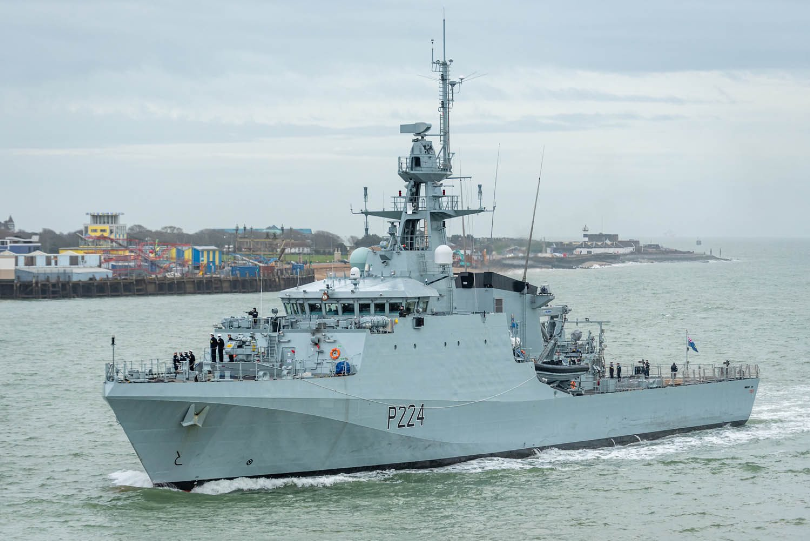
The HMS Trent arrived recently in Guyana after a leisurely cruise from Barbados. It was dispatched to Guyana as a show of force and support to Guyana after Venezuela's Maduro annexed/reclaimed some 2/3 of Guyana, including most of its oil fields and the most mineral rich part, which once belonged to Venezuela but was taken by the British in a bogus 1899 international tribunal.
In response to the presence of the war ship, Venezuelan President Nicolas Maduro deployed a a joint military exercise "Gen. Domingo Antonio Sifontes 2023" as his own show of force to support Venezuela's claims over the rich Essequibo region.
Maduro chose to interpret the presence of the British patrol craft as a military threat and provocation by the UK against "the peaceful and noble, but also warrior, Venezuelan people."
"Venezuela will not stand idle in the face of any threat, no matter where it comes from. We do not accept provocations. Venezuela has the right to defend its integrity," Maduro stated passionately for the cameras.
As a former British colony, this is certainly not the first time that Guyana has hosted British naval vessels, nor will it be the last. But it is a good opportunity for Maduro to play the strong-man and pander to his base, who don't fully understand the issues but do believe that the vast Essequibo region belongs to Venezuela, along with all of its oil, natural gas, gold, diamonds and other treasures.
Tiny Guyana is in a difficult position. Its claim on the Essequibo is not very strong but it desperately needs the territory, even though only about 125,000 of its population of 800,000 actually live there. Most of Guyana's wealth is the region claimed by Venezuela and formerly annexed by Presidential decree earlier this month after a somewhat bogus public referendum on the 3rd of December. Venezuela has given the foreign oil companies operating in the region 90 days to leave and has started issuing Venezuelan ID cards to thousands of residents of Essequibo. At the same time, Maduro claims that it is committed to a peaceful resolution of the issue and got Guyana's Muslim President to sign a non-violence pact at a meeting on St. Vincent & the Grenadines on 14 December.
The response from the White House nursing home in Washington was initially aggressive with an immediate show of military force but then took a different tone when the U.S. completed a prisoner swap with Venezuela starting on 20 December. Shortly after, Maduro announced a deal with British oil company Shell to develop Venezuelan offshore gas fields to supply Trinidad and Tobago and beyond with natural gas.
Maduro may reason that he can get away annexing a large portion of Guyana because Venezuela is larger and more powerful and that international oil companies would rather do business with him than little Guyana. It is true that the oil majors don't really care who they pay the meagre royalties to but are certainly cautious about trusting Maduro.
Complicating the situation is the fact that Guyana's President is Muslim and he recently formed an alliance with the crime state of United Arab Emirates. Defending Guyana against Venezuela could mean inviting an Islamic terrorist beachhead into the region.
Then there is China, which has substantial influence over Maduro. It may be China's intention to embroil the U.S. in yet another war it cannot win, however, if China is successful in putting their boy into power in Taiwan with elections next month, they may not need to start a war between Venezuela and Guyana that the U.S. would certainly involve itself in. They can just get their new Taiwan President to align with Beijing and the One China program and won't have to resort to armed conflict that could mean war with the U.S. While China would emerge the winner of such a war, China seeks to avoid open conflict and prefers to get its enemies to defeat themselves from the inside.
The next move is Guyana's.