Venezuela Deploys Military Off Coast of Guyana as UK Sends Warship to Defend It
Lead StoryConflict

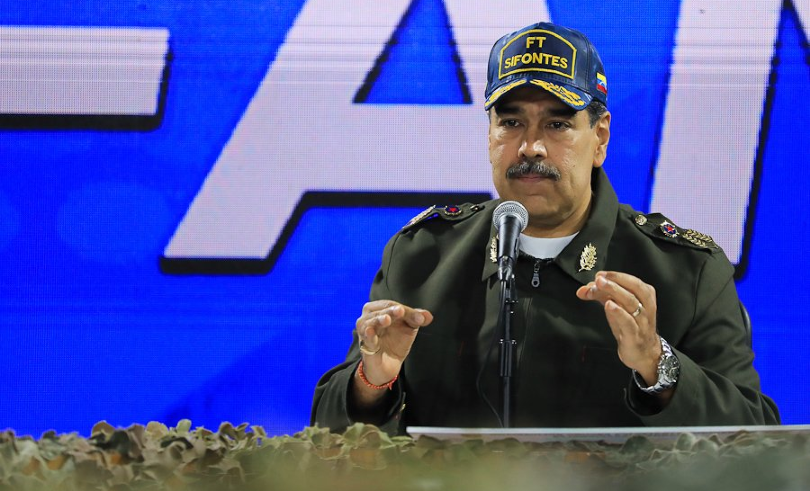
The order on December 28 by Venezuelan President Nicolás Maduro to send out the troops came after the United Kingdom issued a statement on December 24 that its HMS Trent patrol ship would be heading toward Guyana shortly after Christmas.
“HMS Trent will visit regional ally and Commonwealth partner Guyana later this month as part of a series of engagements in the region during her Atlantic patrol task deployment,” the statement from the UK Ministry of Defense read.
The HMS Trent, part of the UK Royal Navy, was already stationed in Barbados for drug trafficking enforcement support regionally prior to that announcement.
The HMS Trent is a River-class offshore patrol vessel, just 90 meters (295 feet) in length with only one main 30 mm gun emplacement, four 0.5” heavy machine guns, and two smaller machine guns mounted on the structure. It has a small landing pad where helicopters and drones can land and take off. It can carry a maximum of 50 naval personnel, including up to 18 marines and 30 sailors. Despite being a warship, with such limited firepower and onboard military its appearance near Guyana is more symbolic than anything else.
That symbolism is important, however, as it comes in response to Maduro making a series of rapid moves this month which he aims to conclude with Venezuela seizing the Essequibo region of Guyana.
If Venezuela were to be successful in its quest, it would end up controlling new oil reserves estimated at over 8 billion barrels of oil, plus access to one of the most plentiful natural caches of gold, silver, bauxite, diamonds and other valuable minerals in this part of South America.
Those moves began with the citizens of Venezuela voting on December 3 on a referendum effectively declaring the Essequibo region of Guyana and its territorial waters offshore as now belonging to them. It also authorized the government to take the necessary next steps to secure the Essequibo region as a new Venezuelan state named Guayana Esequiba.
The basis for the land dispute is complicated. It dates from the early days of Venezuela’s independence, when the country did indeed have legitimate claims on the land Maduro now says belongs once again to him. Those claims, which date back to when Venezuela finished its war for independence from Spain in 1823, were ultimately adjudicated by an “Arbitral Tribunal” in October 1899 which the United Kingdom, then the owner of what was British Guiana. That arbitration board, which included the UK among its “jurists” and no representative representing Venezuela, surrendered the Essequibo region to British Guiana.
That remained the undisputed decision for that region all the way from the 1899 date, through when the former colony of British Guiana being granted its independence in 1966 as the new nation of Guyana with borders unchanged despite another challenge from Venezuela, up until this month.
The official tally from the vote was supposedly that 67.8% of all eligible voters in Venezuela approved the referendum. Over 90% of those voted in favor of each of the elements of the referendum. Whether the vote numbers are real matters little. What matters more is that Maduro acted faster than most anticipated immediately following the vote.
The day after the referendum, Maduro coordinated an emergency meeting in Mexico City with the Unity Platform group, the main opposition party to his administration, to get them to agree to support the results of the vote. He published a new map of Venezuela showing its new borders. He issued an executive order giving companies like ExxonMobil, which is currently pumping oil from reserves licensed to them by the government of Guyana, three months to leave the area. He then directed Petróleos de Venezuela, S.A. (PDVSA), the state-owned oil company, to create business units covering the new territory, then followed that with orders for the new business entities to begin granting oil and mineral exploration licenses in Guayana Esequiba.
On December 9, the UN Security Council met in private emergency session to discuss the matter. No decisions were made at that time to censure Venezuela for its actions.
Five days after that, on December 14 President Maduro met with President Irfaan Ali of Guyana in a highly choreographed day of talks regarding the dispute in a meeting hosted by Prime Minister Ralph Gonsalves of Saint Vincent and the Grenadines. Maduro and Ali signed off on an eleven-point declaration of peace between the countries at the conclusion of the event. The declaration’s main result was that the two countries would not "threaten or use force against one another in any circumstances". There was also an odd statement that Guyana recognized the UN International Court of Justice as the place to resolve the disputes, while Venezuela does not.
The two parties agreed after that to continue talking though with no commitments as to on what timetable, and if it would dissuade Venezuela in proceeding with its already-declared plans regarding Guyana.
Developments regarding the Essequibo dispute were relatively quiet in the two weeks following that meeting. The sole exception was a visit to Guyana earlier this month by David Rutley, a foreign minister from the UK, shortly after the December 14 Maduro-Ali summit. Rutley’s visit resulted in a brief written statement from him on behalf of the UK which received little publicity and not much comment.
“The border issue has been settled for more than 120 years,” he said, referring to the decisions of the Arbitral Tribunal. “We welcome the recent agreement by Venezuela … to refrain from the use of force and any further escalation.”
Nothing more of substance issued from any front on dispute since that point until the UK decided, apparently with little advance warning, to send its HMS Trent patrol vessel to Guyana to defend its former colony.
Maduro responded angrily to the UK’s action, calling it “the breaking of the spirit of dialogue, diplomacy, and peace of the agreements” already reached to continue discussions with Guyana over the matter.
The Venezuelan president called sending the UK warship was “practically a military threat from London”.
“We believe in diplomacy, in dialogue, in peace,” Maduro said. “But no one should threaten Venezuela, no one should mess with Venezuela. We are men of peace, we are a people of peace, but we are warriors, and this threat is unacceptable for any sovereign country.”
“The threat of the decadent, rotten, ex-empire of the United Kingdom is unacceptable,” he continued.
To counter that threat, in a broadcast message on television yesterday, Maduro announced he has called for “the activation of a joint defensive action of the Bolivarian national armed forces”.
Though Maduro did not explain what that joint defensive action might be, it was confirmed later yesterday that the government was readying 5,600 of its air and naval personnel to defend what it sees as its legitimate rights to the new state of Essequibo. It appears they are being sent to the same waters off the coast of Guyana where the HMS Trent plans to engage in military maneuvers.
That was backed up later by a formal statement released by the Foreign Ministry of Venezuela.
Venezuela, “reserves all actions, within the framework of the constitution and international law, to defend its maritime and territorial integrity,” the Ministry said.
As tensions were rising in Venezuela, Guyanese government representatives said yesterday that the HMS Trent was coming to Guyana as a planned event, and would focus on improving the defense capabilities of the country.
“Nothing that we do or have done is threatening Venezuela," said Guyana's Vice President Bharrat Jagdeo in a quickly arranged press conference late yesterday in the nation’s capital of Georgetown.