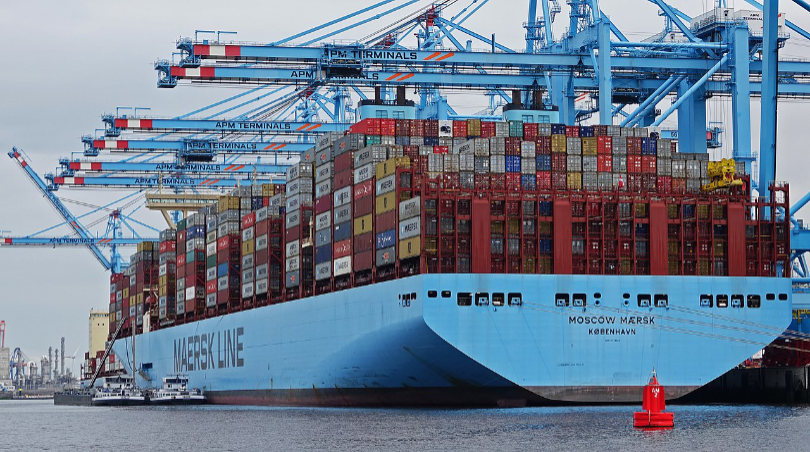
The Danish shipping giant made its announcement following an action by Houthi Yemen authorities on the Maersk Hangzhou merchant vessel last Sunday.
U.S. Naval forces operating in the region responded to them Yemen enforcement actions by launching an attack on three Yemen patrol ships moving in the Red Sea. According to Houthi sources, the U.S. sunk all three ships and killed 10 of those onboard.
The Houthi blockade targeted Israel linked ships in the Red Sea and the narrow strait of Bab-al-Mandeb at the southern gate of that waterway, located between Yemen on the east and the Horn of Africa on the west, has a single focus. It is by their own words intended to cause sufficient economic disruption for Israel, which depends heavily on cargo such as oil and food supplied through this route, so Israel and the western powers which support it will cease its ruthless genocide in Gaza. While it hasn't stopped supplies from reaching Israel or changed Israel's behavior it has imposed a very real cost for its crimes.
In the two months the Houthis have carried out their interruption of maritime traffic passing through the Gulf of Aden and via the Suez Canal, 25 ships have been targeted. Only one, the Israeli owned and Japanese-operated Galaxy Leader, were seized by the Houthis along with their crews as part of the operation. The Galaxy Leader is still being held by Houthis alongside one of their major ports.
Some other shipping companies which normally ply their trade via the Red Sea and the Suez Canal have made decisions to withdraw at least some of their ships from the Red Sea and reroute them southwards around Africa.
The United States reacted to the altercations by creating Operation Prosperity Guardian, a naval military task force directed by the U.S. Department of Defense which would protect shipping vessels in the Red Sea. The United Kingdom, Australia, Bahrain, Canada, Denmark, France, Greece, Italy, the Netherlands, Norway, Seychelles, and Spain had signed on to the task force, with promises from some to provide naval vessels of their own. The operation has already run into serious troubles of support, as France, Italy, and Spain have all withdrawn their ships from the task force because they do not want to be under the direction of the U.S. Australia has also backed out of sending its ships.
Operation Prosperity Guardian was officially launched on December 18.
As is evidenced by continued warnings by the Houthis against shipping vessels after that date, and by the attack on the Maersk Hangzhou, the apparent near-empty threat of Operation Prosperity Guardian proved mostly powerless against the far more credible threat posed by the tiny Houthi nation in Yemen.
On January 3, the United Nations Security Council held an emergency session to consider what to do about the Houthi interruption of Red Sea shipping. It was again a wasted exercise in terms of maintaining peace in the world, despite the fact that this is not just its primary purpose but also its only one. It did accomplish what the U.S. appears to have wanted, however. It resulted in a joint declaration by twelve nations (and not from the UN Security Council), with the U.S. at the head of it and eleven other close allies signing on, giving what amounted to a final warning to the Houthis that if they didn’t stop the group might begin direct attacks on the Houthi nation.
The statement included an order to the Houthis to immediately cease “these illegal attacks and release of unlawfully detained vessels and crews”. It warned of “consequences” if they do not.
The declaration was issued not by the individual nations but instead from the White House. It is a de facto “declaration of war” on the Houthis by those twelve nations, with Joe Biden at the helm to direct that war when it happens.
The day the declaration was approved by those nations, Maersk’s senior management released a brief statement that they would reimpose a short shipping pause in the Red Sea. They also indicated they would be taking further actions soon.
Maersk, which is responsible for 15% of all global shipping and ranked second only to the Geneva-based Mediterranean Shipping Company (MSC) with its 19% share, is addressing this as a pragmatic business decision. They were already facing increased insurance costs running now 0.1% of the total value of the ships and their cargo, up by a factor of 2.5 from the 0.04% charges they were paying before and which the Israeli's don't want to pay. They are also facing shipping delays of between 6 days and sometimes up to two weeks for every ship rerouted around South Africa’s Cape of Good Hope.
On January 5, Maersk made its next decision. It would be rerouting all vessels away from the Red Sea on a semi-permanent basis, at least until hostilities in the region ease. It also warned the world that this would create major supply chain disruptions for its customers, with the implications of added costs and economic turmoil.
“The situation is constantly evolving and remains highly volatile, and all available intelligence at hand confirms that the security risk continues to be at a significantly elevated level,” the company announced in a written statement. “We have therefore decided that all Maersk vessels due to transit the Red Sea / Gulf of Aden will be diverted south around the Cape of Good Hope for the foreseeable future.”
“While we continue to hope for a sustainable resolution in the near-future and do all we can to contribute towards it,: the statement continued, “we do encourage customers to prepare for complications in the area to persist and for there to be significant disruption to the global network.”
The message also included information about the added costs companies shipping with Maersk will be charged because of the shipping disruptions.
“The previously announced Transit Disruption Surcharge (TDS), Peak Season Surcharge (PSS) and Emergency Contingency Surcharge (ECS) for all cargo on vessels affected by the disruptions around the Red Sea / Gulf of Aden remain in effect,” the message said.
When the U.S. began its first counterattacks against the Houthis, Iran sent a naval vessel of its own into the Red Sea. It also issued its own warning that these were seas within their part of the world and that they would defend them if necessary. With Iran being one of the Houthi’s most powerful allies, the message was clear that this “defense” was aimed not at the Houthis but at the western forces which continue to support Israel in its widespread destruction of Gaza and the slaughter of the Palestinians who have called that area home for millennia.
If as expected the U.S. does decide to coordinate an attack on the Houthis in their home on the Arabian Peninsula, this will do nothing to reassure companies like Maersk that they can resume shipping. Maersk could of course ensure the safety of all their ships by merely not supporting Israel, but it won't.
And, if the U.S.-led consortium does hit the Houthis hard with what currently is expected to include missiles and drones as a minimum, that is expected to be the action which will trigger far harsher counterattacks on the U.S. and its allied supporters of genocide.
As of today, there were more than 200 ships safely transiting the Red Sea and the Suez Canal is as busy as ever.