China’s Decision to Halt Stops at Israeli Harbors Could Be Part of a Bigger Plan
Lead StoryConflict
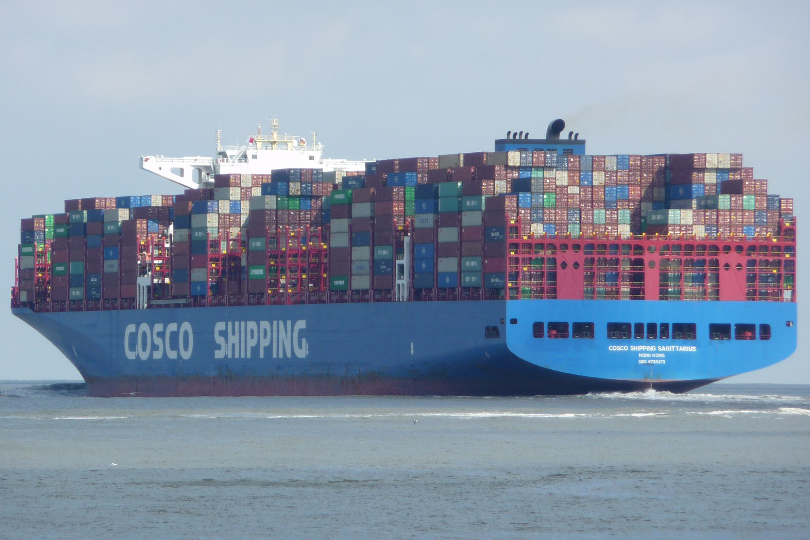
In a surprise move, COSCO, the fourth-largest oceanic cargo company in the world and responsible for roughly 11% of all maritime shipments, decided to suspend all stops at any Israeli ports.
The big question in this case is less about what the company is doing but the impact it will have on Israel and what the strategic intent might be behind it.
Unlike recent decisions by many other cargo carriers such as the one announced on January 5 by Danish cargo ship giant Maersk which claim they are rerouting all cargo away from the Red Sea, this one appears to have nothing to do with concerns that the ship might be attacked by Houthi forces in the same way they have been threatening most other cargo carriers attempting to travel within the Red Sea and pass through the Suez Canal.
That conclusion does not come from anything COSCO has said publicly about why it made its decision, which at this point is nothing. The information about COSCO no longer coming to Israel came via a leak to the Israeli online business publication Globes, so the world knows nothing of any official position by COSCO on the topic.
As to why this is different, consider first that the Houthis had previously said they would not be targeting Chinese vessels in their mission to disrupt shipping in the Red Sea. The Houthis have been targeting shipments heading to or from Israel, however, in addition to all carriers either owned or operated by Israelis. But in view of their previous comment that they would not go after Chinese ships, it seems highly unlikely they would be targeting COSCO ships even with them heading towards a destination in Israel.
Further, China is understood to be the end customer for some 90% of all oil exported from Iran. Even though that oil does not end up stopping at any Israeli port, with the Houthis strategically linked with Iran in many ways, Yemen's Houthis could find themselves in trouble with Tehran if they put any COSCO ship in the Red Sea in jeopardy. That represents yet another reason the Chinese would not likely be a target the Houthis transiting through the region.
So, if the decision is not about risks to the ships and their cargo, what is going on?
As a clue about that, note that the report published in Globes says nothing about the Red Sea at all. The focus is all about Israeli ports.
Consider also that COSCO is one of the primary cargo shipping partners with Israeli shipping company ZIM, where it picks up and drops off goods with ZIM at Israeli ports. With COSCO no longer delivering at those locations, ZIM’s business carrying goods to the Far East will suffer badly. It already has a limited number of ships in its fleet and could not easily absorb the loss of carrying space, as a minimum. Linking to other carriers would also be problematic.
Established in 1945, ZIM was the first major oceanic cargo shipper established by Israel, dating back to the time of its founding. It is also currently the top Mediterranean cargo ship carrier and the 10th largest maritime shipper in the world. In 2023, its ships accounted for roughly 2% of the world’s cargo ship fleet.
COSCO also provides connections for ZIM to up to146 countries and 597 ports.
So COSCO pulling out of Israeli harbors would cause major economic harm not just for Israel but also for its primary shipping line.
The move will also cause serious financial harm to the port of Haifa. That port, the largest in Israel, accounts for over half of all Israeli trade with foreign countries. With COSCO gone, its COSCO Haifa subsidiary, registered in Hong Kong but explicitly targeted for the routes to Israel, would withdraw support for much of the port in terms of docking, unloading, and other operational fees.
Beyond all of this, which is bad enough for Israel on its own, note also that the China does far more than just dock and transfer goods at Haifa Bayport, the official name of the port there. The People’s Republic of China owns Haifa Bayport 100% via the Chinese state-owned subsidiary SIPG. SIPG was formed in 2015 in anticipation of constructing Haifa Bayport, which went into full operation for the first time in 2021.
With COSCO no longer part of the business equation at Haifa Bayport, China could announce soon that Haifa is temporarily not viable and decide to shut it down for the time being. If it does that, it would do so with a full understanding of the damage it will inflict on Israel. If that were to happen, China would never admit that is what it is doing. It would claim instead that this is just something it has to do because COSCO ships were no longer safe landing at Haifa Bayport, and that this caused a secondary impact of forcing them to shut down operations at the port for now.
Israel would likely respond by seizing the port. It would also be backed by the United States in this action. But with China easily able to argue seizing the port is illegal, this could quickly expand into a far messier economic conflict than Israel and the United States might be able to handle.
COSCO has so far not issued its own direct statement about its shipping operations to and from Israel. The Israeli government is reportedly checking directly with the company to verify the news.
Haifa Bayport is one of three major ports in Israel and is the largest and most modern. A check of MarineTraffic.com shows ZERO ships in Haifa today, with only one Israeli boat, the YAMI1 nearby. It could be that there are ships there but that they have all turned off their AIS ship identification systems after a cruise missile from Iraq hit near the port recently. The Port of Ashdod, is currently active with a number of smaller freighters, cargo and container ships and 1 tanker.
Trillions will post more information as it becomes available.