Tensions Rise Between China and U.S. via Philippine Alliance in the South China Sea
Lead StoryConflict
The Philippines, along with Vietnam and other Southeast Asian countries has long-standing claims over territory in what it calls the West Philippine Sea, is headed full speed towards a diplomatic – and possibly military collision course with China over its theft of Philippines territory.
The most recent confrontation between the countries is happening now. While there may be no shelling or missiles being launched between the two countries, observers are concerned the situation could easily lead to that if actions ordered from Washington and Beijing are not managed properly.
The current challenges started as U.S. and Philippine naval forces began what they referred to as a joint “Maritime Cooperative Activity” (MCA) conducted in regions where Philippines’s claims of territorial waters overlap with areas the People’s Republic of China says belong to them. Spokespeople from the Philippine capital of Manila and from Washington tried to downplay the significance of the actions, referring to it in some communication as a “sail along”, presumably to make it seem a far less aggressive action against the Chinese than the term “joint military exercises” would have suggested.
The MCA was planned to start on January 2 but was delayed by one full day and in some cases significantly changed from original plans.
The reasons for moving the date were never explained, with spokespeople from the Philippine side scrambling to come up with something to say as reporters pressured them for answers.
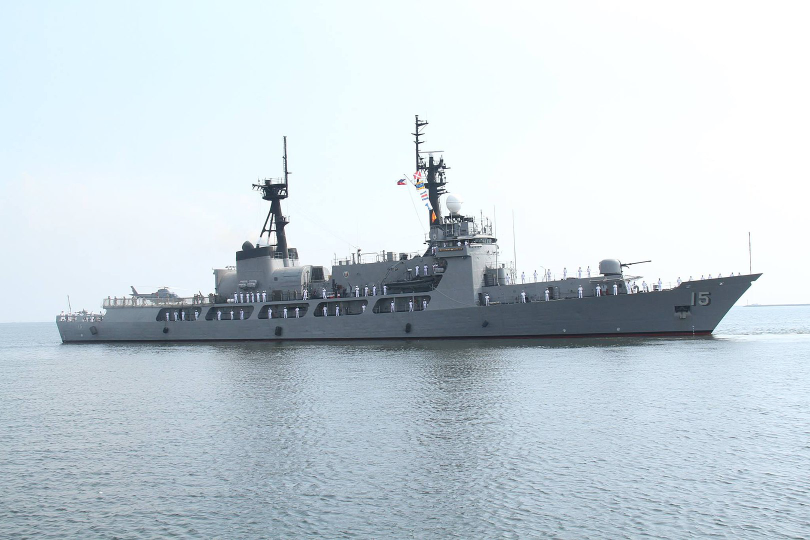
Reporters from the Philippines who were present on the BRP Gregorio del Pilar, a former US Coast Guard Cutter (USCGC) which was originally commissioned as the USCGC Hamiliton before being transferred to the Philippines Navy in 2011, already suspected the real reason. The BRP Gregorio del Pilar was the lead Philippine ship for MCA event.
Rumors were already out even before the reporters were able to ask their questions that as Philippine naval vessels moved into place in advance, China moved its own ships into the same areas. The Chinese ships were few and small, mostly Coast Guard vessels and small gunships. They were, however, apparently just enough to rattle Philippine military personnel and it appears more than enough to cause the U.S. to “blink” and reset plans.
On January 3, those reporters finally had a chance to quiz Vice Admiral Alberto Carlos, commander of the Armed Forces of the Philippines (AFP) Western Command, who was also present on that lead Philippine Navy ship. They asked about the presence of the Chinese ships, which were now visible not far from them.
Carlos did acknowledge the Chinese Navy was nearby. He said his forces had hailed the Chinese by radio questioning why they were out there, but without also issuing demands that the Chinese needed to exit the area on what would have seemed reasonable grounds, that they were trespassing in the West Philippine Sea.
It was a timid response than many had expected from the Philippine side, especially considering that the U.S. Navy was already bringing its warships up from U.S. military bases in the Philippines to join the BRP Gregorio del Pilar the beginning of the naval drills.
When asked what the Chinese were doing there and if it was a problem for the planned exercises, Carlos said about their boats that, “They are not obstructing our movement … [but] they are monitoring our movements here in the training area."
Carlos then revealed that the original plans for the Maritime Cooperative Activity had been changed from original plans put in place by the U.S. He said the American military leaders had directed the change for the start of the exercise from January 2 to January 3, along with dropping the gunnery drills the two nations were originally scheduled to conduct.
Carlos explained away the changes as having nothing to do with the Chinese presence.
“Due to some operational necessity, they have to re-allocate some of their forces to other tasks,” the Philippine Vice-Admiral said.
Later on Wednesday, the Armed Force Philippines (AFP) issued a more formal statement on the results of the first day of the drills. It mentioned that the AFP and warships from the United States Indo-Pacific Command (USINDOPACOM) "performed advanced maritime communication exercises" in West Philippine Sea. The purpose of the exercises for the AFP, the statement continued, were to "develop their confidence in maneuvering near other vessels."
"Further, the conduct of these exercises requires complete coordination between PH-US assets to enhance the operational capabilities and interoperability of both forces," the statement continued.
Among the warships acknowledged by the U.S. to have taken part in the exercises was USS Sterett, a naval destroyer-class vessel. It was deployed about 80 miles from Lubang, Occidental Mindoro.
The USINDOPACOM command said that it also engaged the aged USS Carl Vinson, a Nimitz-class aircraft carrier launched in 1980 capable of carrying 80 military aircraft; the USS Princeton, a guided-missile cruiser of the Ticonderoga class launched in 1987 that provides air defense, anti-submarine warfare, and surface warfare capabilities; and the newer USS Kidd, a guided-missile destroyer launched in 2005. The American military also brought in unspecified multiple combat aircraft as part of the mission.
The Philippines brought three additional warships of its own to the MCA besides the BRP Gregorio del Pilar. Those included the BRP Ramon Alcaraz, the former US Coast Guard Cutter USCGC Dallas, and the BRP Davao del Sur loading platform dock assault vessel. The Philippine forces also included an SAR/multi-role helicopter and an anti-submarine warfare-capable helicopter for this operation.
The military exercises ran last week for several days. According to the AFP releases, during that time the two naval groups carried out close passing exercises such as might be needed in potential warfare challenges with China, communications protocol tests, some joint flight operations including the helicopters, joint patrols, and officer of the watch (OOW) actions.
In conjunction with the exercises, Armed Forces Philippines AFP Chief of Staff General Romeo Brawner Jr. declared the exercises “a significant leap in our alliance and interoperability with the United States”.
"Our alliance is stronger than ever, sending a message to the world," he continued. "We are advancing a rules-based international order and a free and open Indo-Pacific region in the face of regional challenges."
This was the second formal joint military exercise conducted between the U.S. and the Philippines in less than three months. In November 2023, the two countries carried out coordinated patrolling operations off the coast of Taiwan. Those operations were clearly intended to send a message to China that more than the U.S. would be involved if China were to attempt to seize Taiwan sometime in the near future, though it is hard to imagine Beijing being very concerned about the Philippines forces part of those naval drills.
Though not publicly disclosed at the time, those operations were also reportedly carried out in coordination with Japanese military authorities, though not its warships. Prime Minister Fumio Kishida of Japan initiated talks with the Philippines in early November about sending contingents of his own naval and other military forces to be stationed in the Philippines. He did not offer much details about those plans, but the positioning of the Japanese military is as a minimum intended to reinforce international water rights in the South China Sea.
“We share serious concerns on the situation in the East China Sea and South China Sea,” Mr. Kishida said on November 3, 2023, in a joint news conference carried out in Manila during a visit he made there to meet with Philippine President Ferdinand “Bong Bong” Marcos, Jr. “The attempt [by China] to unilaterally change the status quo by force is unacceptable.”
In response to last week’s joint MCA, Wang Wenbin, spokesman for China's Foreign Ministry, said as part of a regularly scheduled press briefing on January 5 that the gathering of forces by the Philippines and the U.S. was doing nothing to resolve the various territorial arguments in the area. It was instead just raising tensions.
“We would like to stress that the US and the Philippines' muscle-flexing, provocative military activities in the South China Sea are not conducive to managing the situation on the sea and handling maritime disputes,” he said.
He went on to issue his country’s own counter-message that the Philippines and the U.S. should first “respect regional countries’ effort to uphold peace and stability in the South China Sea” before creating a bigger conflict.
“China will continue to firmly safeguard our territorial sovereignty and maritime rights and interests and make active efforts to uphold peace and tranquility in the region," he told the audience.
Though the formal military exercises from last week are complete, a handful of U.S. and Philippine vessels have continued patrols in the West Philippine Sea through the weekend. China has also continued to shadow them in their paths as they move about.
While exercises like the ones just completed between the U.S. and the Philippines satisfy a public need from both countries to be seen as taking a stand against China’s position in the South China Sea, they also have the potential for accidental triggering of far more than just a war of words with Beijing.
That almost happened three months ago. On October 22, a Philippine supply ship was on its way to provide food and other supplies to naval personnel stationed on the South Thomas Shoal. While that shoal is considered by Manila to belong to the Philippines, China sees it as theirs and the now long-standing Philippine presence there as trespassing. This time the Chinese did more than just sail close to the supply ship. They carried out what Philippine Armed Forces personnel referred to as “blocking maneuvers” which ultimately resulted in the crashing of one of the Chinese Coast Guard ships into the Philippine supply watercraft.
The incident almost resulted in weapons being fired at the Chinese ship but it was deescalated quickly.
Whether that will continue to happen with each succeeding “accident” of this time is of serious concern to all nations attempting to traverse the South China Sea.
Among those is the Association of Southeast Asian Nations (ASEAN), which after observing the increasing real conflicts in the region, issued a rare statement on December 30, 2023, expressing growing worries about military exercises, which effectively represent a threat of using force against a potential adversary, lighting the fuse for something far more serious.
In that statement, the Foreign Ministers of the ASEAN membership made reference to “the Joint Communique of the 56th ASEAN Foreign Ministers’ Meeting (AMM), in which we recognized the need to maintain and strengthen stability in the maritime sphere in our region and underlined the importance of strengthening maritime cooperation and exploring new initiatives towards this end, as appropriate.”
They then went on to issue their own warning about what might happen if simple cooperative efforts between nations raise tension sufficiently to damage the fabric of world peace rather than to make the world a safer place for all.
“We closely follow with concern the recent developments in the South China Sea that may undermine peace, security, and stability in the region,” the statement continued.
“We reaffirm the importance of maintaining and promoting peace, safety, security, stability, and freedom of navigation in and overflight above the maritime sphere of Southeast Asia, particularly the South China Sea,” it went on. “We also reaffirm the need to restore and enhance mutual trust and confidence as well as exercise self-restraint in the conduct of activities that would complicate or escalate disputes and affect peace and stability, avoid actions that may further complicate the situation and pursue peaceful resolution of disputes in accordance with the universally recognized principles of international law, including the 1982 UNCLOS.”
Publisher's Commentary
The problem with addressing China's land grabs through UNCLOS is that it has already been tried and China simply ignored the ruling against it. UNCLOS ruled in 2016 that China's historic rights claims over maritime areas within its "nine-dash line" are invalid.
Most ASEAN member nations are afraid to anger China and none could defend themselves against China should it choose to target them for reprisal. The U.S. is deluding itself and the Philippines that it could defend against the Chinese military might. America's ships are mostly obsolete and easy targets for China's hypersonic missiles, designed specifically to sink American naval vessels. The U.S. does not yet have any defense against the missiles and its own hypersonic missile program has repeatedly failed. However, China doesn't have to use military force. It can simply impose a trade embargo and quickly bring a nation to heal. In the Philippines it also controls telecommunications and could simply cut-off communications.
Bong-Bong knows that he is defenseless against China but likes the cash from the Americans and needs to pretend to stand up to China to remain popular with dim-witted Filipinos who quickly forgot the nightmare of his parent's hideously corrupt rule. They also choose to forget his own criminal past and convictions.
The occupants of the White House will continue to put up a feeble show of force against China's expansion to convince Americans that Joe Biden isn't really an agent of China.