UN Security Council Votes to Demand Yemen Halt Israel Shipping Blockade
Lead StoryConflict
News Analysis
Despite a complete failure of the Security Council to do anything to stop the armed slaughter of over the Palestinian people in Gaza at the hands of Israel, when it comes to money and profit the 15 members of the Council have no problems working together.
After some debate yesterday, the Security Council voted in favor of the U.S.-authored and Japan-backed resolution "condemn[ing] in the strongest terms the at least two dozen Houthi attacks on merchant and commercial vessels since November 19, 2023, when the Houthis attacked and seized the Galaxy Leader and its crew.”
It “demands that the Houthis immediately cease all such attacks, which impede global commerce and undermine navigational rights and freedoms as well as regional peace and security."
It also calls for the immediate release of the Galaxy Leader cargo ship and crew which the Houthis seized during an attack on November 19, 2023. That is the Japanese-run carrier which is at least partially owned by Israeli interests.
The resolution affirms the need for all parties to respect the navigational rights and freedoms for all parties traveling in the Red Sea. It also supports “the right of member states, in accordance with international law, to defend their vessels from attacks, including those that undermine navigational rights and freedoms.”
While that may sound like an authorization for the countries whose ships have been threatened to consider counterattacks as their means of protecting their rights, that was specifically rejected as part of the final clauses before the draft went for a vote.
The original text of the resolution allowed for “the right of member states, in accordance with international law, to take appropriate measures to defend their merchant and naval vessels.”
For several of the nations involved in the debate, including especially Russia, letting that clause go though appeared to be too much of an invitation for all injured parties in the Red Sea to go after the Houthis with full force in their homeland.
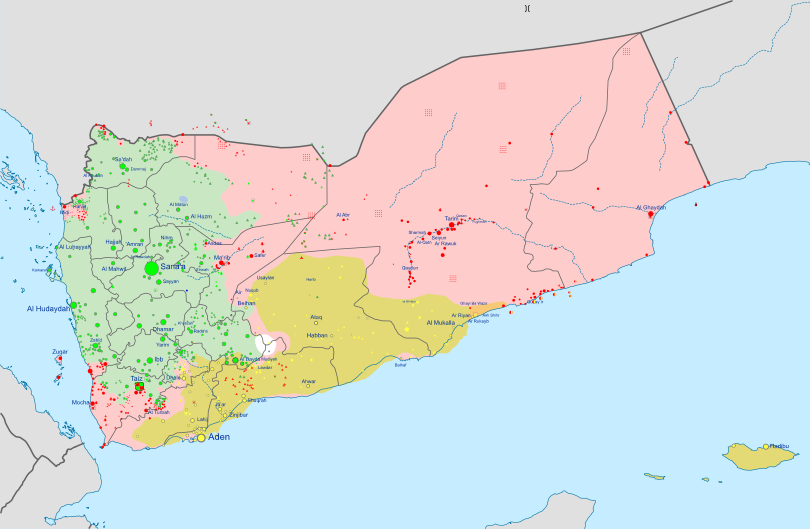
As multiple nations noted during the dialog leading up to yesterday’s vote, despite that the Houthis had warned off shipping traffic and attacked cargo carriers since November, they did so while still holding firm on an internal and still-fragile ceasefire in their ten-year-long civil war with the Saudi-backed government there. With the notable exception of the United States in this matter, most members of the UN Security Council did not wish to risk creating a further humanitarian mess in the Middle East by destabilizing the delicate peace which is in place in Yemen right now and has held for months.
During last week’s open meeting to decide what to do about the Houthi shipping disruptions, the Russian Federation’s U.N. Ambassador Vassily Nebenzia reminded all that the Houthi actions were taken because of what he called “Israel’s brutal operation in Gaza”. Nebenzia warned further that if member states were to attack the Houthis using a Security Council resolution as justification, that could produce “catastrophic” consequences, including undermining the ceasefire in Yemen and setting up a treacherous scenario “for igniting a new major conflict around at least the Arabian Peninsula”, and possibly beyond there.
With pressure from Russia and China to avoid incorporating the original far more hostile language in the resolution passed yesterday, the final resolution moderated that with the more measured acknowledgement “of the right of member states, in accordance with international law, to defend their vessels from attacks, including those that undermine navigational rights and freedoms.”
To reinforce the limits for what the Council members believe those authorized defense measures might be, the resolution also “urges caution and restraint to avoid further escalation of the situation in the Red Sea and the broader region”. It further calls for “enhanced diplomatic efforts by all parties to that end, including continued support for dialogue and Yemen’s peace process under the U.N. auspices.”
The Council members are also conscious that Iran provides arms and other forms of support for the Houthis and added a line in the resolution to address that, but without specifically naming Iran. The resolution asks for member states in the UN for “additional practical cooperation to prevent the Houthis from acquiring the materiel necessary to carry out further attacks.”
The final agreement therefore ended up delicately balancing veiled threats against Iran and the Houthis while also giving at least lip service to the importance of keeping the peace in Yemen, the poorest nation in the Arab peninsula, where over a million people have been displaced and hundreds of thousands actively suffering from lack of food, medicine, and shelter due to the civil war there. It also called for an end to the Houthi attacks on ships there and the return of those captured to date.
What it did not include, however, was anything acknowledging what Russian Ambassador Nebenzia said about the Israeli genocide in Gaza, and how that was the primary reason why the Houthis have been working to disrupt shipping traffic in the Red Sea. The closest it came to that was incorporating a clause asking for member states to work together to address “the root causes” behind the Houthi actions, "including the conflicts contributing to regional tensions."
Russia attempted to add three specific amendments to the resolution which would have made those statements more tangible. Among those was a request to list specifically “the conflict in the Gaza strip” as one of those regional conflicts which were only vaguely referred to in the final document.
It is also of note that the U.S. narrative of late is now actively dismissing that the Houthis have been focused on putting pressure on Israel in its mass destruction and murder in Gaza, as their main reason for going after shippers in the Red Sea. They now regularly point out that many of the ships targeted by the Houthis had nothing to do with Israel, claiming instead that the Houthi objectives have diverged from their original course, which could not be further from the truth.
The U.S. and the western media who follow their lead are also quick to refer to the Houthis not as an independent standalone group, but instead referring to them as the “Iran-backed Houthis”. While they are grateful for that phrasing to stick, they reject news reports which refer to Israel as “U.S.-backed Israel” as inappropriate, despite that it is at the very least as equally accurate when it applies to the never-ending and ever-escalating supply of arms for Prime Minister Netanyahu’s fascist government.
The resolution yesterday passed by a vote of 11 for and 0 against, and much later than expected in the day because of extensive debate behind closed doors. Abstaining were Russia and China, two permanent members of the Security Council, who could have vetoed it but decided to let it go. Algeria, a new non-permanent member of the Security Council whose term began on January 1, also abstained.
The Houthis Respond
Mohammed Ali al-Houthi, the leader of Yemen’s Houthi supreme revolutionary committee, issued a statement on the social media platform X as to their thoughts about the Security Council’s action. The post was published on January 11 at 2:03 AM, Yemen time. It was also simultaneously posted on al-Houthi's Telegram social media feed.
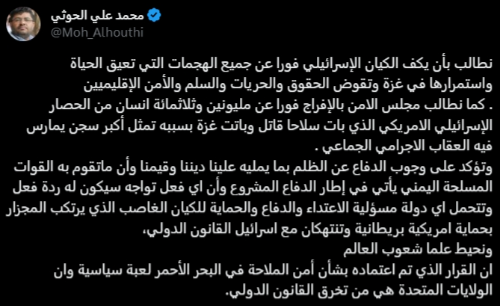
“The decision that was adopted regarding the security of navigation in the Red Sea is a political game,” al-Houthi said.
“We demand that the Israeli entity immediately stop all attacks that hinder life and its continuity in Gaza and undermine rights, freedoms, and regional peace and security,” he continued. “We also call on the Security Council to immediately release two million and three hundred people from the Israeli-American siege, which has become a deadly weapon, and because of which Gaza has become the largest prison in which collective criminal punishment is practiced.”
“What the Yemeni armed forces are doing comes within the framework of legitimate defense,” al-Houthi went on. “Any action they confront will have a reaction, and any country bears the responsibility of attacking, defending bears the responsibility of attacking, defending, and protecting the usurping entity that commits the massacre with American and British protection, and they, along with Israel, violate international law.”
The statement, translated from the original Arabic, comes across as a stark warning to the world as to what could happen next to all involved in this aspect of the Middle East conflict. If the Houthis deliver on the threat issued here, the resolution which just issued could trigger an explosive expansion of the Middle East conflict within just days.