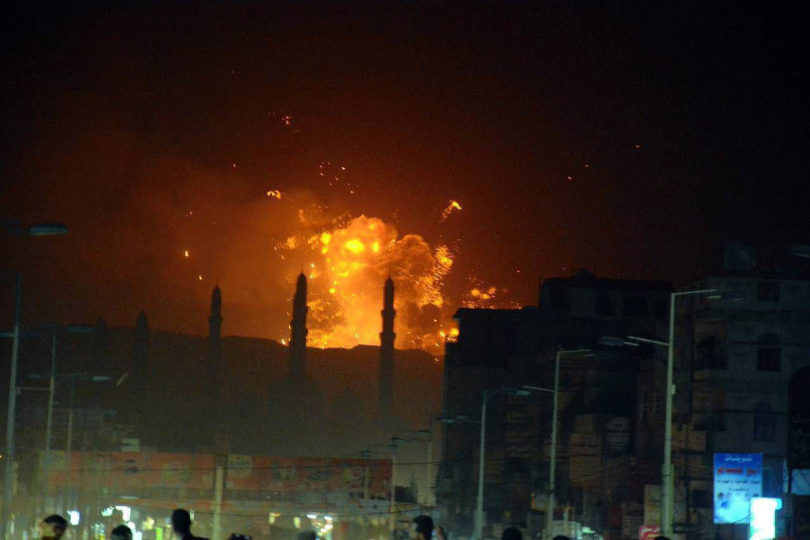
This is major escalation of the war in the Middle East which began this time by U.S.-backed Israeli forces carrying out widespread killings of Palestinian civilians in Gaza.
Independent news sources from multiple organizations confirmed the United States and the United Kingdom have begun as massive attack on the Houthi nation, after securing yesterday what they choose to imagine was approval from the United Nations Security Council to do so.
The Australian government’s Defense Minister, Richard Marles, issued a statement that it had provided support for the attacks as well.
“Australia’s support of these actions came in the form of personnel in the operational headquarters,” he said. “Australia will continue to support any actions which assert the global rules-based order.”
The White House also confirmed that Bahrain, Canada, Denmark, Germany, the Netherlands, New Zealand, and the Republic of Korea (South Korea) also supported the attacks in unspecified ways.
The excuse for the destructive blitz is the Houthis over two months’ worth of warnings against, occasional seizures of, and sometimes minor missile and drone attacks on cargo ships making their way through the Red Sea that were connected to Israel.
Nearly all of the ships targeted by the Houthis were either carrying cargo for Israel or were owned by Israelis. Despite efforts by the west to exaggerate the impact, the number of ships transiting the Red Sea did not decrease significantly. There was little impact on the flow of goods. Some shipping companies, intent on supporting the genocide, diverted some of their ships around Africa instead of through the Red Sea.
The Houthis had hoped the attacks would slow the supply of material to Israel and the ongoing genocide that has killed close to 25,000 innocent civilians, with about half being children.
The Houthis also hoped the decrease in maritime traffic there would cause countries like the U.S. and United Kingdom to push Israel towards a permanent and sustainable ceasefire in Gaza. It did not accomplish that goal.
Instead, it resulted in the U.S. to draft a UN Security Council resolution yesterday which the U.S. chose to believe provides them with carte blanche to wage war on Yemen and those who might support them.
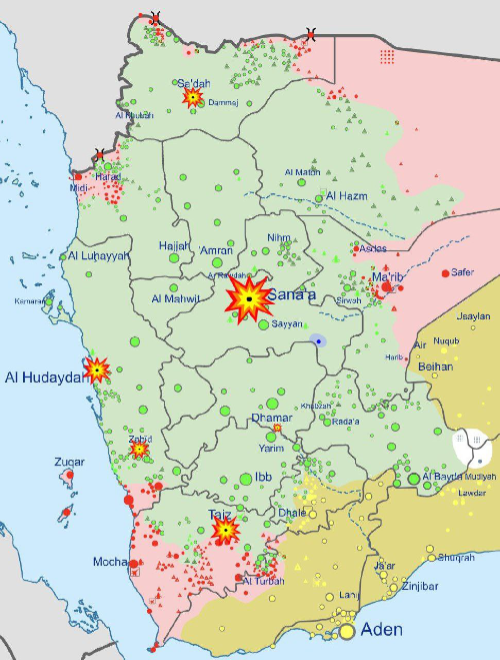
According to multiple independent sources and confirmed by Houthi officials, the American and British attacks were launched well before the sun came up on January 12. The two countries fired on the Hodeidah Airport, near the Houthi-controlled Yemeni coast; a naval base near Hodeidah; a reported military site near Taiz airport; a Houthi military facility located north of Sanaa, the Houthi capital city; parts of Saada, the birthplace of the Houthi movement, as well as the largest city and capital of the Houthi province of Saada; plus other Houthi military and civilian targets.
Some of the American military aircraft associated with the siege took off for this mission from U.S.-controlled airstrips in Cyprus. Some were carrying Tomahawk missiles, similar to the ones provided to the Israelis in the Gaza bloodbath.
UK military sources said they brought in four Royal Air Force Typhoon FGR4 fighter jets for the battles from some distance; they were supported by a Voyager refueling aircraft along the route. Those sources said the Typhoon fighters used Paveway IV guided bombs as part of the munitions used to hit two Houthi-controlled targets located in Bani and Abba, in Yemen.
The U.S. Department of Defense released information saying their attacks were targeting Houthi military logistics, aerial defense, and weapons storage sites.
Defense Secretary Lloyd Austin also released a statement on what happened, providing a bit more detail.
“Today’s strikes targeted sites associated with the Houthis’ unmanned aerial vehicle, ballistic and cruise missile, and coastal radar and air surveillance capabilities,” he said. “The United States maintains its right to self-defense and, if necessary, we will take follow-on actions to protect US forces.”
The Houthis have acknowledged the attacks but not confirmed how damage was incurred on their end or how many people were killed in the attacks.
In a prepared statement, dementia-ridden war criminal Joe Biden declared these attacks could be just the beginning for the Houthis, if they do not immediately back down from disrupting maritime shipping in the Red Sea.
“These targeted strikes are a clear message that the United States and our partners will not tolerate attacks on our personnel or allow hostile actors to imperil freedom of navigation in one of the world’s most critical commercial routes,” he managed to read. “I will not hesitate to direct further measures to protect our people and the free flow of international commerce as necessary.”
UK Prime Minister Rishi Sunak also chimed in, saying the assaults on Houthi territory were “limited, necessary and proportionate action in self-defense”.
The United Kingdom Ministry of Defense issued its own statement on the matter.
“Early indications are that the Houthis’ ability to threaten merchant shipping has taken a blow,” it said.
It continued by saying that “particular care was taken to minimize any risks to civilians” in planning the attacks.
In response to the attacks, senior Houthi official Mohammed al-Bukhait warned in social media posts that the United States and United Kingdom will soon “regret” what they have done, calling the attacks yesterday “the greatest folly in their history”.
He said what these attacks demonstrate is a “unique war” where it is easy to differentiate those on the “right” side of the conflict from “those who are wrong”.
“The goal of one of its parties is to stop the crimes of genocide in Gaza, represented by Yemen, while the goal of the other party is to support and protect its perpetrators, represented by America and Britain,” al-Bukhaiti explained in his posts.
“Every individual in this world is faced with two choices that have no third: Either to stand with the victims of genocide or to stand with its perpetrators,” he said.