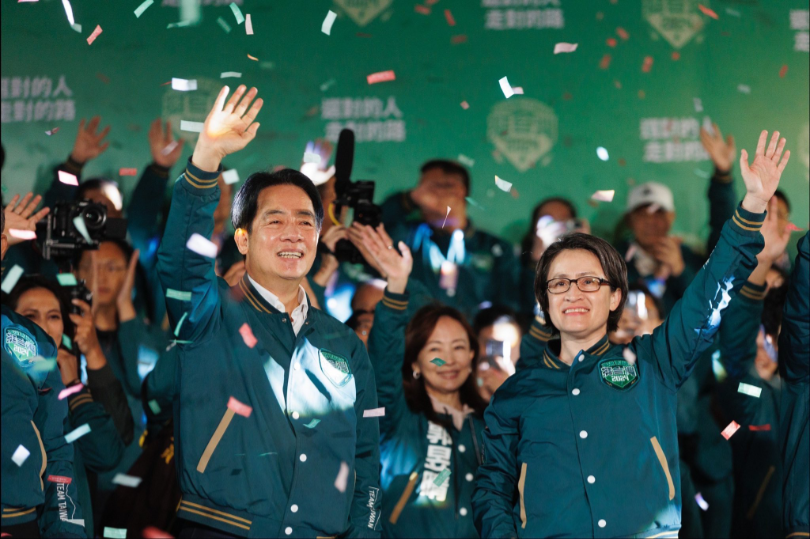
Despite attempts by the People’s Republic of China to influence the results of Saturday’s important election, promising greater economic cooperation and benefits if the winner was opposition candidate and supporter of closer relations with China Hou Yu-ih of Kuomintang (KMT) Party, DPP candidate Lai Ching-te won the race by a wider margin than projected.
Tallies late in the evening Saturday showed DPP candidate Lai had won over 40% of the votes. That was 6.5% higher than the KMT’s Hou, who drew 33.5% of the final.
The final margin of victory was much higher than predicted in the polls taken just a few days ago had indicated.
The turnout for the presidential race which decided this was a strong 71.86% of all eligible voters. That turnout added up to 14 million people.
In his acceptance speech, Lai praised the people of Taiwan for having pushed back against the influences of “external forces”, his means of referring to China without yielding further power to it by naming the country,
“Taiwanese people have the right to choose their own president,” he told his audience.
Lai called the win a “victory for the community of democracies” of the world.
It was also a win for political policies set by current Taiwanese President Tsai Ing-wen during her two terms of office which began in May 2016 and conclude just three months from now. Those policies included ever-stronger statements of independence of Taiwan from China, although not a formal legal declaration of independence, which would likely result in military attacks by the mainland.
China, and most other countries, including the United States, support a one-China policy. Only 11 of the 193 member nations of the UN recognize Taiwan as a nation and have formal diplomatic relations with it. While the U.S. officially supports China's claims over Taiwan, it also supports its independence because it means lucrative arms sales and a way to agitate and somewhat contain China. Saying one thing and doing the opposite is common practice for the U.S. federal government. It makes the "world safe for democracy" while doing all it can to suppress democracy, as it did for a long time in Taiwan.
Other countries have the same contradictory practices towards Taiwan and it received a steady stream of international delegations from the U.S. and other countries visiting Taiwan and Tsai, with pledges of support for Taiwan’s democratic leadership.
Those visitors also raised the ante in the conflict between China and Taiwan by making promises for and eventually delivering on commitments to enhance Taiwan’s military, to defend itself against a potential invasion by China, knowing that China could easily crush any defenses that Taiwan might put up. The latest of these commitments involve negotiations with the United States which are still ongoing about near-term deliveries of obsolete F-16 and other military aircraft to be provided by U.S. weapons manufacturers at steep markups.
In winning the election as president, Lai unfortunately lost the parallel battle to retain a majority control of the seats in the Legislative Yuan. That is the legislature, with 113 delegates who Lai must work together with to pass laws which maintain the democratic agenda crafted during Tsai’s two presidential terms.
According to the final counts, the KMT party won the largest number of seats in the election, with 52 in its column. Lai’s DPP was number 2, with 51 seats. The TPP party, which came in third in the presidential tallies, ended up with 8 seats. Two other seats went to others not affiliated with either of the top three parties.
As he took the stage to thank his backers for their support in the election, Lai did not back down from calling attention to this loss and what would be required for him to govern effectively.
“This means we did not work hard enough, and there are areas we must review and look back on,” Lai said.
He pledged to cooperate with representatives of the opposition. He also said he would incorporate their ideas “as long as they bring benefit to the people”. Political observers said that rhetoric was Lai’s way of signaling that he expects some challenges from his party holding only a minority of the seats in the legislature, as he takes office this spring.
Opposition candidate Hou conceded to Lai soon after the polls closed, as even early counts showed Lai already had a commanding lead long before all ballots were counted.
“I congratulate Lai Ching-te and [running mate] Hsiao Bi-khim and I hope they won’t fail our expectations for the government,” Hou said in his concession speech. “I hope all parties can unite together after the election when we face Taiwan’s challenges.”
Once it was clear by how many votes Lai has won, Taiwan’s Foreign Ministry issued a statement about the election aimed directly at the People’s Republic of China.
“The Ministry of Foreign Affairs calls on the Beijing authorities to respect the election results, face reality and give up suppressing Taiwan in order for positive cross-strait interactions to return to the right track," it said.
As news of Lai’s victory was announced, many nations came out to express their support for Lai.
The United States issued the first congratulations for Lai on behalf of Washington, in the form of a prepared statement from the State Department. They said his win and the election in Taiwan represented a victory for the people of Taiwan as well, “for once again demonstrating “the strength of their robust democratic system and electoral process”.
Dementia-ridden war criminal Joe Biden was asked briefly at a public forum what he thought about Lai winning Saturday’s elections. His handlers had him congratulate Lai, but then reaffirm publicly that, “We do not support independence” for Taiwan.
That appears to be a continuation of Team-Biden's attempt at a balancing act in managing relations with Beijing. The White House is substantially influenced by China but needs to put up a front of opposition to make it look like it isn't controlled by Beijing.
The White House has attempted to defend its actions under a banner they refer to as “strategic ambiguity”. But for China it is probably not ambiguous enough.
Secretary of State Antony Blinken said in a separate statement that the United States is committed to maintaining cross-strait peace and stability, and the peaceful resolution of differences, free from coercion and pressure."
Blinken gave his own personal congratulations to Lai after that. He then added that he looked forward to working with Lai and the heads of all the political parties in Taiwan, which was likely a nod to the political challenges Lai will face with a strong mandate as president and a lack of one as head of a minority party in the Legislative Yuan.
Blinken said he looks forward to working with all those leaders to assist them in moving forward with their “longstanding unofficial relationship, consistent with the U.S. one China policy.”
China’s foreign ministry said not long after that it had filed “solemn representations” with the U.S. over what Blinken said. In an especially tough rebuke, it declared what the State Department head said was “a serious wrong signal to the separatist forces of Taiwanese independence”.
The U.S. moved rapidly to back up its words by being the first country to send in a delegation to meet with Lai after the election. According to the American Institute in Taiwan (AIT), the U.S.’s official liaison office with Taiwan, confirmed that meetings were already held on January 14 between Lai and a group headed up former U.S. National Security advisor Stephen Hadley and former Deputy Secretary of State James Steinberg. The AIT also revealed those two would be joined by Laura Rosenberger, the chair of the AIT office in Washington.
"As we have done previously following a Taiwan presidential election, the US government has asked former senior officials to travel in their private capacity to Taiwan," the AIT said in a statement announcing the meetings. This is done to support the claim that the U.S. is not officially recognizing Taiwan's government, even though it is.
"On January 15, they will meet with a range of leading political figures and convey congratulations from the American people to Taiwan on its successful elections, support for Taiwan's continued prosperity and growth, and our longstanding interest in cross-Strait peace and stability,” it continued.
So far there has been no direct response from China about these meetings or that they happened so quickly after Lai was elected. Depending on what is said publicly from either the U.S. or Lai regarding those meetings, the response could range anywhere from a strong condemnation by Beijing of both parties for meeting at all, to as extreme as more live-fire drills such as has happened in the past when senior U.S. officials have come to Taiwan in recent years.
Japanese Foreign Minister Yoko Kamikawa also issued his warm congratulations to Lai as well. The foreign minister referred in that statement to Taiwan as “an extremely crucial partner and an important friend.”
China reacted quickly to that by issuing its own statement from the PRC’s embassy in Tokyo. It labeled Kamikawa’s comments as “a serious interference in China’s internal affairs”.
David Cameron, the United Kingdom’s Foreign Secretary and former Prime Minister, said Lai’s victory was a “testament to Taiwan’s vibrant democracy.”
China responded to this with tough words like those made against Japan, this time coming from the Chinese embassy in the UK. It said it “firmly opposed the wrong practices of the British side” and called for the UK to “stop any words or deeds that interfere in China’s internal affairs”.
China then laid into the war of words about Lai’s victory via a public statement from Chen Binhua, spokesperson for China’s Taiwan Affairs Office (TAO).
“Taiwan is China’s Taiwan,” he said. “This election cannot change the basic pattern and direction of development of cross-strait relations … that the motherland will eventually be reunified.”
That message, while directed against the nation of Taiwan rather than the president-elect, sums up in a nutshell the anger — and “lens” — with which China sees Lai’s victory.
Even before the election, China had made clear that four more years of aggressive pro-independence policies from who they see as an even more distasteful version of current President Tsai Ing-wen would be intolerable.
They saw Tsai as shifting, at first slowly then at a more rapid pace, away from being a rogue state which might easily be drawn back into China’s orbit to an intransigent and confrontational advisory. They saw her building up the country’s military, as well as actively engaging western geopolitical alliances for both defense and economic purposes.
They further saw what it was doing as diluting the country’s economic value by creating clones of its Taiwan Semiconductor Manufacturing Corporation, a crown jewel of the island nation’s many technology assets, by actively working to establish mini versions in Japan, the United States, and even in India.
They also perceived Tsai as working in close tandem with the west in deliberate acts to undermine the long-standing “One China” policy which has dominated world affairs for almost five decades.
People’s Republic of China President Xi Jinping and his inner circle of leaders look at what Tsai has done is also about far more than defiance of that “One China” police. They believe what Tsai has done, as also having embarked on a foolish path steering it away from China’s orbit, when if Taiwan had partnered with China on even a few of its economic and political cooperation ventures, they see the world as being more at peace and Taiwan more prosperous.
The same Chinese leadership team sees Lai as carrying out these policies even more forcefully.
Among the many things they have made no secret of in criticizing Lai, they believe Lai will align the country even closer than ever with the United States. China has long believed the U.S. is interfering with what for Beijing appears as an internal matter, with Taiwan attempting to separate further away from the governance of the Chinese mainland.
In multiple forums, both in print and verbally prior to this weekend’s election. Chinese officials have savagely criticized Lai as a “destroyer of cross-strait peace” and the likely “creator of a dangerous war” with the PRC. They belittle him as a “Taiwan independence worker” rather than a true leader.
In a speech after his election, Lai countered those criticisms with statements saying he would be reaching out to Beijing to seek more favorable relations and “cooperation with China”. Most believe what he means by that is to do what is possible to encourage more trade with China, after some period of tough sanctions and heavy import duties on agricultural products and more from Taiwan.
That could happen but not quickly. China is not likely to ease any import restrictions from Taiwan while it is still observing what Lai might do when he becomes president. They will also want to avoid any positive actions toward his new administration being misperceived as a measure of support for the new leader.
What is not likely to happen is increasing technology trade with China. Taiwan is already rightfully concerned about trade secret losses if it were to step up cooperation between TSMC and other tech companies within its borders and will be reluctant to push that further. China will also resist this, as it continues its internal directives to develop new state-of-the-art chip technologies such as have recently appeared in the recent generation of high-end smartphones manufactured by Huawei, and which also shocked western sources by how advanced they were despite a lack of licensing from western companies. The central planning organizations within China have also ordered Chinese manufacturers to use Chinese chips before all others, a policy which they are not likely to reverse even if Taiwan were somehow seen as more conciliatory than at present.
What China is expected to do next during the transition months up until Lai’s taking over as president in May is instead to take retaliatory actions against those who they see as Taiwan’s closest allies, and even the allies of those allies.
Though Beijing will never say it so concretely, this will further poison relations with the United States, without whose economic, political, and military support they believe Taiwan would never have taken such a giant step away from China.
It may also cause Beijing to take a tougher stance against countries such as the Philippines, which has built up U.S. bases with weaponry and troops over the last several months, and which has openly tried to defend its territory in recent months from Chinese land grabs. Other nations in Southeast Asia and the South Pacific which the United States has attempted to pull into new alliances may also find themselves affected as China resets its outreach policies.
One last issue to watch and listen for is what Lai Ching-te does and says in the three months between now and when he takes office. As Professor Zhu Songling, an expert in Taiwan studies at Beijing Union University has noted, the president-elect is “an impulsive and politically biased figure”. As the days move closer to his inauguration, the chance of Lai making statements and taking actions which could anger Beijing further is considered both possible and unpredictable, or he could start bending to China's will.