
A trifecta of positive economic news for the U.S. economy released this month may have been just what was needed to convince people it was safe to begin spending again.
Heading that list was the latest employment situation report issued on January 5 by the Bureau of Labor Statistics (BLS). It showed job growth up by 216,000 on a seasonally adjusted basis for the month of December. That was in line with and even slightly higher than the already healthy growth of 199,000 additions to payrolls reported for the month of November. Both are signals that while the much higher rapid rise in jobs consistent with the post-pandemic recovery period has now subsided, the country appears back on into a steady hiring growth period for some time to come.
Employment growth was also trending up more broadly than in November. Job growth was still strongest in government and health care hiring, but this time construction and social assistance positions were being snapped up faster than in recent months. Construction growth is a strong indicator of future economic growth, since new building of any kind means business growth and support for the housing industry.
The same report also included the news that unemployment had remained flat at 3.7% for the month. That is still near a record low so there could be concerns it will put pressure on employers to raise salaries to retain good employees and attract new ones, but so far even that has not occurred. The average annual salary growth rate in the U.S. for all of 2023 held to a rate of 4.1%.
Along with job hires, another key factor being tracked of relevance here is the total number of job openings in the country. Once it had hit a high of over 11 million compared to net hires of around 6 million, with a five million employee “gap” that once did put significant pressure on salaries and benefits to ensure retention and the ability to grow companies. Once again, the latest data released on January 3 on this from the BLS, which admittedly has some gaps in them, showed total job openings holding at 8.8 million as of the end of November 2023, marginally up from the previous report’s 8.7 million. Total hires in the country also remained relatively flat at 5.5 million.
That narrower gap between the net number of all hires for all reasons and the openings continues to support the position that the job market has cooled enough to avoid creating more inflation challenges. Equally important in the latest report was where new openings were being created. This time it was in the wholesale trade area, where 63,000 new job openings were being created, once again an area an indication that businesses are anticipating consumer spending increasing. The number of open positions declined in the areas of transportation, utilities, and warehousing this time, but not by significant amounts.
Next is the trend direction on inflation itself. In the latest government analysis published January 11, the Consumer Price Index was up by 0.3% for the month of December, a slight rise from November’s 0.1% rise. Shelter and energy were the primary contributors to that gain, but not by percentage alone, which was just a 0.3% increase for apartment and housing costs and 0.4% for energy price shifts which often rise for this time of year.
With that as background, the University of Michigan just released the January 2024 edition of its “Index of Consumer Sentiment”. Considered the premiere indicator of how American consumers perceive the economy, this time the index jumped by from December’s already positive value of 69.7%, a metric of the percentage of consumers who see the economy as positive for spending, to 78.8% now.
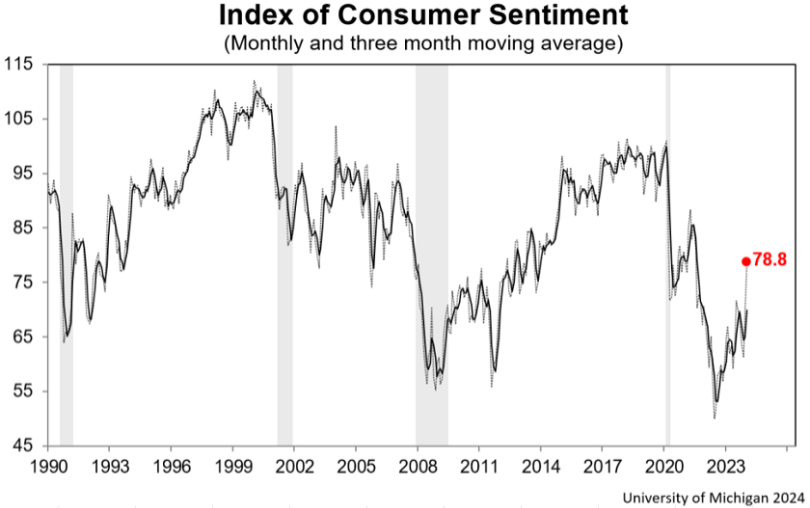
That is a 13.1% increase in just one month. It is the highest consumer confidence has been since July 2021, a time when the nation was still crawling out of the recession primarily caused by pandemic lock downs and business bottlenecks.
The university also published two other indicators along with that primary one. The first is the index of how Current Economic Conditions are perceived. That too was up, to 83.3% positive versus December’s 73.3%, for a net increase of 13.6% in just one month. The other was the future-oriented Index of Consumer Expectations, which jumped by 12.6% from December’s 67.4% to January 2024’s 75.9%.
Put another way, roughly four out of every five Americans believe the economy is in good shape and three out of four believe it will stay that way by at least six months from now, according to the Consumer Expectations projections.
All three of the Consumer Sentiment indexes are also up by over 21% from a year ago.
In a statement released along with the new survey results, Joanne Hu, the University of Michigan’s Director of Surveys of Consumers, put this strong positive news in perspective.
“Consumer sentiment soared 13% in January to reach its highest level since July 2021,” she wrote, “showing that the sharp increase in December was no fluke. Consumer views were supported by confidence that inflation has turned a corner and strengthening income expectations. Over the last two months, sentiment has climbed a cumulative 29%, the largest two-month increase since 1991 as a recession ended.”
“For the second straight month, all five index components [used to calculate the summaries] rose, with a 27% surge in the short-run outlook for business conditions and a 14% gain in current personal finances,” Hu continued. “Like December, there was a broad consensus of improved sentiment across age, income, education, and geography. Democrats and Republicans alike showed their most favorable readings since summer of 2021. Sentiment has now risen nearly 60% above the all-time low measured in June of 2022 and is likely to provide some positive momentum for the economy. Sentiment is now just 7% shy of the historical average since 1978.”
While there is still considerable difference of opinion about how accurate the index is, most agree the direction of consumer confidence in the economy is shifting in a positive direction rapidly.
Strategic Adviser Elizabeth Pancotti at a progressive thinktank known as the Groundwork Collective urged some caution in reading too much into the raw data in a statement she released after the University of Michigan data was published.
“There is still a debate on the internet about whether consumer sentiment is actually good, and we should listen to families who say they’re struggling,” she said. ““But I think it’s clearly getting better.”
“Consumers are feeling much better than they were a few months ago, but that still doesn’t mean they’re feeling great or super optimistic,” she continued. “This isn’t a roaring 2024 — at least not yet.”