Researchers Demonstrate Possible Existence of Navigable Wormholes in the Universe
Lead StoryScience & Tech
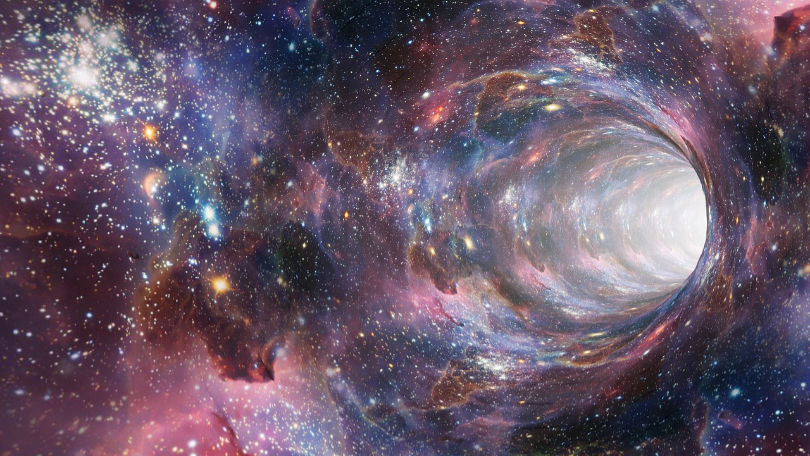
The starting point for the analysis was the assumption that the universe is far from empty but instead filled with particles of “dust” as a minimum, and of course stars, galaxies, nebulae, planetary objects, comets, and more throughout its expanding continuum.
The astrophysicists then modeled that universe of energy and matter using what they refer to as “the well-known Lemaître–Tolman–Bondi solution to the Einstein equations and its generalization with a nonzero cosmological constant and an electromagnetic field”. Those equations, a more modern version of the Friedmann equations from a century past, provided a framework to determine if there might be physical conditions described by these equations which could allow the presence of transient but stable wormholes connecting one region of space-time to a far more distant region.
Dr. Kirill A. Bronnikov, the lead author of the paper describing this work and with affiliations at the Center for Gravitation and Fundamental Metrology at Moscow’s VNIIMS, the Institute of Gravitation and Cosmology at the Peoples’ Friendship University of Russia (RUDN University), and the Elementary Particle Physics Department of Russia’s National Research Nuclear University “MEPhI”, described the nature of the research and goals for what his team was aiming for in a recent discussion about the work.
“A wormhole is a type of highly curved geometry,” he said. “It resembles a tunnel either between distant regions of the same universe or between different universes.”
“Such structures were first discussed in the framework of solutions to the gravitational field equations a hundred years ago,” he continued. “But the wormholes considered then turned out to be non-traversable even for photons — they could not move from one “end of the tunnel” to the other, not to mention going back. Others are now being considered— traversable wormholes in various theories of gravity and the presence of various types of matter. We investigated possible traversable wormholes in the general theory of relativity, which are supported by dust like matter.”
What the researchers discovered was that when they applied their models to systems where there were extant electromagnetic fields, that there could be semi-stable spherically-symmetric distributions of the cosmic “dust” present. They further discovered that the presence of specific electrical charges on the two “poles” of the wormholes could support the transit of light energy in the form of photons, and potentially matter as well.
“A charge on one “pole” inevitably leads to an opposite charge on the other,” explained Dr. Bronnikov. “At this other pole there might be a similar wormhole mouth, and beyond that another universe, and so on. The whole picture will resemble churchkhela, a wonderful Georgian dessert. Some of the wormholes can connect different parts of the same Universe.”
A further analysis showed that a single “mother” universe, as they referred to it, should routinely connect to several “entrances” to alternate wormholes connecting it to the same “daughter” universe.
Next for the researchers is to determine if there is a way to prove this is far more than just a theory.
“Possible observational signs of such objects, in particular, the properties of the cosmic microwave background and magnetic fields, may be the subject of further research,” he said. “It is especially interesting to compare the characteristics of our wormhole models with the observed parameters of cosmic voids and other inhomogeneities in our Universe.”
Could this be the basis for future deep-space travel for mankind someday? Perhaps. In the short term, once wormholes such as the RUDN team described have been uncovered, possibly using tools such as the James Webb telescope, those wormholes could provide a means for electromagnetic imaging of — and communications to — galaxies which would have remained unseen for well beyond the end of existence of the planet Earth.
There is also evidence for wormholes or dimensional portals on Earth at places like the mysterious Skinwalker Ranch in Utah, which was the subject of a $22 million classified research project for the U.S. Defense Intelligence Agency and is now explored in the popular TV series "Secrets of Skinwalker Ranch". At the ranch and across Eastern Utah, objects and creatures have been seen entering and exiting something like doorways between worlds.