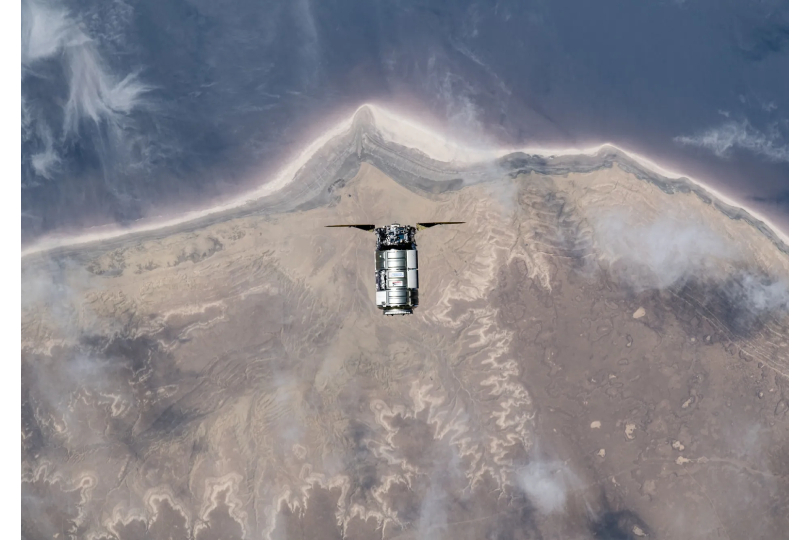
Live launch coverage will begin at 12:15 p.m. and air on NASA+, NASA Television, the NASA app, YouTube, and on the agency’s website, with prelaunch events starting Friday, Jan. 26.
Filled with more than 8,200 pounds of supplies, the Cygnus cargo spacecraft, carried on the SpaceX Falcon 9 rocket, will launch from Space Launch Complex 40 at Cape Canaveral Space Force Station in Florida. It will arrive at the space station Wednesday, Jan. 31.
NASA coverage of rendezvous and capture will begin at 2 a.m., followed by installation coverage at 5 a.m. NASA astronaut Jasmin Moghbeli will capture Cygnus using the station’s robotic arm, and NASA astronaut Loral O’Hara will act as backup. After capture, the spacecraft will be installed on the Unity module’s Earth-facing port.
Highlights of space station research facilitated by delivery aboard this Cygnus are:
- the first surgical robot on the space station
- an orbit re-entry platform that collects thermal protection systems data
- a 3D cartilage cell culture that maintains healthy cartilage in a lower gravity
- the MSTIC facility, an autonomous semiconductor manufacturing platform
- and a metal 3D printer that will test the capability for printing small metal parts
Media interested in speaking to a subject matter expert about science aboard, should contact Sandra Jones at sandra.p.jones@nasa.gov.
The Cygnus spacecraft is scheduled to remain at the space station until May when it will depart the orbiting laboratory at which point it will harmlessly burn up in the Earth’s atmosphere. This spacecraft is named the S.S. Patricia “Patty” Hilliard Robertson after the former NASA astronaut.
NASA coverage of the mission is as follows (all times Eastern and subject to change based on real-time operations):
Friday, Jan. 26:
1 p.m. – The International Space Station National Lab will host a science webinar with the following participants:
- Lisa Carnell, director, NASA’s Biological and Physical Sciences Division
- Meg Everett, deputy scientist, NASA’s International Space Station Program
- Shane Farritor, co-founder and chief scientific officer, Virtual Incision Corporation
- Mark Fernandez, principal investigator of Spaceborne Computer-2, Hewlett Packard Enterprise
- Mary Murphy, director of programs, Nanoracks
- Michael Roberts, chief scientific officer, International Space Station National Lab
- Nicole Wagner, chief executive officer, LambdaVision
- Abba Zubair, medical director, Mayo Clinic
Media must register for the science webinar by 12 p.m., Jan. 26,