
That number was over twice the 1.5% average expected Gross Domestic Product growth predicted by U.S. economic experts, and over one-and-a-half times what Wall Street had been estimating just before the news broke. Whether or not the data is accurate remains to be seen. Team-Biden has been caught lying about economic data before.
While the government reminded everyone that this is still just an advance estimate, and with a final one to be released on February 28, this is still considered very close to a final target.
It is also solid good news both for the economy and the occupants of the White House, as its re-election campaign kicks into higher gear.
The seasonally adjusted estimate for the October–December quarter did slow somewhat compared to the July-September period. The growth rate for the summer quarter was 4.9%.
Factoring in the latest data, the U.S. GDP growth rate for all of 2023 was 2.5%, a solid and still-strong performance in a year when many had previously predicted there would be signs of a recession by year-end. The corresponding growth rate in real GDP for 2022 was just 1.9%.
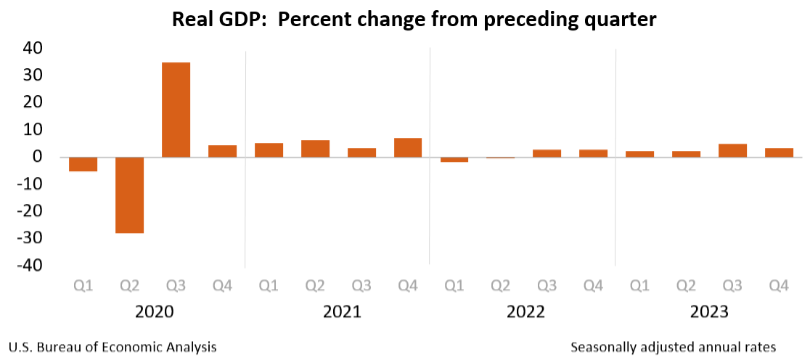
The economic boom last quarter was driven this time by a combination of consumer spending, state and local government purchases, federal spending increases, nonresidential as well as residential fixed investment growth, and exports. Imports, which subtract from the GDP, were up but had little impact on the final numbers.
Consumers spent more both than expected on goods and services alike last quarter. In the services category, food services, accommodations, and health care drove the increases in this category. In the goods sector, nondurable goods such as pharmaceuticals, recreational goods, software, and vehicle purchases all rose.
That consumer spending was buoyed by a 4.2% increase in disposable personal income in the U.S. in the fourth quarter, for a total of $211.7 billion. Consumer confidence was also up for the quarter to record levels, as reported in a University of Michigan survey released this month which showed that 83% of Americans believe the economy is in good condition and 75.9% think it will remain strong for at least another six months.
In the state and local government spending area, increases were both in employee compensation and in buildings, both in new structures and in improvements to existing ones. In the federal government category, non-war spending – particularly related to continuing infrastructure improvements – led the way.
In the export category, increased oil and gas production in the United States greenlit by the Biden administration resulted in larger shipments of petroleum products to other countries, continuing a trend throughout 2023 and extending into 2022. American-based financial services enterprises also continued a long-term trend of increased revenue generation from outside the country.
In the imports area, a substantial portion of the increase was from services, and in turn with travel-related expenses continuing a record of growth extending back into late 2022.
Current-dollar GDP grew in the fourth quarter by an annualized rate of 4.8% overall. That compares to a stronger Q3, where the economy expanded at an 8.3% yearly rate. For the year, current-dollar GDP rose by 6.3%, or $1.61 trillion, for a total of $27.36 trillion.
Further supporting the economic growth was a continuing low inflation rate. As reported by the Department of Commerce in this month’s summary, the price index for gross domestic purchases went up by only 1.9% in the fourth quarter, a substantial decline from Q3’s 2.9% rate. For the year, the comparison was even more dramatic. That price index rose in 2023 by a net of 3.4%, exactly half the 6.8% rate for all of 2022.
The federal government’s measure of the “core” inflation rate, which excludes food and energy prices, was up by a more sizable 4.1% in 2023. That value was pushed up for much of it by higher “shelter” costs including housing expenses and apartment rents, which in turn rose substantially because of continuing Federal Reserve Board lending rate increases last year. By comparison, the core inflation rate for all of 2022 was up 5.2%.
Despite the overall good news for the economy last quarter, some economic storm clouds still loom which could create some challenges in the months ahead.
For example, a report released yesterday by the Department of Labor showed initial jobless claims rose by 25,000 last week to 217,000. That is up from the 199,000 the government had expected based on other projections. Open jobless claims increased by 27,000 for a new high of 1.833 million.
Another concern is that a significant part of the increased consumer spending reported for the fourth quarter was based on credit. Credit cards were part of that, and with interest rates still relatively high through the combination of Fed actions and banks pushing to charge the maximum they can get away with, that will eventually put a heavy burden on individuals and the economy, almost regardless of what happens with business. The holiday season also brought in substantial increased purchases of the “buy now, pay later” type. While those helped push the GDP higher for the quarter, it will also cause consumers to retrench somewhat this quarter, as they begin to begin the ”pay later” part of that deal.
Even if the Federal Reserve Board were to begin to cut bank lending rates sometime in the first half of 2024, as they had suggested they might, it would take months before that would reflect in lower interest rates on regular consumer credit. So for now, despite the positive short term news of relatively strong GDP growth in last year’s fourth quarter, expect consumers to spend less and driving the economy less strongly starting in the current fiscal quarter and beyond. This will probably be the situation despite that those same consumers may feel more optimistic about their jobs and overall business growth as 2024 lurches forward.