ICJ Rules Israel May Have Committed Genocide, But Stops Short of Directing A Ceasefire
Lead StoryConflict
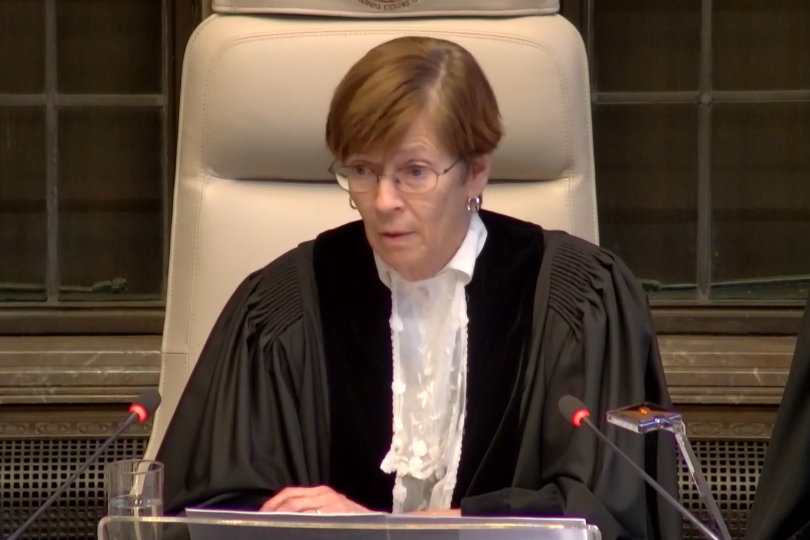
In a detailed ruling delivered live beginning at 1 PM Netherlands time, President of the International Court of Justice Judge Joan E. Donoghue issued what was described as an interim ruling in the matter of whether Israel was guilty of the crimes of genocide against the Palestinian people.
After explaining why it felt the case brought by South Africa against Israel met the necessary standards for standing, jurisdiction, the important consideration of whether the Palestinian people in Gaza constitute an ethnic population for which the charges of genocide could apply, and acknowledgement of prima facie evidence of possible genocide, the court first said that it was asking both sides in this legal case to submit further factual data backing up their assertions in the case.
Then Judge Donaghue ordered a group of mandatory “provisional measures” to be taken immediately:
1. The state of Israel shall, in accordance with its obligations under the Convention for the Prevention and Punishment of the Crime of Genocide, in relation to the Palestinians in Gaza, take all measures within its power to prevent the commission of all acts under the scope of Article II of the convention, in particular (a) Killing members of the group; (b) Causing serious bodily or mental harm to members of the group; (c) Deliberately inflicting on the group conditions of life calculated to bring about its physical destruction in whole or in part; (d) Imposing measures intended to prevent births within the group.
2. The state of Israel shall ensure, with immediate effect, that its military does not commit any acts described in point 1, above.
3. The state of Israel shall take all measures within its power to prevent and punish the direct and public incitement to commit genocide in relation to members of the Palestinian group in the Gaza Strip.
4. The state of Israel shall take immediate and effective measures to ensure the provision of urgently needed basic services and humanitarian assistance, to address the adverse conditions of life faced by Palestinians in the Gaza Strip.
5. The state of Israel shall take effective measures to prevent the destruction and ensure the preservation of evidence related to allegations of acts within the scope of Article II and Article III of the Convention for the Prevention and Punishment of the Crime of Genocide, against members of the Palestinian group in the Gaza Strip.
6. The state of Israel shall submit a report to the Court on all measures taken with effect to this order within one month as from the date of the order.
There was no order to demand Israel immediately cease all hostilities in Gaza, nor was there any condemnation of Israel’s actions to date in Gaza.
What was issued instead was an order for Israel which appears to amount to four directives:
- Don't do anything which might be considered genocide.
- Stop blocking humanitarian aid from entering Gaza and begin helping Palestinians there.
- Do not destroy any evidence of war crimes.
- Submit a report on all actions you took in accordance with these orders by February 26, 2024.
South Africa filed the original case against Israel on December 29, 2023, with the International Court of Justice (ICJ), the most senior legal body operating within the United Nations. It is headquartered in The Hague, in the Netherlands.
It claimed Israel had violated multiple provisions of the United Nations’ Convention for the Prevention and Punishment of the Crime of Genocide. That set of regulations, adopted on December 9, 1948, was intended to set in stone a set of regulations which would prevent forever anything happening again like the mass genocide of the Jewish people which Nazi Germany had carried out before and during World War II.
The Convention was approved by the member states of the United Nations of the time. Both Israel, the country which has been charged with that mass genocide, and the United States, its principal complicit co-conspirator in the current mass slaughter of the Palestinian people, are signatories and both are in gross violation of the Convention.
The International Court of Justice almost immediately agreed to hear the case.
At issue was whether it could be proved that Israel had, according to Article I of the 1948 Convention, committed any of a series of acts exactly as written in point 1 of today’s orders, with “the intent to destroy, in whole or in part, a national, ethnical, racial or religious group”.
Article II of the Convention states that the “following acts shall be punishable: (a) Genocide; (b) Conspiracy to commit genocide; (c) Direct and public incitement to commit genocide; (d) Attempt to commit genocide; and (e) Complicity in genocide.”
On January 11, 2024, lawyers representing South Africa and others supporting the Israeli side of the proceedings met at the Hague before the judges of the International Court of Justice. It was a two-day hearing, with each side allocated the same amount of time to argue their position.
On the first of those two days, South Africa’s lawyers presented an incontrovertible case laying out how the government of Israel was guilty of having committed all the acts listed in Article I, with hard evidence backing each claim. It further delineated how Israel’s leadership and its military had demonstrated their absolute intent to carry out that genocide, regardless of the human toll.
In the summary section of its filing with the ICJ, the South African brief laid bare how important it was to conclude Israel was guilty of the genocidal acts against the Palestinian people in Gaza and to understand how broad and how deep the intent has been to commit those crimes.
“If you fail to call this a genocide, it is on you,” the South African legal team wrote. “It is a sin and a darkness you willingly embrace.”
On the second day of the hearings before the ICJ, Israel was given its chance to explain itself.
It presented what most of the world has already heard, that Israel was simply exercising its legal right to defend itself after the October 7 raid by Hamas, which Israel says was responsible for the killing of approximately 1,139 Israelis, the current official death count there, as its primary defense.
In doing so, Israel did not address many things. Most significant was that as the occupier and oppressor of the Palestinian people in Gaza that it claimed it was slaughtering in self-defense, it has no legal right to self-defense until other articles of the United Nations’ charter. Almost as important was that evidence has emerged since the October 7 attack that a sizable fraction of those who died on October 7 during the Hamas attack were actually killed by the Israel Defense Forces (IDF) itself, not Hamas.
Israel argued against South Africa’s claims that Israeli’s leadership – from Prime Minister Benjamin Netanyahu on down – had proceeded into the war in Gaza with intent to eliminate the Palestinian people, destroy their homes and entire way of life, or force them to evacuate their homeland forever. The country’s lawyers claimed it was a misunderstanding, and that, despite what South Africa’s lawyers had presented as well as what most of the world has already observed, Israel had taken “extraordinary efforts” to avoid civilian casualties in the region.
Israel’s lawyers at one point even went so far as to claim that, for example, “Hospitals have not been bombed”, despite that as of now there are no fully functioning hospitals remaining in Gaza because of that bombing.
Then there was what Tal Becker, a principal legal advisor to Israel’s foreign ministry, told the ICJ judges about the real truth of what was going on in Gaza, at least as he wished them to believe it to be.
It would be “impossible,” Becker said, “to understand the armed conflict in Gaza without appreciating the nature of the threat Israelis face”.
“If there were acts of genocide, they have been perpetrated against Israel,” he told the ICJ gathering.
With its ruling today, despite the Court doing its best to appear to be taking a strong stand against Israel’s horrific genocide in Gaza today, it proved unfortunately once again that it has neither the courage nor the power to direct even the most criminal of nation-states to halt their slaughter.
As of January 26, 2024, local time, Israeli forces have murdered at least 26,083 and injured another 64,487 Palestinians in Gaza since this phase of the war began on October 7, about half of those being children. This does not include the many thousands missing and likely buried under the rubble of the thousands of demolished buildings.
Palestinians have thanked the ICJ and Israel has chosen to ignore it and ramp up its genocide.