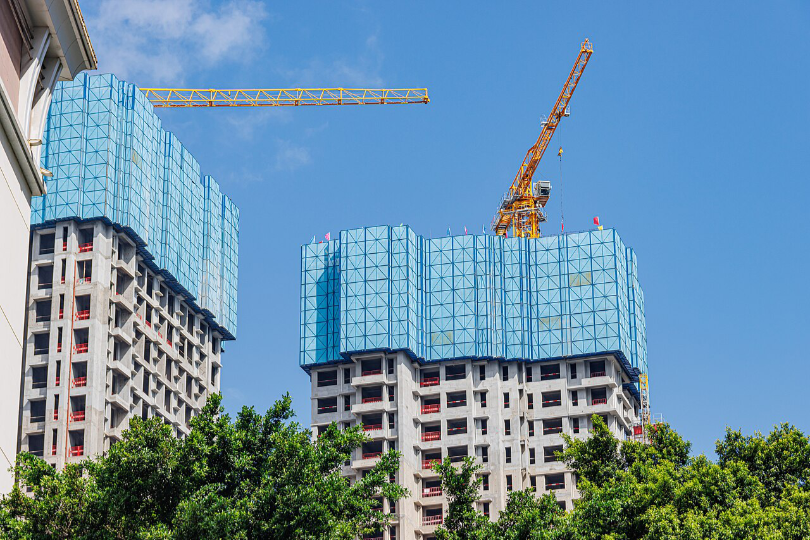
This forced liquidation is a sign that even the senile Chinese dictatorship may be forced to accept that its multi-trillion dollar capitalist ponzi scheme that resulted in thousands of empty ghost cities and an estimated 65 million unused housing units is a grand failure. This bankruptcy is likely just the first in a long line of bankruptcies that will severely damage China's economy.
Here is how the schemes worked:
Someone with ties to party bosses would obtain big loans in China and sometimes offshore investors to build empty shells of apartment buildings and houses as cheaply as possible and then sell the unfinished apartments to investors. Some of the money would be siphoned off and some used to build more structures that looked like apartment buildings. Thousands of fake cities were built, often without any of the essential water, sewer or electrical infrastructure. The cities were built primarily to feed the greed and naivete of investors, who had no intention of living in the apartments and had faith that some day they would be completed and they could sell them at a profit, or they could rent them or eventually live there when they retired.
The number of ghost cities eventually reached a point where it became more difficult for potential investors to convince themselves that buying a useless apartment in a fake city wasn't such a good idea after all and the government started to prosecute some of the local corrupt officials who participated in the scams. In 2020 the government imposed new restrictions on funding of new real estate projects.
Many of the masterminds behind the scams stole billions from their companies and fled the country.
Not all of the cities were scams but just failures due to poor planning and/or lack of support from government for the required infrastructure of roads and utilities.
Many economists predict this will be the end not just of Evergrande, at one time the premier high flying property developer responsible for some of the most prestigious construction projects in China, but also of Country Garden, another which followed the same game plan as Evergrande and has also found itself drowning in debt.
It also opens the door for China becoming more public about the need to diversify its economy at a time when both domestic demand and export sales are sagging.
The decision handed down yesterday by Judge Linda Chen, the presiding judge in the Hong Kong court which had coordinated proceedings in Evergrande’s attempts to keep its creditors at bay, came after just forty minutes of desperate last-minute proposals by attorneys representing the developer. Those proposals would have canceled some of Evergrande’s estimated over $333 billion of debt outright, restructured payment plans for other parts, and forced sales of certain assets at considerable discounts.
There was no plan for either China’s Central Bank or other parts of the government to bail out the company in any way. The courts were the company’s only hope.
Judge Chen first asked the attorneys to stop negotiating. Then she delivered her message.
“I think it would be a situation where the court would say enough is enough,” she said.
She then directed the company to prepare to sell off all its assets and work out a plan to support the many creditors as best they could.
There is no appeal possible in this decision.
A Short History of Evergrande’s Financial Woes
Evergrande had already been in trouble financially for years when in August 2021 the company, after not being able to meet payment obligations, suspended construction activities on several properties.
It blamed its defaults on short-term difficulties tied to the lockdowns and business cutbacks during the pandemic period.
Whether the Chinese government accepted that excuse is not known, but shortly after the construction halts began it issued a warning to the developer that it must reduce its debt burden, suggesting it already had data showing Evergrande was in far more serious trouble than just the economic downturn would indicate. Government economists were already monitoring a precipitous drop in commercial and residential property sales for all developers across the country.
Just one month later, in September 2021, Evergrande defaulted on two offshore bond coupon payments which added up to $131 million. Though there was a thirty-day grace period to pay them, the company was not able to do anything about them.
In November 2021, it was revealed that Hui Ka Yen sold off just under 10% of his previous 77% ownership of the company. The sale was worth HK$2.68 billion ($342.7 million), and was more than enough to create even bigger concerns among the company’s creditors.
The following March, 13.4 billion yuan ($1.9 billion in current U.S. dollars) of deposits in Evergrande’s property management divisions were seized by Chinese banks, over growing creditor concerns.
In November 2022, China Construction Bank seized a high-value home owned by the Chairman of the Board of Evergrande in Hong Kong’s The Peak complex. Mounting debts owed to the bank were the reason.
One year ago, with investigations by China’s Central Bank over the company’s financial stability ongoing, Evergrande’s then accounting firm and auditor, PricewaterhouseCoopers, cancelled its contract to support Evergrande further. It cited differences of opinion over audits going back to 2021 as the principal cause.
In March 2023, after an independent auditing committee found Evergrande’s directors were not managing financials effectively, the company finally announced plans for restructuring the offshore debt they had defaulted on two years earlier.
In April 2023 things seemed to be improving for the company’s financials, even as the real estate market remained very soft. Evergrande reported publicly that over three-quarters of the company’s senior (class A) debt holders and just under one-third of its subordinate debt (class C) owners had accepted Evergrande’s proposal.
By July it became clear that good news would not last long, as sales of its properties and rentals in ones it owned on its own continued to fall.
That was also the same month when it announced final audited earnings statements for 2021 and 2022. In 2020, the last year when the company was making money, it recorded net profits of 8.1 billion yuan, equivalent to $1.1 billion in current dollars. In 2021, the final audits showed the company had lost 476 billion yuan ($66.3 billion). In 2022 the situation was better but still disastrous; it lost 105.9 billion yuan ($14.8 billion).
With such sizable debt with the property market in China bad enough that selling off assets could not produce enough cash to cover it, in August 2023 Evergrande filed bankruptcy protection in the United States, under Chapter 15 of the U.S. bankruptcy code. That is a part of American bankruptcy law which can protect non-U.S. companies which are in financial trouble from having assets they hold in U.S. banks or property from being seized or sold by creditors based in the U.S.
In China, pressures were increasing on Evergrande to come up with a plan which would keep it afloat, satisfy its bigger creditors for now, and avoid a further catastrophic collapse of the company. In October the Hong Kong High Court ordered the company to put a final proposal for review five weeks later. It met that target date on time, then was forced to amend its proposal in a filing made in December.
The December filing too was found lacking by the creditors and the court. Evergrande was given until yesterday, January 29, 2024, for its final proposal.
That is the one that Judge Chen rejected, once and for all.
What Happens Next
For Evergrande and its creditors, there will be a mad scramble by creditors to get top priority as the fire sale of properties the company owns, and other assets are either transferred as is or sold for pennies on the dollar.
For China, the situation is far more complicated and serious.
It is the end of an era in which the People’s Republic of China orchestrated much of its highly lauded economic growth path via loan guarantees, direct injections of capital, and access to favorable credit for investors and consumers.
It followed this easy-money path in all its ventures.
This included the creation of a low-cost and high-quality manufacturing empire for all kinds of products, making China the “go-to” destination for everything from textiles to the most advanced technology products in the world.
It also led to an unparalleled domestic construction growth, which up until recently constituted a full 25% of the country’s Gross Domestic Product.
Together those two primary pillars for Chinese economy, dovetailed with relatively strong consumer spending from workers benefiting from the growth of those other industries, drove the PRC’s overall GDP growth to the strongest in all of Asia for most of the last two decades.
Unfortunately for companies like Evergrande, that also created a completely unsustainable domestic real estate market. Overbuilding and the creation of “ghost cities” became the norm, with entire waves of new buildings remaining completely empty sometimes months and even years after construction, and with feeder roads to them carrying virtually no traffic.
Evergrande lapped up the easy money and expanded its construction empire eventually to encompass over 1,300 development projects in over 280 cities.
The liquidation will take some months to complete. There will also be domino-effect fallout as the company’s creditors end up absorbing a substantial part of the over $330 billion hit on their balance sheets and other real estate empires crumble.

Now the focus for real estate investors and the Chinese Central Bank is on Country Garden, another major real estate developer in China, to see whether it too might be forced into liquidation.
As of September 2023, Country Garden was managing 5,200 active real estate projects, approximately four times the number Evergrande had within its portfolio at its peak.
Just a month earlier the company announced it had lost 48.9 billion yuan ($6.7 billion) for the January — June 2023 reporting period, down from squeezing out just a narrow profit of 612 million yuan ($84.3 million) for the same period the year earlier.
It also revealed in the same month that it too had just defaulted on interest payments due on two of its loans earlier in the year.
Because of its serious cash crunch, Country Garden ended up coordinating a short-term special stock offering with a face value of 255 million yuan ($35.1 million), but that was insufficient to resolve its current cash concerns. The company ended up selling off a shopping mall it had owned for $420 million, which temporarily helped.
Meanwhile, Country Garden’s debts have ballooned to over $200 billion and are still climbing. With what just happened to Evergrande, it is likely banks and other creditors will not wait long before demanding actions to protect them.
If Country Garden were to fall along with Evergrande, it would create an even more serious ripple effect in the construction industry. The company has just under 70,000 employees, which while small compared to manufacturing giants like Foxconn’s 1.3 million headcount, is still the biggest of the developer giants. And if it fails, it will, just like the current dismantling of Evergrande, contribute to the mass failure of construction companies, building materials suppliers, and financing enterprises which depended on this sector of the economy to keep them going.
China is reportedly working on a plan to recover from this, but it could take years before it finds a sustainable way out of the real estate market “trap” it created on its own as the 21st century began.
Had China not greedily embraced capitalism and abandoned its communist ideology, it would not have had such rapid growth, and also wouldn't be facing trillions in bad debt and bankruptcies of some of its largest and most esteemed companies.
The dictatorship can probably handle the severe economic blow, but the political fallout will be harder to manage. And, cleaning up its mess at home may distract it from its grand plans for global domination for awhile.