U.S. Reimposes Sanctions on Venezuela After CIA's Candidate Disqualified
Lead StoryGovernment

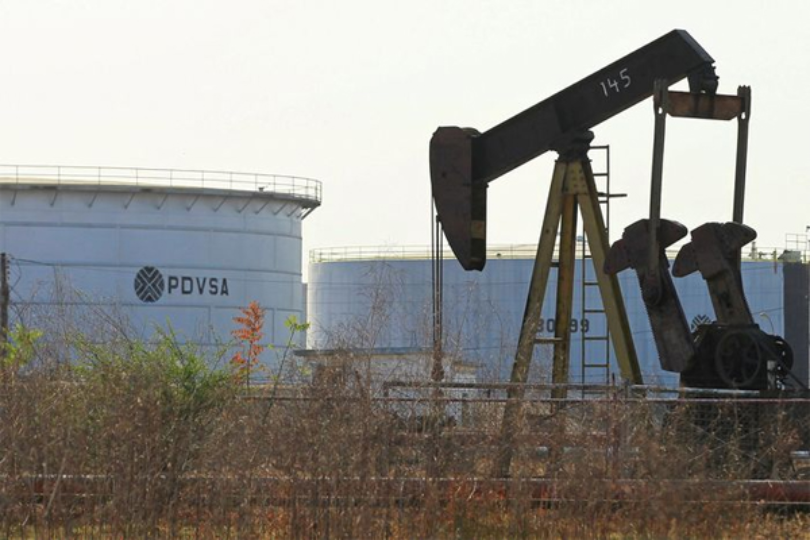
It did so after it accused Venezuela of violating a key term of the agreements which had allowed for the easing of many of the sanctions it had imposed on Venezuela over the past ten years.
In October 2023, after numerous behind-the-scenes negotiations between senior officials within the United States and Venezuela since 2022, the U.S. government announced it was finally cutting back on the severe oil and gas trade restrictions it had imposed on the South American nation in 2017, while the Trump gang was in power.
Venezuela began to reap some of the early benefits of that easing in 2022. That was when the White House authorized California-based Chevron Corporation a new license to use its existing oil wells and storage facilities in Venezuela once again. Simultaneous with that, Team Biden authorized additional licenses for Spain’s Repsol and Italy’s ENI to begin pumping and shipping oil from Venezuela as well.
Negotiations between the two countries continued, and in October 2023 the U.S. authorized an even broader licensing oil and gas licensing scheme with minimal trade restrictions for Venezuela.
The elimination of many sanctions over those two years enabled Petróeos de Venezuela, S.A., the country’s state-owned oil company, to an average production rate of 695,192 barrels per day for all of 2023. That is the highest production rate the nation has achieved since 2020.
Production was also on the way up, with Venezuela estimating its production volume for December 2023 was 802,000 bpd. Further, even though some two-thirds of the country’s oil was still heading to China, its primary customer, PDVSA was finding ways to diversify its sales.
Everything was looking up for the country’s oil industry. Sufficient income was also coming into the country that it was believed economic benefits would trickle down to other areas of the economy as well.
Even beyond business, as U.S. and Venezuelan government officials continued talking on many issues, in December 2023 the two nations announced a landmark prisoner swap deal between the countries.
In that deal, the U.S. managed to secure notorious Malaysian criminal Leonard Glenn Francis, also known by his nickname Fat Leonard, back into its clutches.
Francis ran Glenn Defense Marine Asia (GDMA), a regional ship support company which had done extensive business with the U.S. Navy for years. Francis made that business successful thanks to bribery of naval officials from the Secretary of the Navy on down the line, even involving senior officials within the Naval Criminal Investigative Service (NCIS). The bribes were diverse, ranging from bags of cash to outrageous gifts and trips, Cuban cigars, and prostitutes. In return Francis received lucrative naval support contracts on an ongoing basis and at highly inflated prices.
Francis had been convicted for some of his crimes years earlier, but in 2022 escaped from a lenient unsupervised house arrest situation and eventually made his way to Venezuela on his way to Russia. The U.S. wanted him back bad, ostensibly so he would finally meet justice in prison but most likely also because of secrets he held about the many people in the military he had compromised and the immense amounts of kompromat he still had on them.
Francis actually had his own private naval ship that functioned as a party ship and brothel that accompanied U.S. Navy ships from port to port. Francis recorded Admirals and down engaged in various types of debauchery. The ship also carried a security force of up to 200 Ghurkas and at times provided various lethal services against those the U.S. wanted targeted.
Leonard serviced Russian and Chinese ships as well, but not to the same degree as the Americans, who didn't seem to care that they were being recorded engaging in embarrassing and criminal acts. Nor were they concerned that Leonard might be supplying classified intelligence to the Russians and Chinese, as long as he kept the party going.
In return for giving the man known as “Fat Leonard” back to the U.S., Venezuela was able to convince Washington to release Alex Nain Saab Morán, known mostly by the simpler name of Alex Saab, from U.S. prison into President Nicolás Maduro’s custody. Saab was a Columbian-born former businessman/scammer who assisted Venezuela with elaborate ruses to get around U.S. sanctions on Venezuela. As such he was considered a hero by Maduro and arch criminal to American authorities.
Saab was convicted in Columbia in May 2019 on charges of money laundering, concert to commit crimes, illicit enrichment, fictitious exports and imports, and aggravated fraud. He was eventually extradited to the U.S. on related charges, for which he was finally convicted and was serving prison time at the time the swap of Leonard Glenn Francis for Alex Saab was arranged in December.
Further prisoner swaps were also arranged between the U.S. and Venezuela at the same time.
All this was happening, with the easing of sanctions being the most significant for Venezuela, subject to one catch. The U.S. insisted that Venezuela ensure there would be “free and fair elections” in Venezuela going forward, with U.S. eyes very much focused on the upcoming Venezuelan presidential election to happen roughly by May 2024. “Free and fair elections” for the U.S. means that its own candidate gets into power.
The first step of that came when the main opposition party in the country ran a critical primary election on October 22 to select the person who run against Maduro for president this year.
The elections themselves ran mostly smoothly, with some concerns about balloting methods and potential small instances of voter fraud, but nothing which appeared to have a chance of changing the outcome. The person who won was María Corina Machado, a right-wing businesswoman from a successful family of business leaders, and a former member of the national legislature. She ran on an agenda which was pro-business and against many of the socialist policies Maduro and his predecessor, Hugo Chavéz, had championed for years. Machado was also widely popular and seen as the first serious contender to beat Maduro in the upcoming election, should that election be carried out legally.
With Machado’s win came another big problem. Back when she had been in the legislature, she had been banned by the country’s Controller General in running for any elected office in the country for 15 years for supporting U.S. sanctions against Venezuela and the theft of Citgo, its flagship oil refiner and retailer in the U.S. worth tens of billions. While that might seem an absolute block to her even running, the U.S., which was aware of this, alleges it stipulated to Venezuela that this particular ban had to be lifted for it to agree to ease its sanctions.
Maduro’s justice officials sprang into action soon after Machado’s strong win and challenged the legality of the outcome of that election in court.
Within just days after Machado’s strong win, Venezuela’s Supreme Justice Tribunal took the case and ruled on it. They threw out the results of the opposition party’s primary, and Machado’s winning the nomination with it.
Machado and her party appealed the conviction and lost.
Then this week, on January 29, the U.S. government announced it was reapplying in full its past trade sanctions against Venezuela, because it claimed the country had violated the terms of the sanction easing by not honoring the U.S. stipulation that the Maduro government must ensure “free and fair elections” in the country.
Venezuela’s government is furious, with repercussions from its anger still pending.
Vice President Delcy Rodriguez released the first public blast at Washington for what it had just done, in a statement released on the social media platform X yesterday.
“All of Venezuela rejects the rude and improper blackmail and ultimatum expressed by the US government,” she wrote.
And as the Caracas government’s first action in response, she warned the U.S. that it may begin blocking receipt of Venezuelan migrants back to its country, a deal reached with the Team-Biden in October as part of the removal of the sanctions.
“If they take the wrong step of intensifying the economic aggression against Venezuela,” she said, “as of February 13 repatriation flights for Venezuelan migrants would be immediately cancelled.” While Venezuela can't keep its citizens from returning, it doesn't have to allow the U.S. flights to land.
Rodriguez went on to say that her government was now reviewing all aspects of the bilateral agreements cut with the U.S. in October and determining what other actions it might take.
She made it clear more would likely be necessary to counter the U.S.’s “deliberate attempt to strike a blow to the Venezuelan oil and gas industry.”
So far there has been no comment from the White House about its reimposing the oil and gas trade sanctions on Venezuela.
Publisher's Commentary
It is understandable that Venezuela would not want to allow the CIA to run its own candidate in the Presidential elections, but if it is going to pretend to be a democracy it will need to allow some opposition, even if that opposition is controlled. While the Maduro regime has grown more sophisticated in its thuggery, it still plays the game of geo-politics poorly at times.
And while the sanctions are inconvenient, Venezuela doesn't really need the U.S. to expand its oil production if it would simply reign in the rampant corruption. Cuba, China, Russia and Iran have all tried to work with Venezuela but can't get past the gross corruption and incompetence of its rulers to move the country forward. The kleptocracy that narcissist Hugo Chavez allowed to form while he was basking in the adoration of fans still keeps Venezuela mired in dysfunction and Maduro in power. As long at the ruling elite have their hand's on the country's oil wealth, they will be difficult to dislodge.
Where Washington may try to apply pressure is with Maduro's annexation of some 2/3 of neighboring Guyana. But, so far, the annexation has been in word only and Venezuela hasn't actually placed its people in the disputed Essequibo region and continues to engage in peaceful dialog with Guyana on the matter. To spark an armed conflict to justify its entry into the dispute and wage war on Venezuela, the U.S. might have to stage a false flag event, which it is an old hand at. Dressing up some Colombian cartel thugs in Venezuelan uniforms to massacre a village might be enough provocation for Guyana to shift out of its passive victim stance and justify the U.S. attacking Venezuela.
Maduro is playing a dangerous game and will have to tread carefully if he wants to stay in power.