Supreme Court Questioning Points to Trump's Name Remaining on State Ballots
Lead StoryGovernment
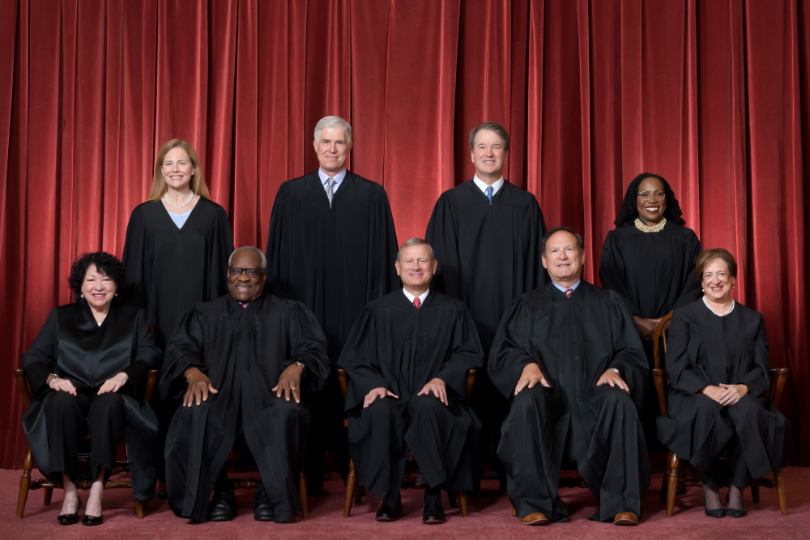
The central question under review at the court proceedings in Washington yesterday was whether Donald Trump should be banned forever from holding public office for helping orchestrate and being part of in a insurrection against the U.S. government.
It is a Constitutional question, involving whether the provisions of Section 3 of the 14th Amendment, passed soon after the end of the Civil War as a means of blocking previous Confederate secessionists from being a part of the still shaky reassembled United States, applies to the actions committed by Donald Trump connected with attempting to block what many have celebrated in the past as America’s unique process for the peaceful transfer of power.
Section 3 of that Amendment reads as follows:
“No person shall be a Senator or Representative in Congress, or elector of President and Vice-President, or hold any office, civil or military, under the United States, or under any State, who, having previously taken an oath, as a member of Congress, or as an officer of the United States, or as a member of any State legislature, or as an executive or judicial officer of any State, to support the Constitution of the United States, shall have engaged in insurrection or rebellion against the same, or given aid or comfort to the enemies thereof. But Congress may by a vote of two-thirds of each House, remove such disability.”
In both words and deeds, Donald Trump committed actions which many believe constitute evidence of having “engaged in insurrections or rebellion” as defined in the amendment. That evidence includes many actions, many of which are still being adjudicated in court. They include Trump’s incitement to riot on January 6, 2021, for Capitol Building protesters he encouraged to come to the Capitol and do what they could to “take back the government”, at least in Trump’s mind. It includes also his pressuring Vice-President Mike Pence to set aside certifying the Electoral College vote that same day, on the grounds that there may have been election fraud serious enough to flip the election to Trump for a second term. It also involves allegations Trump arranged for alternate electors to be put in place in multiple states, just waiting for the opportunity to be slid in place of the proper ones, so they too could vote for Trump rather than Biden. It further refers to Trump and those reporting to him actively calling for the Secretaries of State in multiple states to “find more votes”, as Trump is on record as having done in Georgia via a recording that state official recorded at the time.
After yesterday’s arguments before the nine justices of the Supreme Court, there appear to be enough questions on their side to suggest they will ultimately rule against the state of Colorado and for now the entire question of whether Trump should be eligible to become president of the United States.
Many arguments were offered up by Donald Trump’s attorneys in the case, but based on comments and questions made by the Justices two stand out as the likely justifications for overturning the Colorado Supreme Court’s decision last fall to ban Trump from the ballot based on the 14th Amendment language.
The first of those was that only one state’s decision was in question in this hearing, rather than at least many. Deciding in favor of Colorado and then basing the future of the nation on that state’s Supreme Court ruling alone seemed too much for liberal and conservative justices alike.
“Why should a single state have the ability to make this determination not only for their own citizens but for the rest of the nation?” asked liberal Justice Elena Kagan, mostly for her peers rather than directed at the attorneys from Colorado who were arguing the case. “That seems quite extraordinary, doesn’t it?”
She was joined in that openly skeptical position by strongly conservative Justice Amy Coney Barrett.
“It just doesn’t seem like a state call,” she said.
Chief Justice John Roberts built on that by speculating what could happen if the actions in Colorado, plus perhaps also Maine whose Secretary of State concluded Trump had violated the 14th Amendment to the Constitution, and others who are reportedly reviewing Colorado and Maine’s arguments and considering similar actions, ended up striking Trump from the ballot and denied him enough votes to prevent him – just perhaps – from once again occupying the White House and giving federal agencies over to his sponsors.
Roberts called that possibility, that just a few states’ rulings on the 14th Amendment issue could block voters from being able to vote for Trump (or any candidate, for that matter), a “pretty daunting consequence”.
A second issue of serious concern is related to Roberts’ last comment, that an important legal issue the Court has to consider at this point is about improperly elevating the rights of the states in a matter of this magnitude. It may seem like a subtle difference to the public, but for the Court is a major one.
Again Chief Justice Roberts led the charge in raising the question of whether any state court should be able to ban someone from running for office using the 14th Amendment as justification.
“That seems to be a position that is at war with the whole thrust of the 14th Amendment and very ahistorical,” he said.
Another problematic issue for the court yesterday involved the charges of insurrection which are key to applying Section 3 in banning someone who had “previously taken an oath” to uphold the Constitution in a previous position as a State or Government officer, including those who had been President or Vice-President. The reason for the Court’s questioning this part of the matter is that in most cases the charges of insurrection are still in litigation, whether they involve illegal pressure on secretaries of state in Georgia, incitement to riot in the District of Columbia, and in multiple states regarding the creation of fake elector slates who were poised to take over for the real ones in Georgia and Michigan, just to name two examples.
There were also questions such one posed by Justice Brett Kavanaugh, who seemed to take an even dimmer view of the power of the states in these matters, and whether the right answer was just to let the normal election process proceed.
“What about the idea that we should think about democracy, think about the right of the people to elect candidates of their choice, of letting the people decide?” he asked at one point in the proceedings.
There were other considerations which seemed of high importance to the Justices.
Chief Justice Roberts mused over the possibility that some Republican states might retaliate if the Colorado ruling were upheld by using the same 14th Amendment argument to ban Biden from the ballot, arguing that he too had been involved in an insurrection. Justice Samuel A. Alito Jr. echoed that, saying supporting the Colorado ruling could result in “unmanageable consequences”, perhaps coming with each one an appeal to the U.S. Supreme Court to resolve it.
Several Justices also openly acknowledged and worried that upholding the Colorado decision could result in mass protests and chaos across the country. They seemed even to suggest that such worries should weigh on their decision, despite the fact that what the Court rules in this matter is supposed to be based on law rather than fear, or the will of the people.
Jason Murray, a lawyer representing the voter group which brought the original case forward in Colorado recommending Trump be removed from the ballot there, advocated with his colleagues for the Justices to make their decision without fear being a factor, no matter how serious the repercussions might be. Doing so would send the right “legal message” to all that encouraging insurrections such as Trump is accused of would not be tolerated either now and in the future.
“This court can write an opinion that emphasizes how extraordinary ‘insurrection against the Constitution’ is and how rare that is because it requires an assault not just on the application of law, but on constitutionally mandated functions themselves like we saw on Jan. 6,” Murray said yesterday.
Despite that point of view, the prevailing comments from the justices during the hearing suggest they will rule to reverse the decision of the Colorado Supreme Court and Trump will stay on the ballot in every state.
Publisher's Commentary
What was not discussed at the Court was evidence that the so-called January 6 insurrection was orchestrated and manipulated by the federal government itself as a way to identify and neutralize patriots who were willing to push back against government corruption, or that Trump was actually right in that there was substantial vote fraud by Democrats. (Trump's own rigging of the election was evident but mostly failed, while the Democrat's rigging of the election succeeded and continues to be concealed.)
No matter how misguided or gullible the January 6 protesters were, most were peaceful and well-meaning patriots who wanted to restore integrity to the election process. Their prosecution and extreme punishment confirms that the federal government is very broken and is the enemy of the American people.
A large percentage of Americans support the overthrow of the current fatally broken system and Donald Trump resonated with those feelings of anger and frustration, and it is that reality which should be a topic of open national discussion.
The Constitution of the United States served the nation reasonably well for more than two centuries, but is now woefully inadequate and obsolete. Representative democracy with all its politics and corruption is destroying the nation. It is now time for direct democracy and the complete elimination of political parties, politicians and lobbyists. Modern telecommunications and computers eliminate the need for representatives because the people can be presented with the facts about issues and collectively make decisions. No longer do the people need to elect someone to send off to the Capitol to represent their interests.
Government should serve the people, not rule them, prey upon them or even lead them. It should provide essential services best furnished collectively and should do so at the least cost and with the greatest efficiency.
Upgrading the American system of governance doesn't have to require a revolution or civil war. It could simply arise from the people in the form of a new Constitution that Americans can all agree upon.