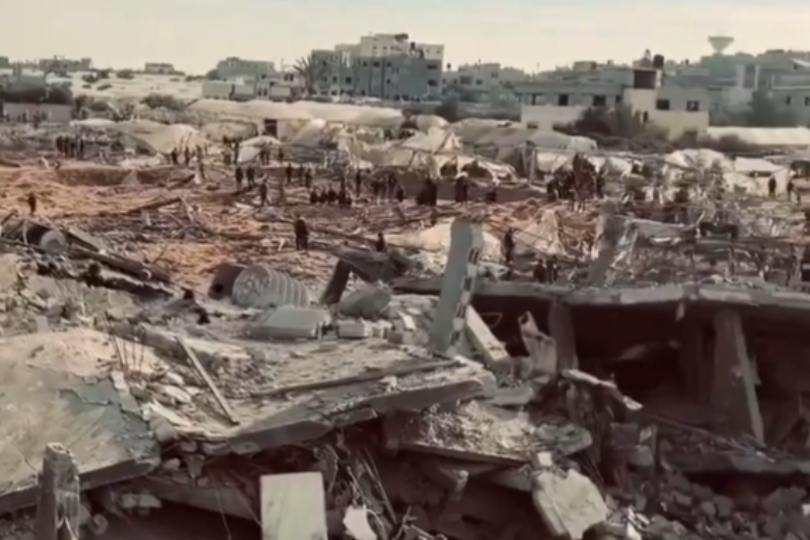
Yesterday fascist Israel began what could be the last and bloodiest phase of its mass genocide in Gaza, while the U.S. and other colonies of Israel send more weapons and cash to support the genocide, other countries act as concerned spectators and millions of humans protest furiously.
The scene of this crime is in Rafah. It is the southernmost governorate in Gaza, with 64 square kilometers (25 square miles) of territory within its borders. It is immediately south of Khan Younis, a region Israeli Defense Forces once declared would stand as a place of refuge and never be attacked.
Rafah is also home to 1.4 million Palestinians who fled from the northern parts of Gaza because Israel said the southern part of the region would also be a safe place to shelter as the vicious destruction of central and northern Gaza proceeded. Though it defied any logic to believe Israel, which continues to maintain Hamas is hiding in every crevice and outcrop throughout, would allow any part of Gaza to remain unscathed, the Palestinian people chose to run where they could, perhaps in the hopes that pressures from nations outside Israel would finally bring a lasting ceasefire to the region.
They were duped. Now over half of the original 2.3 million Palestinians in Gaza’s total 365 square kilometers are huddled in Rafah.
Even before the war, the Gaza strip was one of the most densely populated regions of the world, with 5,853 people in every square kilometer of space. Now the 1.4 million in Rafah are packed in there with a hard-to-imagine concentration of almost 4 times that number in any given area, for an average of 21,875 people per square kilometer. Most without clean water, food or sanitation.
They were forced there after Israel first claimed Khan Younis, located immediately north of Rafah, would also be a protected area along with Rafah. Within just weeks of many arriving there for shelter Israeli proceeded first to drop leaflets and broadcast warnings to those living in Khan Younis to get out or die, then sent its military in recklessly and indiscriminately to bomb refugee tent centers, temporary and permanent buildings for housing, schools, and hospitals. After the first waves of bombings there left most of the city with rubble and corpses throughout, the Israeli Defense Forces moved in on foot and via ground carriers to murder many of the Palestinians who chose to stay there, searching for lost family members and friends.
As the hundreds killed there soon mounted into the thousands, as one Israeli official after another was given air time on many western media outlets to justify what they had done, they first said there was no choice because Hamas was hiding everywhere throughout Khan Younis. When confronted by the few who challenged that by saying the mass murders of so many civilians were not acceptable, many Israeli officials shrugged their shoulders, saying that the people had been warned so it was their fault that they had become targets.
A week ago, a longer-term potential ceasefire was floated by a negotiating team consisting of representatives of Israel, Qatar, the United States, and Egypt, as part of a long-term peace plan in Gaza. It passed onto Hamas, who pushed for this not just being a temporary ceasefire but a steppingstone to final peace. Hamas also included a demand for Israel to pull its entire military force out of Gaza as a condition of the deal.
Israeli Prime Minister Benjamin Netanyahu rejected the response outright, declaring that ending the war before the last Hamas person still standing in Gaza was either captured or dead would never be accepted.
The Attack on Rafah Begins
Meanwhile, Israel’s military was readying its latest – and potentially last -- assault on Gaza. This time the target would be Rafah, with immense Palestinian civilian casualties ahead including a higher-than-usual percentage of them being children because the parents fleeing the north had died in disproportionate numbers already. As before, the excuse for the slaughter of innocents would be that Hamas was hiding among them or that they were themselves all part of Hamas in some way.
More specifically, Israel claims there are four Hamas brigades in operation in Rafah which must be taken out by one means or another.
In advance of that assault, the United Nations warned that even without the military having begun its attack, there were already “unprecedented levels of acute food insecurity, hunger, and near famine-like conditions” in Gaza. With the bombings and ground assaults to come, that would also become more serious.
Reporters on the Hamas-affiliated Al-Aqsa TV station said on February 11, also before the attacks, that one of Hamas’ senior officials declared that what Netanyahu and his war cabinet were about to do in Rafah would end up “blowing up the hostage exchange negotiations” which were ongoing. That official accused Netanyahu and his War Cabinet of deliberately undermining what could have been an imminent substantial prisoner swap, by “committing genocide and a new humanitarian catastrophe.”
Days before the attacks on Rafah which began first on February 10 with a few targeted bombings, Israel officials made multiple public directives to the 1.4 million Palestinians there to flee or risk being killed. The difference between this and past such warnings was there was nowhere else to flee to. There is no place left in Gaza which Israel’s leaders could offer up as another place for refuge, and the border with Egypt is sealed as best that country can make it. From the start of the genocide, Egypt has only allowed a few thousand to cross to safety and most of those were foreigners, not Palestinians.
Israel is already attempting to paint Egypt as part of the problem, that if only they would allow Palestinian refugees across the border they would no longer be in danger. As multiple spokespersons for Israel have said, all Egypt would have to do is open the border and many who Israel otherwise will end up killing would finally be safe.
The problem with this logic comes first that Israel would never allow mass refugee camps to exist on the Egyptian side of the border with Gaza, because those camps might include Hamas within their ranks and would be be bombed, then Israel would invade with ground troops and likely seize the land as its own. Again, regardless of how crazed it may sound, allowing the refugees to pass through as a mass would eventually lead to the IDF war spreading across the border into Egypt, as several of Israel’s leaders have already hinted in various interviews.
Another reason what Israel is saying is irrational is that Egypt, a country riddled with its own economic problems and unable to feed and house its own ever exploding population, has little capacity to accept another estimated over 1 million who might choose to escape there. Even if the United Nations, World Food Programme, or other agencies might step in to help, in the end these would be refugees suffering close to as badly as they had been on the Gaza side of the border.
On February 11, during an interview aired on U.S.-based ABC television’s “This Week” show, Prime Minister Netanyahu told host and interviewer George Stephanopoulos that the deadly attacks on Rafah were imminent.
“We’re going to do it,” he said.
“We’re going to do it while providing safe passage for the civilian population so they can leave,” he continued.
But when pushed to explain just how this would be different from the past, and how such safety could be guaranteed for over 1.4 million stuck mostly in refugee camps just north of the border with Egypt, he had no concrete answers. “[We are] working out a detailed plan,” he claimed.
Just the day before, Netanyahu’s forces undermined his own words in the interview as they launched an early airstrike on Rafah which resulted in blowing up a police vehicle there.
“They said Rafah is safe, but it is not,” said a resident of Rafah who was interviewed in a televised report this weekend from Gaza. “All places are being targeted.”
Yesterday, the Zionist monsters moved from just blowing up a few vehicles to begin their full-scale mass destruction of the buildings and temporary refugee camps in Rafah, along with the indiscriminate killings of Palestinians sheltering within and around those places.
During these first major assaults on Rafah, Israel attempted to shift the conversation from their mass murder to a story of heroism on behalf of the Israeli Defense Forces (IDF) as they fought to rescue two of their own from what they claimed were the clutches of Hamas.
Israeli military spokesperson Daniel Hagari spoke of the rescue as taking place during an hour-and-a-half “wave of attacks” which he said were carried out “to allow the force[s] to cut off contact and hit the Hamas terrorists in the area.” The IDF forces then moved in to shield the Israeli hostages from harm from their own blasts, as the IDF rushed them away from where they had been held.
The two which the IDF rescued were Fernando Simon Marman and Louis Har. According to Israeli sources, they were dual citizens of Israel and Argentina who were reportedly captured by Hamas fighters during the infamous October 7 attack in Israel. They were taken from the same house in Nir Yitzhak, a kibbutz situated near the northern border of Gaza, where other family members of the two, including Clara Marman, Fernando Marman’s sister and Har’s girlfriend, were also staying. After capture, they were moved by Hamas into Gaza.
Clara Marman and other members of that house were freed separately in November as part of the last ceasefire hostage-exchange arrangements.
While little is known of whether the IDF knew the two were in fact being held captive at that location, Israel made space for the rescue by launching multiple airstrikes in Rafah beginning the night of February 11. According to Gaza officials, those aerial attacks killed dozens of Palestinians throughout the city, with no evidence that any of those murdered in those raids had anything to do with holding Marman or Har hostage. What the raids did, however, was to create enough chaos so Israel’s military could march in with guns blazing into what they claimed was a major Hamas site and a place where potentially many Israeli hostages were being held.
Once located, Marman and Har were airlifted out of the area and to a hospital in Tel Aviv. After physicians took a look at them both, it was announced in a joint statement from the Israeli government, the military, the local police force, and the Shin Bet domestic security agency that they were both in good physical condition.
Though that they were in good physical condition could only have happened if, assuming that the story that they were being held by Hamas is true, they had also been treated with care by Hamas during their captivity. Those present at the scene as they were brought out from where they had been staying said that they had no signs of physical harm on them, though they were both physically thin.
“Fernando and Louis, welcome home,” Prime Minister Netanyahu was quoted in the release as saying, as he attempted to spin this into a major public relations win for Israel, and for the many citizens of his own country which believe Netanyahu has not done enough to free its citizens held prisoner by Hamas.
“I salute our brave fighters for the daring action that led to their release,” he added.
According to a Hamas statement made after the two hostages were saved, not mentioned by Netanyahu or the IDF spokesperson were that at least three Israeli hostages beyond these two which the IDF had attempted to rescue died of wounds from the Israeli airstrikes which were credited at saving Marman and Har.
Israel soon moved on from such propaganda blitzes to pure killing. According to the Gaza Health Ministry, Israel’s IDF forces had already killed at least 67 Palestinians in Rafah by early morning on February 12.
Multiple nations raised concerns about this last stand of the genocide in Gaza in public statements released coincident with the launch of mass bombing runs on Rafah.
“The distress in Rafah is already unbelievable,” wrote German Foreign Minister Annalena Baerbock in a post on the social media platform X, “1.3 million people are seeking protection from the fighting in a very small space. An offensive by the Israeli army on Rafah would be a humanitarian catastrophe. The people of #Gaza cannot disappear into thin air.
“The people of Gaza cannot disappear into thin air,” wrote German Foreign Minister Annalena Baerbock in a social media post on X on February 10.
“An offensive by the Israeli army on Rafah would be a humanitarian catastrophe,” she continued. “The people of Gaza cannot disappear into thin air.”
Germany continues to support the genocide and provides unconditional support to Israel.
In the United Kingdom, UK Foreign Secretary and former Prime Minister David Cameron said he was “deeply concerned” about the siege on Rafah.
“The priority must be an immediate pause in the fighting to get aid in and hostages out,” he wrote.
The UK also continues to support the genocide with weapons, funding and bombing Yemen.
Saudi Arabia’s Foreign Ministry also issued warnings of its own.
“Invading Rafah… which is the last refuge for hundreds of thousands of civilians whom the brutal Israeli aggression displaced will have [grave] consequences,” it said in a written statement.
It declared its firm “rejection and strong condemnation of forcibly” displacing people within Gaza and demanded an emergency Security Council meeting “to prevent Israel from causing an imminent humanitarian catastrophe whom everyone who supports the aggression will be responsible for.”
The dictatorship of Saudi Arabia actively supports the genocide by providing safe passage across its highways for supplies to Israel through Jordan. It also suppresses any protests against the genocide and censors information about it in Saudi media.
U.S. President dementia-ridden war criminal Biden, one of those the Saudis was referring to as part of the “everyone” who is supporting the attacks, reportedly warned Netanyahu early on February 11 that Israel’s “military operation in Rafah should not proceed without a credible and executable plan for ensuring the safety of and support for the more than one million people sheltering there."
At the same time as that, Biden told Netanyahu he continued to support the Israeli objective "to see Hamas defeated and to ensure the long-term security of Israel and its people."
The U.S. continues to be the largest supporter of the genocide and continues to pay tens of billions in American's hard earned tax dollars and air-lift hundreds of tons of weapons. American soldiers and mercenaries are also there on the ground involved in the killing spree, and the U.S. continues to wage war on Yemen for trying to impose a blockade on ships servicing the genocide.
The European Union’s senior foreign policy official, Josep Borrell, issued his own statement on Rafah in the social media platform X on February 11.
“I echo the warning by several EU member states that an Israeli offensive on Rafah would lead to an unspeakable humanitarian catastrophe and grave tensions with Egypt,” he wrote. “Resuming negotiations to free hostages and suspend hostilities is the only way to avert a bloodshed.”
The EU as a whole continues to support the genocide with multiple EU members continuing to supply weapons and funding.
Netanyahu rapidly dismissed any criticism of the actions already in process in Rafah, seemingly regardless of how many innocents would be killed and the number of war crimes he and his government would commit in the process.
“Those who say that under no circumstances should we enter Rafah are basically saying lose the war, keep Hamas there,” Netanyahu said in the interview shown Sunday on ABC’s “This Week” newscast.
According to reports in Gaza, on February 11 alone Israel had carried out 50 airstrikes on Rafah, on homes, hospitals, mosques, and one of the biggest refugee tent cities there.
There are solutions:
The UN General Assembly could remove the veto power of UN Security Council permanent members so that the U.S. couldn't keep blocking any meaningful action. Then the Security Council could impose an arms embargo, economic sanctions, demand a ceasefire and impose an actual safe zone.
The International Criminal Court could replace the corrupt Karim Khan so that it can issue arrest warrants for Israeli and American war criminals. While it would not be able to enforce the warrants, the UN Security Council could try.
BRICS, Shanghai Cooperation Organization or the Arab League could admit Palestine as a member and then collectively impose a safe zone in South Gaza. While this would require them to evolve their mandate, there is likely enough support among members.
More nations could join the resistance to Zionism by cutting diplomatic ties with Israel, implementing trade embargoes, imposing sanctions and and support Yemen and the various resistance groups.