Israel Attacks Lebanon with Extensive and Reckless Airstrikes
William Tell Lead StoryConflict
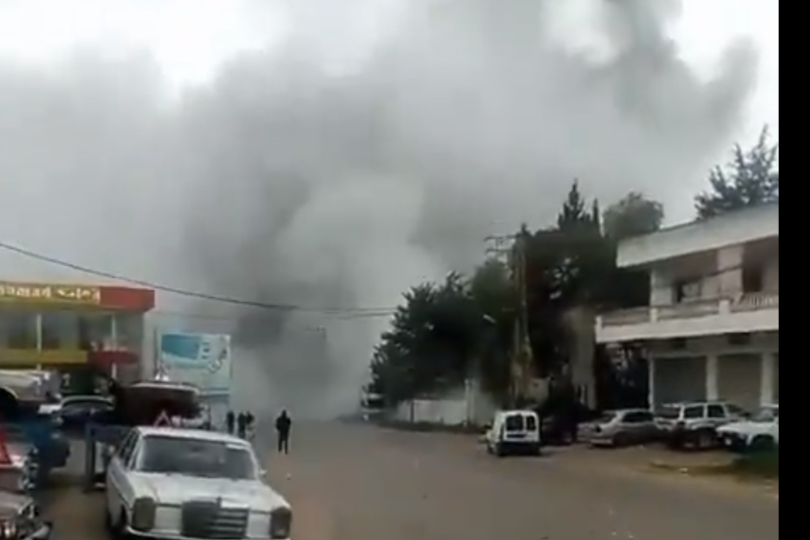
This along with previous attacks Israel carried out in Lebanon over the last several months, along with Hezbollah countering most of them though in a narrower fashion, are now in danger of triggering far more than just back-and-forth lethal firefights across the Lebanese border.
Early on February 14 local time, a series of rockets launched by Hezbollah from southern Lebanon first struck military targets in Netu’a, an Israeli settlement approximately 5 kilometers (3.1 miles) south of the border, then followed by a second grouping aimed at an Israeli Defense Forces (IDF) base in Safed, just slightly further south at 8 km (5 miles) away. Both locations are in areas Israel had mostly evacuated after the October 7 Hamas strike in northern Israel, along with succeeding raids across the border both by Hezbollah and Israeli forces. Both targets were also strictly military.
This time the Hezbollah rockets killed one IDF soldier who was part of the nation’s border protection services. They also wounded eight other Israelis, currently not identified as civilian or military but most likely also part of IDF because civilians had been moved out of the region earlier. The rockets destroyed a nearby house and also caused some damage to the Safed base.
The wounded were airlifted to Safed’s Ziv Medical Center for treatment. One of the injured is reportedly in serious condition.
Israel responded quickly to Hezbollah’s rockets with air raids clearly intended to punish and warn Hezbollah at the same time. That news was first announced in a social media post from IDF spokesperson Israeli Rear Admiral Daniel Hagari.
“IDF fighter jets began an extensive wave of attacks in Lebanese territory, more details later,” he wrote.
Information provided by Israeli military sources some time later said the first targets struck in Lebanon yesterday were on multiple Hezbollah control rooms and other facilities.
Lebanon’s National News Agency described those attacks very differently. It said the first of Israel’s counterattacks on Hezbollah killed a woman and her two children in al-Sawana, plus one Hezbollah person who was in a separate room where the others died. The damage caused by the Israeli airstrikes was described as “vast”, spreading across eight separate targeted regions.
Lebanese security forces said the Israeli attacks during the day killed four people and wounded many more.
Hezbollah said the Israeli forces had killed three of its fighters in the attack as well.
After several hours of quiet during the day yesterday, Lebanese state news agencies said an Israel drone blasted into an apartment building in the southern Lebanese city of Nabatieh early in the evening. The news said the drone murdered four members of the same family in that blast.
As a protective measure, regional officials ordered all schools and government offices in Nabatieh closed on February 15.
In its follow-statement regarding Israel’s response on February 14, the military gave only a slightly expanded summary of their earlier one.
“A short while ago, numerous launches were identified crossing from Lebanon into the areas of Netu’a, Manara, and into an IDF base in northern Israel,” the Israeli military spokesperson said in a written statement. “The IDF struck the sources of the fire.”
Israeli government spokesperson Ilana Stein took this a step further in her comments.
“As we have made clear time and time again, Israel is not interested in a war on two fronts. But if provoked, we will respond forcefully,” she explained. “The current reality, where tens of thousands of Israelis are displaced and cannot return to their homes, is unbearable. They must be able to return home and live in peace and security.”
Hezbollah did take credit for the initial attacks which triggered this set of Israeli responses but said this is not the time to stop pressuring Israel from the north as Netanyahu and his team continues the mass murder and destruction in Gaza.
Hezbollah head Sayyed Hassan Nasrallah said that only a complete ceasefire in Gaza would stop their attacks.
“On that day, when the shooting stops in Gaza,” he said, “we will stop shooting in the south.
Nasrallah had attempted to find at least one solution to prevent more civilian casualties in Lebanon as a result of Israel’s airstrikes on that country, when he proposed on January 5 the idea of setting up a demarcation zone that Hezbollah, Israel and Lebanon would agree to honor along the Lebanon/Israel border.
France built on that earlier this week with a proposition for the Lebanese government to consider as part of this. It would designate a region extending from the border with Israel northwards for 25 miles as one where no armed militia, military forces, weaponry, or other arms assets, other than those owned by the Lebanese government or a proposed United Nations’ peacekeeping force, would be allowed.
France’s proposal has a phased approach to it. It would begin with a ten-day period in which Hezbollah would withdraw its forces a minimum 6 miles north of the Israeli border as a first show of good faith. That would be followed by a broader withdrawal and ceasefire to the north.
Though France, the United Kingdom, and others involved in working with Hezbollah and Lebanon on this claim progress has been made on this proposal, Nasarallah there is no forward movement on it at all.
As for the supposed talks, he said, “they’re nonexistent”. Even Israel has not acknowledged either that the talks are going on or that it would abide by the rules France has suggested for the ceasefire.
“These delegations … are trying to intimidate,” Nasrallah said on February 13 in a televised interview.
“This party of intimidation…will not work,” he continued. “Now if we stop fighting in the south, what [happens] to Gaza?”
Another aspect of Israel’s intimidation tactics against Hezbollah and Lebanon came later in the day yesterday, from Benny Gantz. Gantz is a former political advisory of war criminal Netanyahu who was brought on to be a part of the fascist country’s “emergency war cabinet” formed to lead the destruction of Gaza and the genocide of the Palestinian people. The purported objective of the war cabinet is to ensure “Total Victory” against Hamas, regardless of the cost.
In his remarks about the airstrikes and drone attack Israeli forces waged against Hezbollah targets in Lebanon yesterday, Gantz for the first time publicly suggested Israel might be considering an even more serious escalation of the war on its northern front.
“It is important that we be clear — the one responsible for the fire from Lebanon is not only Hezbollah or the terrorist elements that carry it out, but also the government of Lebanon and the Lebanese state that allows the shooting from its territory,” Gantz said. “There is no target or military infrastructure in the area of the north and Lebanon that is not in our sights.”
Israel’s armed forces chief of staff, Lt. Gen. Herzi Halevi, chimed in, declaring that, “This is not the time to stop” in its war with Hezbollah.
Hezbollah’s Nazrallah responded to those threats by declaring that, “You escalate, we escalate.”
Later in the day yesterday, after Israel’s last airstrikes finished, Hashem Safieddine, a senior official within Hezbollah reporting into Nazrallah, said his group would respond militarily to what Israel just did.