Venezuela Orders Closure of Local Human Rights Office, Accusing It of Plotting Coups and More
Lead StoryHuman Rights
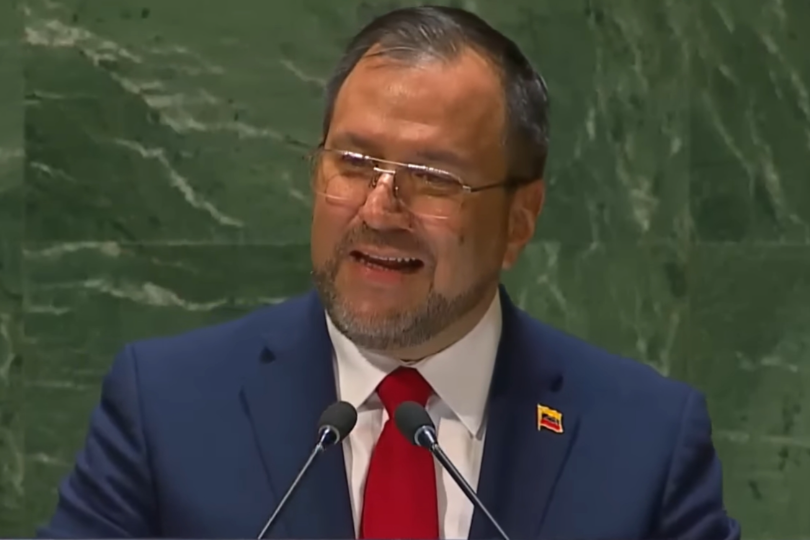
As the Maduro regime clings to power by suppressing the CIA-back opposition, it has engaged in an increasing number of human rights abuses under the previously watchful eye of the UN Human Rights Office. Instead of softening the abuse to avoid international criticism, it has removed the watchers with the greatest authority.
In a press conference yesterday in the country’s capital of Caracas, Venezuelan Foreign Affairs Minister Yván Gil declared the Venezuelan technical advisory office of the United Nations Commissioner for Human Rights was no longer and perhaps never was operating its approved role “to improve [and] to optimize” human rights conditions in the country, or as had been part of its charter when first set up in 2019, to “show the world the advances in human rights in Venezuela.”
Instead, he said, the role of the UN agency had deteriorated into an “international sounding board to maintain a discourse against the Bolivarian government and against the Venezuelan people.”
“[The UN Human Rights Office has] “become the private law firm of coup plotters and terrorist groups that permanently conspire against the country,” Gil went on. "“In no state is this tolerable."
Though he did not cite specific examples of these charges, there have been separate government allegations that the U.N. and the United States were involved in multiple attempts to oust President Nicolás Maduro from office in recent years.
Among the most notable of these happened shortly after the fall 2018 election of Maduro to a second term was deemed a fraud in January 2019 by the Trump gang in the United States and the heavily U.S.-influenced Lima Group, group of 14 nations comprising Argentina, Brazil, Canada, Chile, Colombia, Costa Rica, Guatemala, Guyana, Honduras, Mexico, Panama, Paraguay, Peru, and Santa Lucia. Their pick for who should be running the government was opposition leader and head of the country’s National Assembly Juan Guiadó, who had lost against Maduro at the ballot box but with many legitimate claims of voter intimidation, vote-buying, and deliberate manipulation of final vote counts.
The United Nations was just one of many global agencies who piled on with their criticism of the 2018 Venezuelan presidential elections, which the country attempted to soothe by allowing it to establish a technical advisory office of the United Nations Commissioner for Human Rights later in 2019, but not until the international firestorm regarding the election died down.
After multiple threats from the Maduro administration to stop asserting he was the rightful president, Guiadó, who reportedly was backed by more than $2 billion in funds funneled via the United States to his party via various sources including the CIA, eventually Guiadó fled Venezuela into neighboring Colombia. Colombia at that time was headed up by a narco-terrorist regime run by CIA.
More recently, in 2022 and 2023 the Biden administration reached out to the Maduro government with offers of warming relations with Venezuela and easing existing trade sanctions. What the Biden gang insisted on in return for that were two things: a prisoner swap and guarantees that there would be “free and fair” elections this time both in the primaries coming last fall and in the national presidential elections set for the spring of 2024. In Washington-speak "free and fair elections" means those that the U.S. is able to control to ensure that only their puppets are put on the stage.
The first wave of sanctions were eased in November 2022. That was when the U.S. officially authorized Venezuela’s state-owned Petróleos de Venezuela, S.A. Avenida (PdVSA) to allow Chevron Corporation access to previously seized assets in Venezuela. The company began pumping oil again via PdVSA and began shipping it again to the U.S., without paying Venezuela anything.
While that move was more to ease tensions between the countries than anything else, beginning mid-2023 the White House sent representatives to Venezuela to negotiate a new deal regarding further sanctions removals in return for the “free and fair” election promise. The 2023 discussion eventually led to a broader easing of sanctions across-the-board with the South American nation. By doing so, it helped the Maduro government to increase oil shipments in 2023 to the highest it has produced in four years.
Coming with that was also something which initially seemed like a breakthrough for U.S.-Venezuelan relations. That was the October 22 election in Venezuela. It concluded with the election of María Corina Machado, a skilled right-wing politician with a strong pro-independent-business background, as the candidate who would run against Maduro in the spring 2024 presidential contest. The only problem is that she had been barred from running for office because of her treasonous actions in supporting U.S. sanctions and the theft of Venezuela's U.S. oil company, Citgo.
From a U.S. and even United Nations perspective, these elections, which allowed for extensive online voting and had the appearance of being a properly conducted and fair election. That election also awarded Machado with over 90% of the ballots cast in that opposition primary balloting. Machado was also alleged to be supported strongly behind the scenes by the CIA, making this an even more promising outcome for the Biden White House but unacceptable to Venezuelans who didn't want to return to the bad old days of a vicious right-wing dictatorship, torture, death squads and the wholesale looting of their nation's resources.
For a short while it appeared Machado not only had won fairly but that she might have the momentum, mostly likely supported both indirectly and directly by the United States and the Lima Group, to make her candidacy the first viable one since Maduro had been named successor to former President Hugo Chávez.
The U.S. was also getting what it wanted from Venezuela in an important prisoner swap with the Caracas government. That came in late December when Venezuela turned over the notorious Malaysian criminal Leonard Glenn Francis, also known by his nickname Fat Leonard, in return for the United States giving up Alex Saab, a Colombian-born former businessman who helped the Maduro regime evade U.S. sanctions and skim money from various contracts.
By ignoring the fact that Machado was barred from running, all looked promising for the U.S. objectives of seeing Maduro genuinely challenged in the next election, in securing some of what it was looking for both in increased oil production, and perhaps gaining a stronger connection in South America, where the U.S. had seem several of its former strong allies in Brazil and Colombia shift to left-leaning governments which at this point are most distant than ever from apparent U.S. influence.
In parallel, however, on December 3 Maduro structured a special election declaring his country was the rightful owner of two-thirds of the land mass (and associated oil and gas reserves offshore) of its neighbor Guyana to the south. Although he has not yet gone to war to seize those lands, Maduro met with Guyana's President Irfaan Ali on December 14 to discuss the issue, ordered his oil ministry to negotiate licenses for the reserves it intends to take over, proved to some extent he was serious about what he was about to do when deployed his navy off the coast of Guyana when a British military ship began cruising the area to defend the interests of its former colony there, and followed up negotiation with Guyana with a session held in Brazil late last month led by Foreign Affairs Minister Gil.
As expected, both the United Nations and the U.S. were strongly vocal in their opposition to what Maduro was doing regarding Guyana, though to date neither has announced publicly any plans to stop him.
Meanwhile, the Venezuelan government found a way to undermine María Corina Machado’s primary election win from October. Just days after the election, the government appealed Machado’s win, not on problems with the voting but on the separate issue that she had supported the U.S.- and U.N.-backed sanctions against Venezuela some years before. That case went to the country’s Supreme Justice Tribunal last fall and the government won.
Officially, Machado was now out of the running, but she appealed, all the while with the U.S. keeping quiet about what was happening in hopes Maduro would push through what it wanted and let her proceed with her candidacy.
Machado’s appeal against the ban from running was turned down last month, effectively ending her run as the only authorized opposition candidate to Maduro.
All this resulted in the U.S. reimposing past trade sanctions on Venezuela as of January 29. If it couldn't get its way it would punish Venezuela.
The United Nations also apparently began squeezing harder on Venezuela from within the country, digging in further into human rights abuses it had already been investigating but with a bit more pressure this time, with the Machado court loss fresh and the potential for a takeover of part of Guyana in the offing.
Venezuela reacted to all with anger, but it was only this week that this anger boiled over to the point of requiring some sort of symbolic response to what the U.S. and U.N. had been doing to it in the background.
A first warning about what was about to happen came earlier this week when the Maduro administration on February 13 announced it had detained noted local human rights attorney Rocio San Miguel. According to Venezuela’s Attorney General Tarek William Saab, San Miguel was arrested on charges of conspiracy against Maduro himself. Among the claims Saab alleged San Miguel was involved with was a coup to assassinate Maduro and assist with an attack on the nation’s military.
San Miguel has a history as a tough legal advocate for human rights issues in the country and involving the nation’s corrupt army, navy, and air force. She was taken by government officials as she and her daughter were awaiting takeoff on a flight headed from Caracas to Miami this on February 8.
The United Nations had remained publicly quiet about the incident for some days while attempting to work the issue of San Miguel’s arrest via both its global offices and via the local office of the technical liaison office of the UN Commissioner for Human Rights in Caracas. Then, just one hour before the announcement by Foreign Minister Gil that that UN Human Rights office is being shut down and all employees kicked out of the country, the UN issued a formal statement demanding San Miguel be given “due process guarantees, including right to defense” in her case.
During the UN Human Rights Council’s tenure operating its Venezuelan technical office, the international agency voted to launch a special mission to investigate allegations such as those San Miguel had been litigating for years. Those included disappearances of people without charges, alleged kidnapping and torture, and murder by Venezuelan military teams. That mission was never launched, after the government put its personnel under surveillance, as well as investigative journalists, other human rights agencies, and legal activists such as San Miguel.
When San Miguel was taken captive last week, a group of 200 NGOs along with the United States, the European Union, and Canada issued a statement demanding her release. They said she was taken as part of an ongoing campaign by the Maduro government for the “criminalization and persecution of the work of promoting and defending human rights and closing civic space in Venezuela.” It further said San Miguel was taken in line with past campaigns declaring anyone who fights for human rights there are “internal enemies” of the state and often called out for “alleged conspiracies and attempts at ‘assassinations.”
With the announcement yesterday of the formal closing of the technical support office for the UN Commissioner for Human Rights, the UN agency has until February 22 to evacuate the 13 employees of that office.
Given the continued failure of the corrupt Maduro regime to meet the needs of its citizens and the lack of any viable opposition not controlled by the U.S., Venezuelans have been leaving the country in droves, with an estimated 7.7 million having left so far.