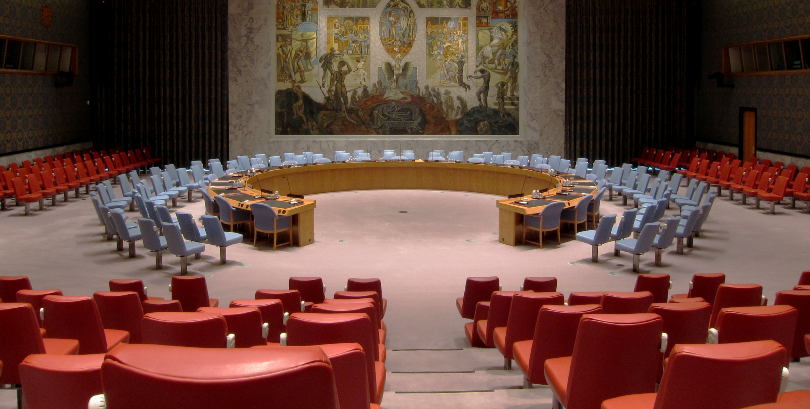
With the United States finally saying there is a Gaza United Nations Security Council ceasefire proposal it would sign off on, it may seem as if hell just froze over because of how radical the shift in stance appears to be.
When one parses the language of its recommendation and its timing, it becomes clearer this is less dramatic in change in posture, as well as far more political than humanitarian in nature.
Last week Algeria put up its first formal UN Security Council during its tenure as a new non-permanent member of the council since January 1, 2024. The African Arab nation called for an immediate humanitarian ceasefire, both to stop the killing and to allow more humanitarian aid to flow into all of Gaza.
The Algerian resolution did not stop there.
It also demands the unconditional and immediate release of all hostages seized by Hamas during the October 7 attack. It is estimated Hamas took 250 Israelis captive during that raid, roughly 100 of which multiple sources say may still be held in Gaza.
Further clauses include language directing Israel to halt any plans for the forceful movement of Palestinians out of Gaza and requires the Netanyahu administration to “scrupulously comply” with all tenants of international law, most especially regarding protecting Palestinian citizens in the war zone.
This is the resolution which the United States said it will veto when it comes for a vote in the entire UN Security Council on February 20.
A common thread of past U.S. vetoes of U.N. Security Council resolutions in Gaza is anything which dictates some immediate action on Israel’s part to bring a halt to the war, so vetoing this would be no exception just for that part alone. But Algeria’s resolution also includes what for the U.S. amount to poison pills, including telling Israel it must stop committing war crimes according to international law. Even the call for Israel not to proceed with driving Palestinians out across the border into Egypt would be too much for the United States to swallow.
Even the hostage release Algeria has called for Hamas to deliver on in this resolution is a problem for the United States. That is because, despite it being something one would think Israel would happily support as a stand-alone dictate, the United States is currently actively engaged in negotiating a broader new bilateral hostage swap deal of its own.
As Linda Thomas-Greenfield, the U.S.’s U.N ambassador put it, she and others involved in the negotiations brokered by Qatar and Egypt with Israel and Hamas, are still active. This involves a new phased hostage-release process which would take place over a minimum period of six weeks, as well as a ceasefire during that time which Thompson says would provide a breather in “which we could then take the time and the steps to build a more enduring peace.”
Though she admits those negotiations “have not been progressing as expected”, Thomas-Greenfield said she believes that “though gaps remain, the key elements are on the table” to allow for a deal like this to proceed.
She further said that adopting the Algerian Security Council resolution would undermine those talks, “and indeed, may run counter to them.”
“For that reason, the United States does not support action on this draft resolution,” she said. “Should it come up for a vote as drafted, it will not be adopted.”
In making that statement, Thompson also referenced multiple conversations between Joe Biden and Benjamin Netanyahu to attempt to steer Israel away from the ground assault most world leaders except Biden believe is inevitable.
Netanyahu is also continuing to refuse any ceasefire which does not incorporate Hamas unconditionally surrendering to Israel and turning over all Israeli hostages in full, not just those taken in its October 7 attack. He claims that Rafah, where he plans a major ground assault beginning on March 11, is a major hiding place for the last remnants of Hamas.
The resolution the United States is offering in place of what Algeria came up with proposes a ceasefire in Gaza which would happen “as soon as practicable” instead of the “immediate” language currently up for vote. That language provides Israel with considerable room for avoiding compliance with the resolution, assuming it comes up for vote and passes, and allows the Biden White House the appearance of having been a bit tougher on Israel than in the past.
More serious for Israel than the ceasefire language, however, are assertions in leaked drafts of the alternate proposal that Israel’s current plan, of pushing the Palestinians remaining out of Gaza and into tent refugee camps such as Egypt appears to be setting up across from Rafah, cannot be allowed to happen “under current circumstances” and “would have serious implications for regional peace and security”.
The vote on the Algerian resolution is expected to happen on February 20 and at this point will be vetoed by the U.S. for the reasons explained earlier.
With leaks of the U.S. counter to that already spreading, Prime Minister Netanyahu is expected to comment on and reject that draft once it solidifies further.
It is unclear at this time when the U.S. proposal will come before the Security Council for formal debate and voting, but it is expected within days, with the hope that it may blunt some of Netanyahu’s soon-to-be-announced plans for the Palestinians in Rafah.