Diplomatic Sparks Fly Early as the 2024 G20 Foreign Ministers’ Meeting Begins in Brazil
Lead StoryGovernment

2024 is the year Brazil takes the helm as president of the G20 Group of Nations. As a leading member of BRICS, Brazil is expected to have a positive impact on the G20.
That is the international collective which historically has included the twenty top-ranked countries by economic clout. Those twenty have up through last year included Argentina, Australia, Brazil, Canada, China, France, Germany, India, Indonesia, Italy, Japan, Mexico, Russia, Saudi Arabia, South Africa, South Korea, Turkey, the United Kingdom, the United States, and the European Union. The EU has its own representative, separate from the individual members of the EU which are also present. The group was formed to encourage economic cooperation and financial linkages across the globe.
In September 2023, the G20 added its latest member, the African Union (AU). The AU is made up of 55 member states from within the continent of Africa and represents almost the entirety of that continent.
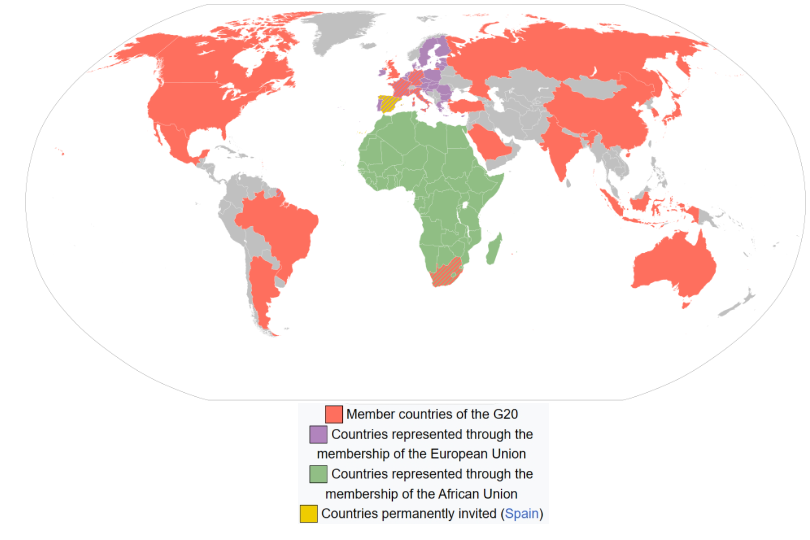
In total, the G20+1, including the AU, accounts for over 67% of the global population, 80% of the Gross World Product (GWP, the sum of the Gross Domestic Products (GDP) of individual nations), and 75% of all international trade.
With such enormous financial and geopolitical clout, the G20 meetings have over time become a focus for discussion of some of the most challenging diplomatic issues addressed anywhere, including many which extend well beyond its original financial-focused charter.
Based on comments made forth earlier this week by Brazil’s own President Lula da Silva about Israel’s war against the Palestinians in Gaza, and the first introductory remarks by that country’s Foreign Minister at the G20 Foreign Ministers’ summit which just began yesterday, this could be one of the most contentious and controversial years for the G20 in a long time.
Lula made his initial headlines this week while attending the African Union’s 37th Ordinary Session of the AU Assembly, held in Addis Ababa, Ethiopia.
His presence there was an important one, in part because he is the president of the host nation for the G20 meetings beginning this week which would be the first ever attended with the AU as a full member. He also has an overlapping role as leader of one of the founding members of the BRICS geopolitical and economic alliance, a group which added the AU headquarters nation of Ethiopia along with Egypt, Iran, Saudia Arabia, and the United Arab Emirates, effective as of January 1, 2024.
While speaking at the podium in Ethiopia on February 18, President Lula da Silva proved once again he is not shy about speaking his mind in public about important geopolitical issues. After acknowledging the normal pleasantries to those who had brought him there, Lula chose to speak about Israel’s slaughter of the Palestinians in Gaza.
“What is happening in the Gaza Strip to the Palestinian people has no parallel in other historical moments,” he said.
“[But] in fact, it did exist,” he went on, “when Hitler decided to kill the Jews.”
This was not the first time Lula had dared draw such a parallel in public statements of his about Israel’s genocide in Gaza. In October, just weeks after the October 7 invasion by Hamas into Israel triggered the attacks in Gaza, Lula was one of the few world leaders who immediately demanded a ceasefire in the war.
“[The] innocent people of Gaza must not pay the price for the insanity of those who want war,” he said in a public address at the time.
Then in November, soon after Israel blew apart and raided Al-Shifa, what was at the time the largest operating hospital in Gaza at the time, Lula attacked what he saw as the depravity of those who planned and executed that assault. He spoke directly against the Israeli argument that despite the deaths of many of the 1,500 patients, 1,500 medical workers, and possibly 15,000 innocent people using the hospital as a temporary shelter at the time, the excuse that Hamas might be hiding somewhere nearby, or underneath was no excuse for what they were doing.
“Israel’s attitude toward children, toward women, is the equivalent of terrorism,” Lula said. “There’s no other way to put it.”
“If I know a place is full of children, even if there’s a monster inside,” he continued, “I can’t kill the children just because I want to kill the monster.”
Then in January, when fellow BRICS member South Africa chose to charge Israeli formally for committing genocide at the United Nations’ International Court of Justice, the office of the president of Brazil released this statement:
“The president expressed his support for South Africa’s initiative to bring Israel before the ICJ to determine that Israel immediately ceases all acts and measures that may constitute genocide or related crimes under the Convention on the Prevention and Punishment of the Crime of Genocide.”
While Israel’s Prime Minister Benjamin Netanyahu initially just rejected Lula’s comments in October, November, and in January at those times, the latest pronouncements made at the AU summit proved to be more than he could let go without firing back and taking action.
“President Silva has disgraced the memory of six million Jews murdered by the Nazi,” Netanyahu said immediately following Lula’s comments, referencing the estimated total killed during World War II. “and he has demonized the Jewish state like the most virulent anti-Semite.”
“He should be ashamed of himself,” the Israel prime minister declared.
On February 19, the next day, Israel’s foreign minister summoned the Brazilian ambassador there to the country’s Holocaust memorial for a public shaming of sorts.
President Lula responded by recalling his ambassador to Israel and at least temporarily shutting down formal relations between the two countries.
Then yesterday, as the regular meeting of the G20 Foreign Ministers opened, after welcoming the delegates to 2024’s first meeting of the G20 + African Union assembly with Brazil in charge, Brazilian Foreign Minister Mauro Vieira set the tone for this summit by building on what Lula had already been saying regarding Israel’s genocide in Gaza and now criticizing the United Nations for being powerless to do anything about them.
His comments came only a day after the United States vetoed the most recent UN Security Council resolution demanding an immediate humanitarian ceasefire in Gaza. That was the one put forth by Algeria and backed by most Arab states.
There Vieira used this forum as an opportunity to promote a key part of President Lula’s global agenda which calls for redesign and reform at the world’s biggest international governance organizations. Those include the World Trade Organization, which of late has been seen as far more political than purely economics-based, multilateral financial institutions such as U.S.-dominated World Bank and International Monetary Fund, and the United Nations, both as a whole as well as more specifically related to the United Nations, where a single nation such as the United States or Russia can defy the rest of the UN via vetoes on resolutions such as those condemning Russia’s invasion of Ukraine last year, and now against Israel and its vicious slaughter in Gaza.
"We cannot ignore the fact that global governance needs a revamp," Brazilian Foreign Minister Vieira told the delegates in Brazil yesterday. "Our differences must be handled under multilateralism and the UN, using as methods dialogue and cooperation, and never armed conflict - matters to be further discussed ... in the session dedicated to the reform of global governance."
“[But] multilateral institutions are not adequately equipped to deal with current challenges, as demonstrated by the unacceptable paralysis of the Security Council in relation to ongoing conflicts,” he said further.
That followed just days after President Lula made a very specific recommendation for reform for the UN Security Council, as he observed the slow-motion train crash of the most recent Security Council veto by the U.S. approaching swiftly.
“We need to add more people and end the right of veto in the U.N., because it is not possible for a country alone to be able to veto the approval of something approved by all members,” Lula said while still in Ethiopia at the AU summit.
While speaking to the G20 delegation, Vieira broadened his statements about what was happening globally, as his country was “deeply concerned” about increasing global conflicts and buildup of military forces to address them. He called out not just the obvious concerns of existing wars in Ukraine and Gaza, but also at a total of over 170 other wars on various scales currently taking place elsewhere.
Besides the carnage such conflicts could inflict on the world, the foreign minister said that the spending of over $2 trillion now annually on troops, military equipment, and munitions could be used for better purposes than defending against potential war or destabilizing the world further.
“If inequalities and climate change do, in fact, constitute existential threats, I cannot avoid the feeling that we lack concrete actions on these issues,” Vieira told his audience. “These are the wars we must fight in 2024.”
President Lula and Foreign Minister Vieira hope these statements will lead to a shifting of global priorities among the world’s nations in 2025, away from war and towards some of those international governance reforms already put forth. The goal is to gain momentum before the annual meeting where most of the heads of state of the G20 assemblage gather on November 18-19 in Rio de Janeiro, as Lula’s grand finale event during his year’s term heading up the G20.