Caribbean Community Summit Opens in Guyana with Self-Sufficiency and Cooperation on Agenda
Lead StoryGovernment
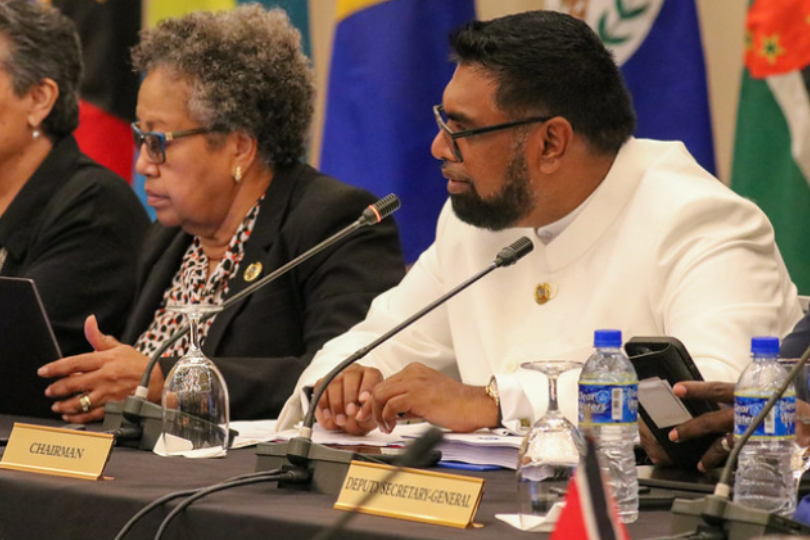
The 15 member nations of the Caribbean Community (CARICOM) began their meetings against a backdrop of surprising quiet throughout the Caribbean despite a time of economic challenges for many, food insecurity issues at a peak, and one serious border dispute at play this year.
CARICOM, which came into being on July 4, 1973, with the original name the Caribbean Community and Common Market, was founded with objectives of improving economic integration and coordinating foreign policy matters among its members. Since that time, Barbados, Jamaica, Guyana, and Trinidad and Tobago, the original four nations which were a part of it from the beginning, have been joined by nine others. Those added later include Antigua and Barbuda, Bahamas, Belize, Dominica, Grenada, Haiti, Jamaica, Montserrat, Saint Lucia, St. Kitts and Nevis, St. Vincent and the Grenadines, and Suriname.
The group also has four Associate Members: Anguilla, Bermuda, British Virgin Islands, and the Cayman Islands.
This year’s meeting is being chaired by Dr. Mohammed Irfaan Ali, the president of Guyana. Joining him at this year’s session are 12 other heads of state of the total of 15 members, along with representatives from Canada, the Dominican Republic, Saudi Arabia, the United Kingdom, and the United Arab Emirates. The United Nations is also sending delegates.
President Lula da Silva of Brazil, the nation which holds the rotating presidency chair role for the G20 group of nations this year and which was a founding member of BRICS, is also coming to the summit at the invitation of Guyana’s President Ali.
Besides Lula, Venezuelan President Nicolás Maduro is also attending as an invited guest of the group. With his country having announced in December that it believes it has statutory rights to most of the territory of Guyana, this year’s host nation for the summit, even his being invited sends a positive political message that disputes should be worked through rather than addresses primarily by violence. Whether that comes to pass in reality is unclear, since Maduro also has already declared plans to begin selling rights to what it sees as its rightful share of offshore Guyana oil and gas perhaps as early as next month. But having yet another forum where Ali and Maduro can speak of what happens next with other Americas nations present may have some benefit.
During his introductory remarks at this year’s summit, CARICOM Chairman Ali spoke of some of some of the most important subject areas the group of leaders will be discussing together this week.
The first was about eliminating hunger and malnutrition throughout the Caribbean by 2030. According to statistics Ali cited, roughly 57% of the population of the region suffers from food insecurity. The number is also climbing every year.
The second goal relates to eliminating the high cost of food in the Caribbean, which is directly related to that individual countries are unable to produce enough food domestically to feed their own populations. According to a recent World Bank report, between 80% and 90% of all food consumed in the Caribbean is imported, resulting in far higher costs than a self-sufficient agricultural community would deliver, along with far fewer people being able to pay for adequate food than in other regions, all other factors being equal. That import factor is behind CARICOM’s target to reduce the cost of imported food, through a combination of increased domestic production and sourcing more efficiently, by a factor of 25% by the end of 2025.
“The 25 by 25 remains a top priority. However, we are of the view that we must now focus on ending hunger and malnutrition by 2030,” Dr. Li said to the gathering. “We are proposing to bring together the human assets that this region nurtured into international fame.”
Ali said that CARICOM was actively working with external partners as varied as Canada and Saudi Arabia to help improve the resilience and efficiency of food production in the Caribbean. The goal is simultaneously to produce more food as well as to break down trade barriers which prevent member states in CARICOM from being able to pursue trade economically with their neighbors.
“We continue to work to remove trade barriers within member states, and the people of CARICOM must press leaders to remove trade barriers,” Ali continued. “People of this region, call on your leaders to remove these barriers."
Caricom Secretary General Carla N. Barnett took the stage yesterday as well, to go over how the CARICOM bloc is working together within its network and with other countries to deal with the many issues plaguing member nation Haiti. It is a special case requiring an integrated approach, something Barnett referred to as one of the many strengths of the organization.
In separate comments, Barnett reiterated CARICOM’s long-term commitment to holding their international group as a “Zone of Peace” within the Americas, even while, she said, "various border disputes and the passage of dangerous weapons and drugs across our lands and seas" impact the nations of the Caribbean.
In addition to eliminating hunger and increasing food trade among the member states, Ali and Barnett highlighted other topics which the group of leaders will be discussing together during this summit. Those include improving emergency response capabilities, resilience, and mitigation in the face of extreme weather, heat, and drought related to the climate crisis. Ensuring more effective national security and coordinating planning regarding regional air and maritime transport are also on the list.