
It is also a project that will transform the nation economically, both during the building of the railroad and after it is up and running. But only if the government and its oligarchs don't steal the funding.
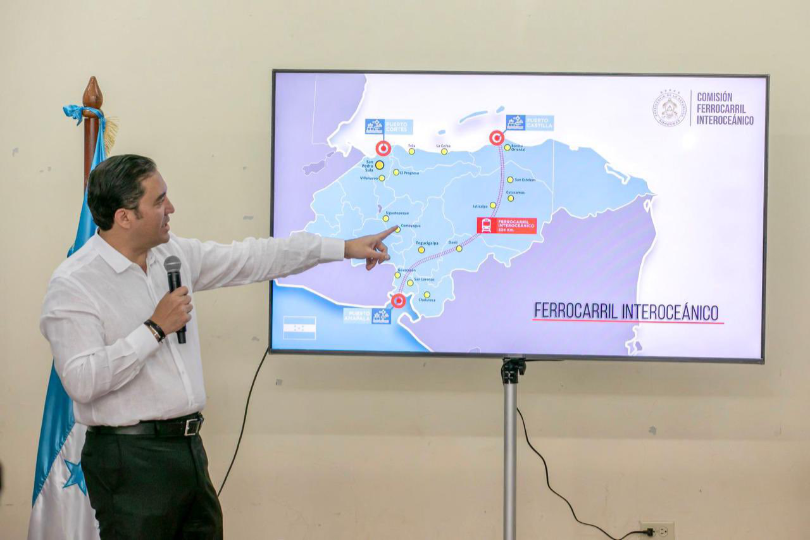
The idea behind the project is to create a railroad link, built wholly within Honduras, which will connect oceanic cargo traffic from the Caribbean Sea to the Pacific Ocean on its southern side. Think of it as a Panama Canal, with specialized logistics and cargo ship loading/unloading facilities added on both sides of the country, and with a unique train system linking the two new port areas.
As envisaged when it was brought past the idea stage to something more concrete in meetings held in the summer of 2023, it would involve expanding Puerto Cortés along the Gulf of Honduras, Puerto Castilla with more direct access to the Caribbean Sea, and Amapala at the gateway to the Pacific Ocean. Puerto Castillo and Amapala would be connected by a brand-new rail link for the primary “Interoceanic Railroad” entity.
Puerto Cortés would also be connected to both of those ports through a combination of smaller rail tracks and means of moving cargo from those smaller railroad sections onto conventional roadways for the final part of their journey.
It is estimated the project will take 10 to 15 years to complete. Though bidding is still some time away, project costs are expected to run about $20 billion.
The news that the project would proceed ahead was announced via Héctor Zelaya, the private secretary representing Honduran President Xiomara Castro, and who also heads up the commission for the project.
Zelaya recently held a meeting of the commission where the working group went over the results of meetings held in Mexico with a delegation headed up by Honduran Foreign Minister Alicia Bárcenas and other officials. There they were briefed on the planning and execution of both the recently launched El Tren Maya (the Maya Train), a project focused on increasing tourism, and the extensive Inter-Oceanic Corridor initiative in the Isthmus of Tehuantepec. The Corridor project will eventually result in the construction of a wide range of new manufacturing and business entities, some of which will be wholly Mexican owned and run, and others with international partners such as companies from the People’s Republic of China.
“We are going to fulfill the aspirations of the Honduran people by facilitating the movement of goods between the Atlantic and Pacific Oceans, which will place Honduras at the forefront of international commercial transportation," Zelaya said after listening to the briefing.
He also issued a statement after this session via the social media platform X in which he announced that the “National Commission of the Interoceanic Railroad in session at the Naval Base of Puerto Castilla, Colon, [has] declared the Port of Castilla as an area of national interest and priority for the construction of the Interoceanic Railroad."
The Commission also released figures recently detailing that the new Interoceanic Railroad will be able to support passage of cargo ships with carrying capacities of over 300,000 tons. Overly optimistic specifications for the project will also allow for shipment of as many as 10,000 containers every 24 hours. Even if that level of capacity could be achieved it couldn't handle the cargo of even one of the largest container ships in 24 hours, which can carry more than 14,000 containers.
Though the project is still in the planning stages, many nations have expressed strong interest in being a part of it. These include China, the United States, Italy, Japan, Qatar, South Korea, and Spain. Honduras doesn't have the money for the project and would need others to pay for it.
As the climate crisis worsens, it is unknown if drought will persist in Panama or not and continue to restrict the use of the canal there. The canal was built using locks that consume enormous amounts of fresh water and the drought has substantially reduced the number of ships that can transit the canal. The older locks use about 50 million gallons of freshwater water for each ship. The Canal Authority has been developing a a $8.5 billion sustainability plan to adapt the canal to drought over the next five years and if successful a railway in Honduras would probably not be worth the cost. Now that El Niño has peaked, Panamanians are hoping that the rains will return in May as usual.
Nicaragua previously had plans to build a canal across its land but its Chinese backer withdrew in light of the realities of such a massive undertaking.
As China shifts more of its manufacturing for the Americas market to Mexico and other countries in the hemisphere, the need to transport so much across Central America will decrease.