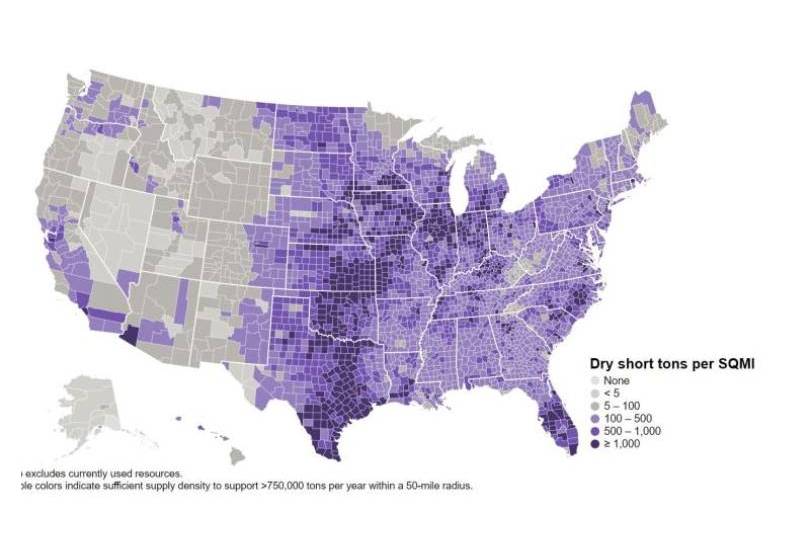
The 2023 Billion-Ton Report, or BT23, announced by DOE on Marach 15, is the fourth in a series of national biomass resource assessments spanning two decades. The report identifies feedstocks that could be available to produce biofuels to decarbonize transportation and industrial processes.
The report examines different levels of market maturity to assess the quantity of biomass that could be produced, its price, geographical density and distribution. The report covers biomass production capacity from some 60 resources, including winter oilseed crops, trees and brush harvested to prevent forest wildfires, purpose-grown energy crops, macroalgae such as seaweed cultivated in ocean farms, waste captured from cities and carbon dioxide from industrial plants. Harnessing emerging resources, such as algae, could boost biomass availability by another 250 million tons per year, depending on price, the report found.
The United States currently uses about 342 million tons per year of biomass to generate 5% of the nation’s energy. In a mature market where between 1.1 and 1.5 billion tons per year of biomass is available, the nation could produce 60 to 85 billion gallons per year of sustainable aviation fuel, reaching the goal of meeting 100% of the sector’s demand by 2050. Another use would be producing enough electricity to replace the power currently generated with fossil fuels.
No single source of biomass can supply all that’s needed, and the report identifies opportunities for biomass production down to the county level based on local conditions and evolving technologies. These resources and easy-to-use tools are available on DOE’s Bioenergy Knowledge Discovery Framework website.
Farmers and bioeconomy stakeholders can use the report as a first step to identify biomass production opportunities. Hardy perennial crops such as poplar trees and switchgrass that need less water and fertilizer, and winter oilseed crops like carinata and pennycress can provide additional farm income. Cities could capture waste discarded in landfills, supporting a circular economy.
The report follows the 2005 U.S. Billion-Ton Study, the 2011 U.S. Billion-Ton Update and the 2016 U.S. Billion-Ton Report, all managed by ORNL researchers. The new assessment includes contributions and reviews by 52 experts from 11 federal agencies, national laboratories, universities and industry.
The 2023 report “is the culmination of 20 years of meticulous analysis taking into account the potential from croplands, forests and new sources of biomass along with economic and environmental considerations, transportation and logistics and evolving technologies. We identify pathways to boost both rural and urban bioeconomies in support of a cleaner future,” said Erin Webb, lead for the Bioresource Science and Engineering group and relationship manager for DOE’s Bioenergy Technologies Office at ORNL.
ORNL’s biomass resource expertise, including Billion-Ton data and analysis, also supported the Roads To Removal national report released in December 2023 that identified 1 billion metric tons of carbon dioxide removal potential in the United States, charting a path toward the goal of a net-zero emissions economy by 2050.
UT-Battelle manages ORNL for the Department of Energy’s Office of Science, the single largest supporter of basic research in the physical sciences in the United States. The Office of Science is working to address some of the most pressing challenges of our time.