Venezuela Opposition Candidate Machado Names Alternate to Run Against Maduro
Lead StoryPolitics
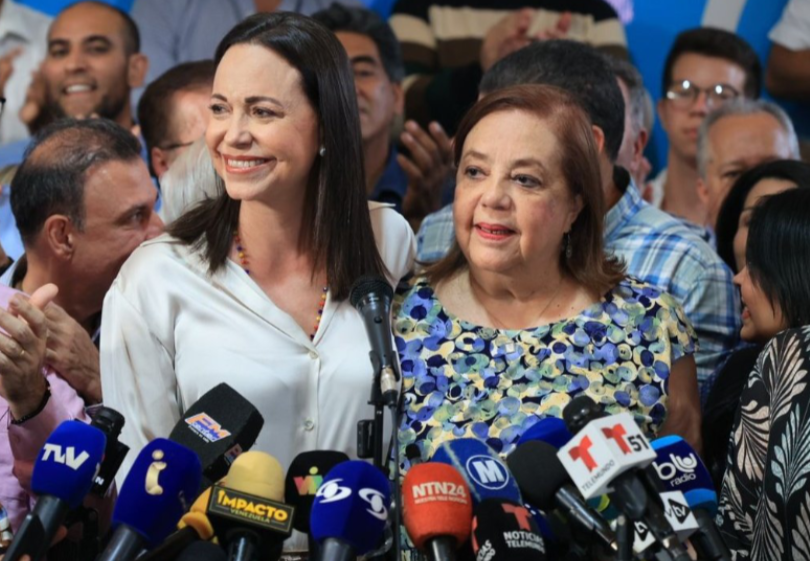
On July 26, 2024, Nicolás Maduro will be running for a third six-year term as president of Venezuela. Just six months ago it looked like another easy win for him. Then in October he ran into a surprisingly strong opposition bid from María Corina Machado, head of the Vente Venezuela party, a candidate who by actions taken this week has once again made a move which could still make for a tougher-than-expected presidential election race just four months from now.
Originally appointed to the post of president after the March 5, 2023, death of the country’s long-standing former populalist dictator Hugo Chávez, Maduro won his first formal presidential election by a narrow margin just a month later, in April 2013. During the eleven years since he took office, Maduro solidified his power in the country during that first term; reinforced and expanded the corrupt socialist agenda of his predecessor; managed to win re-election in May 2018 despite numerous challenges over charges of widespread election fraud; survived an attempt in January by National Assembly Leader and CIA stooge Juan Guaidó to take the presidency away from him, despite Guaidó being backed by the U.S. dominated Lima Group of nations, the CIA, and Donald Trump; and managed to navigate his way through extreme financial pressures caused by the combination of tough U.S. sanctions imposed while the Trump team was in power, and by installing what is considered one of the world’s most corrupt administrations.
Maduro’s government remained in control because of that corruption, some important benefits his administration provided to the poorest of his people (including subsidized low-cost housing and fuel), and a ruthless approach to eliminating most opposition party options from having any chance of securing enough political support or even being allowed to run for office, depending on the candidate.
The U.S. has remained determined to unseat any independent government and install its own puppet ruler in Venezuela so that American oil and mining companies can loot the nations wealth, as it had done up until Chavez came to power. It has waged a nasty war against Venezuela using various criminal proxies, severe economic sanctions, sabotage of infrastructure and the theft of Venezuela's international assets.
The Maduro regime was able to pull together a credible case alleging the opposition leader was guilty on charges of laundering over $5.2 billion from multiple overseas sources, likely the CIA.
This stealth war combined with the Maduro's regimes own gross corruption and incompetence has caused nearly 8 million Venezuelans to flee their homeland.
The challenge for Maduro last year came from the first very demonstrably different candidate in terms of new policy positions to stand against Maduro in years, and who even now appears to have strong popular backing despite multiple legal assaults challenging her candidacy.
That candidate, María Machado, won the opposition party primary on October 22 with an estimated over 90% of the total votes cast. It was a vote with the sort of strong numbers and wide-ranging popular support with a higher-than-usual probability of beating Maduro when this summer’s elections take place.
A former Venezuelan legislator, Machado’s credentials include a highly respected educational pedigree. She is a graduate from the Institute of Advanced Studies of Administration (IESA), the most respected educational business school in the country, with a degree in Industrial Engineering and a specialization in Finance.
Machado also brings to her candidacy a family with deep roots in successful businesses in the country, something analysts point to as part of her broad appeal. Machado’s father, The recently deceased Henrique Machado Zuloaga, María’s father, was a senior executive in the country’s metallurgical industry. Machado’s family also founded Electricidad de Caracas, considered one of the most important national corporations in Venezuela of the last century, as well the Sivensa and Sidetur steel companies. All were expropriated to a significant degree during the administration of Hugo Chávez, but they still left Machado and her family with enough assets remaining to continue growing their businesses despite the growing power of the socialist government under Chávez.
As co-founder of the Vente Venezuela (“Come Venezuela”) party which she has led since 2012, even before Maduro became president, Machado has stood for vastly different political principles than her socialist opponent. Those include privatization of government-held businesses, rededication of the country to a market economy, passage of legislation and bringing in new business leadership to support the new kind of economy, and social guarantees for the people. All of these were major points she made during her primary campaign running from mid-2023 through the last intense weeks before the October 22 primary.
Machado also made the highly controversial pledge during that campaign that she would privatize the country’s current most important business asset, Petróleos de Venezuela (PDVSA), the state-owned oil company, should she win the primary and the upcoming election this July. This made her a darling of U.S. oil companies. Venezuela sits on the world's largest petroleum reserve.
Machado was also understood to be backed in a significant though covert way by various forces from the United States, including the Central Intelligence Agency, just as Juan Guaidó before her had been. It was never discussed in public and may have been primarily in the form of indirect financial support for her campaign, with money never reaching Machado directly to avoid direct charges against her by the Maduro administration.
Machado won her primary campaign despite one serious issue which would prove to haunt her in the weeks and months since the October primary. That was a prior ruling by Venezuela’s Controller General some years ago which banned her from running for elected office for a period of 15 years. It was a punishment for her having spoken out in support of the sanctions the United States and the Trump team had levied against the country.
That could have stopped her, but when the Biden White House agreed last year to lift substantial portions of its sanctions on Venezuela in return for a broad-based pledge that the country would run “free and fair elections”, it also demanded the country reverse the Controller General’s decision preventing Machado from running for office. Maduro’s government agreed to those terms, began pumping oil from its vast reserves again, and raising production to the highest levels in years.
Soon after Machado won her primary victory, however, the Maduro government took steps quickly to short-circuit her upcoming bid for president.
The first began within days after the primary, with the government asserting the opposition primary election process itself was corrupt, with Maduro’s team asserting everything from ballot fraud to vote buying and inadequate safety provisions associated with online voting. That ended up going to the nation’s highest court, el Tribunal Supremo de Justicia for resolution. It ruled on October 30 that "Following the request of preventative protection and in consequence, all the effects of the distinct phases of the electoral process conducted by the National Primary Commission are suspended.”
It was a clever ruse, ironically by claiming that the opposition party candidate won her victory without conducting its own “free and fair election” rather than by going directly against the past ban on Machado’s candidacy.
Machado’s party filed numerous challenges to that ruling, including a well-crafted legal appeal to the same Venezuelan high court which directly confronted the assertions of election fraud by the government. It ended up losing what appears to be its last attempt to reverse that in January, as the court turned down a final appeal which demanded hard evidence for its actions. This time the Tribunal also reasserted its claims that Machado was still banned from running for elected office anyway, under the supposedly previously listed ruling that she could not be a political candidate in the country for a 15-year period. Bowing to pressure from Maduro’s cronies, the Tribunal also supported administration charges that Machado was connected with certain financial mismanagement issues while she served in the country’s National Assembly.
Following that, on January 29 the U.S. cut through all this by re-imposing some of the sanctions it had lifted prior to the Venezuelan primary. It did so by claiming the Maduro government violated its rules about “free and fair elections” by denying Machado’s win.
After those sanctions began again, Maduro and his cronies responded with denouncements for what had come out of Washington and further actions taken behind the scenes to ensure Machado’s campaign was now finished, once and for all.
That escalated to a new boiling point last week, beginning with the release of a report by an independent team which had been looking into the Maduro administration’s ongoing human rights abuses. It also had been studying the growing list of actions by Maduro and his cronies against Machado and other possible challengers for political power in the country.
That report was presented early on March 20 to the United Nations Human Rights Council at a hearing in Geneva. There Marta Valiñas, the head of that panel of experts which produced the report, called out Maduro’s government for gross abuse of power and violation of human rights across the country.
“The mission confirms that, as has happened in the past, the authorities invoke real or fictitious conspiracies to intimidate, detain and prosecute people who oppose or criticize the government,” she told the UN council members.
“At the same time, the attorney general’s office continues to operate as part of the government’s repressive machinery to grant the appearance of legality to the persecution of critical voices,” she added.
Hours after that hearing happened across the ocean from Venezuela, Tarek William Saab, the very attorney general who the human rights investigative panel head Valiñas had mentioned was a key to the country’s human rights corruption, announced his country had issued arrest warrants nine members of the team which was running María Machado’s primary and now presidential campaign bids. The arrests were ordered against Magalli Meda, Machado’s campaign manager, along with eight other members of Machado’s staff.
Saab said the nine involved were part of a vast anti-government conspiracy which was out to push Maduro out of power by any means. He said they were mustering a campaign against Maduro which included social media, mass demonstrations, and a planned violent assault on government military barracks. Two of those who had warrants issued against them were already taken into custody when Saab made his pronouncements. One was reportedly campaign manager Meda. Two others tied to the Machado campaign, Henry Alviarez and Dignora Hernandez, were also arrested last Wednesday by Saab’s office. Five others who have not yet been named were also reportedly detained as the political sweep continued.
After the warrants were issued and the arrests begun, María Machado took to social media to condemn Saab’s actions and to call for the public to stay strong despite what was happening.
“These cowardly actions aim to close Venezuela’s path towards change and freedom in peace and democracy,” she wrote on the social medium platform X. “Venezuelans, I ask you for strength and courage in these difficult times. Today, more than ever, we need to be united and firm to continue moving towards our goals.”
Saab’s actions appeared carefully choreographed to prevent Machado’s party from having any chance of a foothold in the coming presidential campaign. The period in which candidates can register for the election runs just five days, from March 21 to 25.
It seemed now inevitable that everything Machado’s Vente Venezuela party had campaigned for would now come to an end. But on March 22, Machado surprised everyone by announcing her party had selected Corina Yoris, a philosophy professor who supports Machado’s political agenda, to take her place for the upcoming July 28 elections. Not only that, it was also announced Yoris had the full support of the entire party.
Machado made the announcement in a press conference few had suspected was coming so quickly. By making the announcement publicly and with her present, Machado signaled her party’s run to unseat Nicolás Maduro from office would continue, but with a new person who she would fully support and campaign for vigorously.
It is also assumed that, by some still hard-to-imagine miracle Yoris wins despite Maduro’s coordinated attacks on the party, Machado would be named to some senior position within the party.
“We have found a person of my total trust, honorable, who is going to fulfill this procedure,” Machado said as she introduced Yoris to the reporters before her on Friday. “This was a decision that arose from within the discussion of the unitary forces and that gives us all confidence.”
Most assume the Maduro administration will come out forcefully against Yoris first as she files her registration as a candidate. Expectations are it will attempt to reject her on the grounds that she was part of the commission which helped set up the October 22 primary election, and that she probably had some role to play in alleged election fraud committed on that day. But in this the Maduro administration will need to tread carefully, since this will become even more obviously an attempt to undermine any remaining sense of credibility and fairness for the July elections. It could also inadvertently trigger stronger-than-expected support for the Vente Venezuela party both from within the country and from outside entities carefully watching what Maduro is doing.
Besides the internal issues which could play on what will happen with Machado’s party’s new candidate for president, the United States is also expected to be involved from the sidelines and possibly more in the upcoming election, just as Washington supported National Assembly leader Juan Guaidó after the last one. As evidence for that, the just passed $1.2 trillion federal emergency funding act which dementia-ridden war criminal Joe Biden just signed includes an allocation of $50 million for “democracy programs for Venezuela”. That funding is outlined on page 919 of the bill, in a section entitled “Latin America and the Caribbean”. The money will almost certainly be used to undermine Maduro’s candidacy, along with vastly more in dark money.
For now, this is Corina Yoris’ time, and her words following María Machado’s announcement that she would be taking the lead for the opposition party are being listened to by far more than just Venezuela.
“We are heading toward a transition path in Venezuela,” Ms. Yoris told the reporters before her. “We are all necessary at this moment.”
Venezuela's curse of vast deposits of oil means that it will remain in the cross-hairs of powerful criminals who want to loot that oil and will stop at nothing to get it.