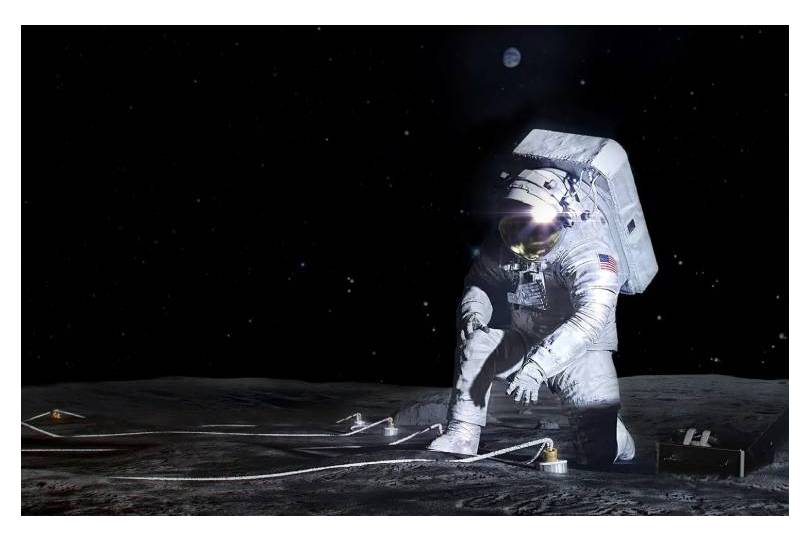
The instruments will address three Artemis science objectives: understanding planetary processes, understanding the character and origin of lunar polar volatiles, and investigating and mitigating exploration risks. They were specifically chosen because of their unique installation requirements that necessitate deployment by humans during moonwalks. All three payloads were selected for further development to fly on Artemis III that’s targeted to launch in 2026, however, final manifesting decisions about the mission will be determined at a later date. Members of these payload teams will become members of NASA’s Artemis III science team.
The Lunar Environment Monitoring Station (LEMS) is a compact, autonomous seismometer suite designed to carry out continuous, long-term monitoring of the seismic environment, namely ground motion from moonquakes, in the lunar south polar region. The instrument will characterize the regional structure of the Moon’s crust and mantle, which will add valuable information to lunar formation and evolution models. LEMS previously received four years of NASA’s Development and Advancement of Lunar Instrumentation funding for engineering development and risk reduction. It is intended to operate on the lunar surface from three months up to two years and may become a key station in a future global lunar geophysical network. LEMS is led by Dr. Mehdi Benna, from the University of Maryland, Baltimore County.
Lunar Effects on Agricultural Flora (LEAF) will investigate the lunar surface environment’s effects on space crops. LEAF will be the first experiment to observe plant photosynthesis, growth, and systemic stress responses in space-radiation and partial gravity. Plant growth and development data, along with environmental parameters measured by LEAF, will help scientists understand the use of plants grown on the Moon for both human nutrition and life support on the Moon and beyond. LEAF is led by Christine Escobar of Space Lab Technologies, LLC, in Boulder, Colorado.
The Lunar Dielectric Analyzer (LDA) will measure the regolith’s ability to propagate an electric field, which is a key parameter in the search for lunar volatiles, especially ice. It will gather essential information about the structure of the Moon’s subsurface, monitor dielectric changes caused by the changing angle of the Sun as the Moon rotates, and look for possible frost formation or ice deposits. LDA, an internationally contributed payload, is led by Dr. Hideaki Miyamoto of the University of Tokyo and supported by JAXA (Japan Aerospace Exploration Agency).
Artemis III, the first mission to return astronauts to the surface of the Moon in more than 50 years, will explore the south polar region of the Moon, within 6 degrees of latitude from the South Pole. Several proposed landing regions for the mission are located among some of the oldest parts of the Moon. Together with the permanently shadowed regions, they provide the opportunity to learn about the history of the Moon through previously unstudied lunar materials.
With the Artemis campaign, NASA will land the first woman, first person of color, and its first international partner astronaut on the Moon, and establish long-term exploration for scientific discovery and preparation for human missions to Mars for the benefit of all.