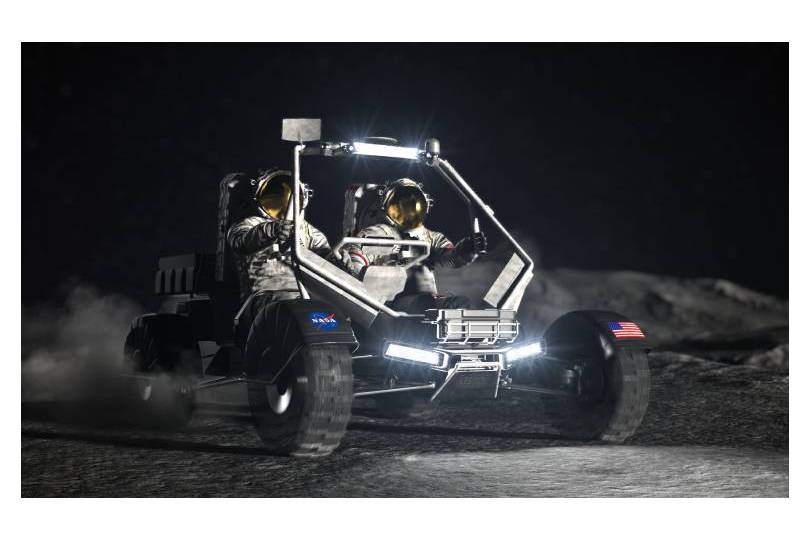
The awards leverage NASA’s expertise in developing and operating rovers to build commercial capabilities that support scientific discovery and long-term human exploration on the Moon. NASA intends to begin using the LTV for crewed operations during Artemis V.
NASA will acquire the LTV as a service from industry. The indefinite-delivery/indefinite-quantity, milestone-based Lunar Terrain Vehicle Services contract with firm-fixed-price task orders has a combined maximum potential value of $4.6 billion for all awards.
Each provider will begin with a feasibility task order, which will be a year-long special study to develop a system that meets NASA’s requirements through the preliminary design maturity project phase. The agency will issue a subsequent request for task order proposal to eligible provider(s) for a demonstration mission to continue developing the LTV, deliver it to the surface of the Moon, and validate its performance and safety ahead of Artemis V. NASA anticipates making an award to only one provider for the demonstration. NASA will issue additional task orders to provide unpressurized rover capabilities for the agency’s moonwalking and scientific exploration needs through 2039.
The LTV will be able to handle the extreme conditions at the Moon’s South Pole and will feature advanced technologies for power management, autonomous driving, and state of the art communications and navigation systems. Crews will use the LTV to explore, transport scientific equipment, and collect samples of the lunar surface, much farther than they could on foot, enabling increased science returns.
Between Artemis missions, when crews are not on the Moon, the LTV will operate remotely to support NASA’s scientific objectives as needed. Outside those times, the provider will have the ability to use their LTV for commercial lunar surface activities unrelated to NASA missions.
NASA provided technical requirements, capabilities, and safety standards needed for LTV development and operations, and the selected companies have agreed to meet the key agency requirements. The contract request for proposal required each provider to propose a solution to provide end-to-end services, including LTV development, delivery to the Moon, and execution of operations on the lunar surface.
Through Artemis, NASA will send astronauts – including the first woman, first person of color, and its first international partner astronaut – to explore the Moon for scientific discovery, technology evolution, economic benefits, and to build the foundation for crewed missions to Mars. Advanced rovers, along with the agency’s SLS (Space Launch System) rocket and Orion spacecraft, commercial human landing systems and next-generation spacesuits, and Gateway are NASA’s foundation for deep space exploration.