U.S. Threatens Sanctions Against China for Supporting Russian Military
Lead StoryGovernment
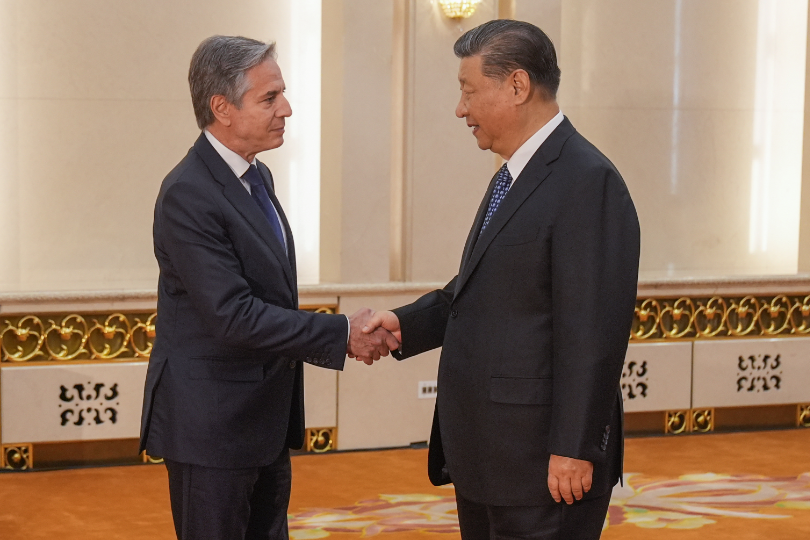
According to a televised interview Antony Blinken held after returning from meetings with People’s Republic of China (PRC) President Xi Jinping, he threatened what he described as serious economic sanctions on China if it were to be found the country was supporting Russia’s war efforts in Ukraine.
While he was there, Blinken also pushed China to back down on using its own military to enforce claims in the South China Sea, and not to meddle in the upcoming presidential elections.
It was an unusually confrontational agenda for a set of meetings which had been billed as building a new and closer relationship with China.
Regarding the Ukraine War, and China’s role in aiding Russia despite harsh sanction already in place against Moscow and key military suppliers there, Blinken described the evidence against China in this matter as extensive and unarguable.
“Russia would struggle to sustain its assault on Ukraine without China’s support,” Blinken said in his comments after leaving China. “China is the top supplier of machine tools, microelectronics, nitrocellulose, which is critical to making munitions, and rocket propellants, and other dual-use items that Moscow is using to ramp up its defense industrial base.”
Ukraine would certainly have been forced to seek peace without the endless military aid and cash handouts from the U.S. intended to compel the government to continue sacrificing its people in a conflict it cannot win.
Blinken also said he made it clear to Xi that NATO, the European Union, and the rest of the G7 group of nations were also on the U.S.’s side of this point and prepared to take serious economic actions against China as a combined force if necessary, which is not really true.
“Fueling Russia’s defense industrial base not only threatens Ukrainian security, it threatens European security,” he told the press after the meeting. “Beijing cannot achieve better relations with Europe while supporting the greatest threat to European security since the end of the cold war.”
Though sanctions on Chinese entities have not made much difference in policies the PRC chose to take regarding either Russia or in the Asia-Pacific region, Blinken reminded his mostly western audience of the strong measures the administration of dementia-ridden Biden has taken against China since it has been in charge.
“I made clear that if China does not address this problem, we will. We’ve already imposed sanctions on more than 100 Chinese entities, export controls, et cetera,” he said. “As before, we are prepared to act to take additional measures, and I made that very clear in my meetings today.”
American sanctions have in reality only made target countries stronger and more independent, and that includes China.
While the sanctions for its support of Russia might represent a minor concern for China, of bigger importance for Xi over the next months is building a stronger economic connection with Europe. It has grown more critical as evidence grows that China’s economic growth cannot be maintained solely from domestic sources, and alternatives to China’s international manufacturing presence are growing in Asia, particularly in countries such as Vietnam and to some extent in India. It is also more important than ever that China avoid new “dumping” tariffs in Europe such as the new ones the U.S. is moving into place against imported Chinese steel and aluminum.
Helping build these economic bridges is a high priority as Xi begins a busy month of diplomatic travel in May within Europe.
Among those stops is in Hungary, where Xi will meet directly with Hungarian Prime Minister Viktor Orban from the 8th to the 10th of May. The country is considered a promising prospect for joint business ventures between it and China, especially as it has proven to act highly independently of the rest of Europe on a variety of issues.
Though Orban himself has not said much about the upcoming visit, Gergely Gulyas, the Hungarian prime minister’s chief of staff, has already indicated how important the upcoming meetings with Xi will be.
“Hungary thinks that it is not worth setting up ideological boundaries when it comes to economic relationships, and we are happy about the Chinese president’s two-day visit,” Gulyas said in a press statement.
Though economic discussions are the principal focus of the meetings between Xi and Orban, it is expected the Ukraine War will also be a topic because of strong opinions Orban has on the issue, and equally strong connections both leaders have regarding Russia.
On the pivotal issue of the European Union providing many billions of euros more of aid to Ukraine to keep the futile war effort going, for example, Orban exercised the sole veto against that aid back in December, on the grounds that there was neither a path to victory nor a roadmap for peace negotiations with Russia laid out as part of the guarantee of further aid. Orban later relented and the aid package is soon to be approved.
Orban has also continued to maintain a strong personal relationship with Russian Federation President Vladimir Putin for years. Orban was one of the few European leaders to recognize Russia’s annexation of the Crimea in 2014, for example, and has in the past defended Putin as the primary force behind Russia’s reemergence of an important international power in the 21st century. Orban’s connections with Putin also reportedly continued to remain strong even after Russia invaded Ukraine, even though Orban has rejected Putin’s actions in sync with much of the rest of Europe.
Xi is also scheduled to visit both France and Serbia as part of his upcoming European tour.
With France, though exact dates and subjects for discussions planned there have not been announced yet, it is expected to be a mix of international trade issues and the Ukraine War. Of high priority for Xi is to help set a process in place for the upcoming Ukraine peace summit which will take place in Luzern, Switzerland, next month. Xi also wants Russia to be represented at the summit, and already has Switzerland in its court lobbying with the rest of the EU, NATO, and the United States for Moscow to be present. Russia has so far been locked out of all past meetings like this one, and although China does provide some counterbalance to the alliance of western countries who are there to support Ukraine, not having a physical representative from Russia would make any real negotiations difficult to pull off.
No details are yet available for the Serbia visit. There is also no information if Xi might be negotiating behind the scenes for other meetings with world leaders while in Europe.
What is coming up soon after these visits that was a part of the discussions between Xi and Secretary of State Blinken this week is President Putin’s planned meeting with Xi in Beijing in about a month. It will be Putin’s first state visit since recently being awarded another term as president, in an election mostly staged to appear fair but which even Moscow is not going out of its way to claim was anything but rigged.
Putin’s visit will be watched closely by the world to see what public agreements of support Xi makes for Russia. Blinken’s visit to Xi this week was at least in part timed based on that trip, with the hope that perhaps new threats of sanctions might somehow influence Xi to alter his posture toward Putin and perhaps the Ukraine War.
Xi is already on his own reportedly urging Putin not to meet with North Korea Supreme Leader Kim Jong-On as he travels out from Moscow next month. With multiple military intelligence sources already proclaiming North Korea has been providing some weapons support for Russia in the Ukraine War, and with the peace summit looming, Chinese ministry officials and Xi are hoping Putin can at least postpone this visit for some time.
Other topics which were also part of Blinken’s discussions with Xi this week included new American affirmations of support to push China back from its already established sea and land positions in the South China Sea.
Over the last year, the U.S. has more tightly linked in Australia, South Korea, Japan, and the United Kingdom in multiple maritime war exercises in the South China Sea to enforce these positions. It also recently signed off on tripartite agreements with Japanese Prime Minister Fumio Kishida and Philippine President Ferdinand “Bong Bong” Marcos, Jr., on joint military support plans to keep China out of what the U.S. considers international waters not far from the Philippines. The U.S. is also flowing massive injections of military aid support in terms of money, munitions, weaponry, and American troops into the Philippines as well.
Despite all the moves by the U.S. on this issue, China has remained firm in its position that the territory in the South China Sea is Chinese. It is also actively enforcing it through deployment of its own military vessels, and use of some of those – in the form of Chinese Coast Guard vessels – in “firing” on Philippine vessels it sees as encroaching on its territory with water cannons.
Though there was no official announcement from Xi regarding Blinken’s insistence that China move out of the disputed oceanic and land territories in the South China Sea, China’s Foreign Minister Wang Yi did address some of those points in statements made yesterday after Blinken had departed.
“China’s legitimate development rights have been unreasonably suppressed and our core interests are facing challenges,” he said.
He then openly questioned, “Should China and the United States keep to the right direction of moving forward with stability or return to a downward spiral?”
“This is a major question before our two countries, which tests our sincerity and ability,” Wang said.
Wang also issued an open warning to the U.S. “not to step on China’s red lines on China’s sovereignty, security and development interests.”
“Should our two sides lead international cooperation on global issues and achieve win-win for all, or engage in rivalry and confrontation or even slide into conflict, which would be a lose-lose for all?” Wang asked. “The international community is waiting for our answer.”
In his own statements afterwards, Blinken agreed that finding a point of cooperation was a “shared responsibility” of the two nations, even while emphasizing the U.S. willingness to take on whatever conflicts – military, economic, or both – might be necessary to enforce the U.S. positions.