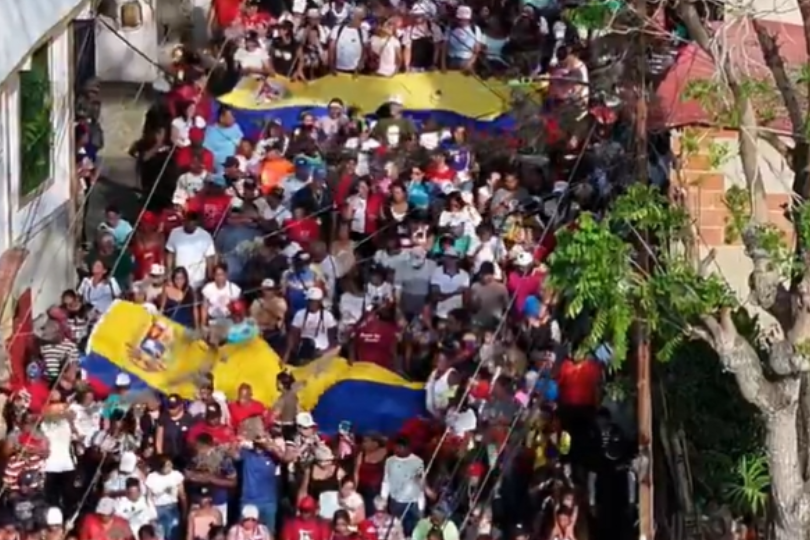
The site of Monday’s march against American oppression and in favor of the government of President Nicolás Maduro was the city of Petare, Venezuela, located in Miranda, the second largest of Venezuela’s 23 states. The small town is also part of the metropolitan city of Caracas, the country’s capital.
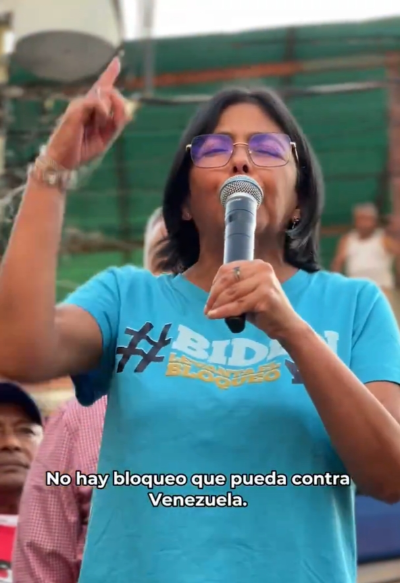
The protest, led by Venezuelan Vice President Delcy Rodriguez and Miranda Governor Hector Rodriguez, was attended by thousands as they walked in opposition of long-standing sanctions imposed against their country by the United States.
Some of those sanctions date to when Barack Obama was president and his government imposed economic punishments against the socialist government of President Nicolás Maduro, beginning in 2014. The first of those were imposed when protesters – that Maduro said were influenced by American agitators – were the victims of a major crackdown by the Venezuelan police. Further sanctions were added in 2017 during the Constituent Assembly election, during the 2018 presidential election which resulted in Maduro winning another term and have continued to at least minimal effects since then.
All along the purported intent of the sanctions was to provide support to those opposing Maduro’s presidency, and to counter what is known to be one of the most corrupt governments in South America. While entities such as Transparency International have documented that corruption in considerable detail year after year, it is also without question that a major reason for the freezing of international Venezuelan assets at the direction of the United States and long-term economic blockade which has rendered it impossible for Venezuela to cash in on its vast oil supply is the U.S. desire to have access to that oil for its own economic interests.
It is a tug of war which will continue so long as the United States maintains its anti-Maduro trade policies and continues to put pressures on which it hopes could remove Maduro’s government in favor of one more amenable to U.S. interests.
The topic is especially sensitive for Venezuelans now, after last year puppet Biden for a few months had lifted substantial portions of the existing sanctions against the country. For the first time in years, as of October it allowed Venezuela to begin to process oil at fields from its state-owned oil company, Petróleos de Venezuela, S.A. (PDVSA), and begin to ship some of that oil to U.S. corporations for refining and further sale. The U.S. allowed this under an agreement by Maduro to allow the entire presidential election process this time to run without major interference from the existing administration, apparently in hopes that the then expected right-leaning and U.S.-friendly opposition candidate María Machado might gather enough momentum to unseat Maduro.
Though Machado did win the Opposition Primary, multiple moves by the Maduro administration quickly derailed her candidacy. Those steps included a court challenge to her candidacy, on the grounds that she had committed treason against the state by endorsing the U.S. sanctions. Maduro’s senior legal officials also arrested senior individuals within Machado’s candidacy. They also stepped in quickly to invalidate when Machado selected Corina Yoris as an alternate who could carry her party’s banner forward in the upcoming election scheduled to happen on July 26, 2024.
As they led Monday’s march against the U.S., few of those details were mentioned by the country’s Vice-President or the governor of Miranda. Instead, they focused on rallying strength from the citizens of the country against the crushing sanctions imposed on them by the United States.
"Today, the people of Petare took to the streets against the criminal blockade,” Vice-President Rodriguez said. “We told Biden: Lift the blockade now!”
"They will never see President Maduro kneeling before the Yankees,” he continued, speaking to the cheering people in the streets. “He has confronted the empire because the Venezuelan people deserve respect.”
In his message, Rodriguez harshly criticized the right-wing party of opposition candidate María Machado, pointing to how despite the party claiming to be there to support the people of Venezuela, it was at the same time urging the U.S. to continue its tough sanctions which the Vice-President were continuing to harm every Venezuelan.
Darcy Rodriguez rallied the masses before him by telling them all that the government of Nicolás Maduro was in the process of developing a participatory democracy which a shift in power to the far right could only derail.
“Let’s defeat the stateless people who want to hand over Venezuela to the empire. Let's allow Venezuela to continue on the path towards social and economic well-being,” she urged the crowd.