After a six-week state trial held in New York City, the jury delivered a guilty verdict on all 34 felony counts of falsifying business records to cover up a crime.
The case is often referred to as the “hush money” trial because a key factor in the case involved Donald Trump paying porn star Stormy Daniels $130,000 in return for her silence about having an affair with her. The reason why Trump paid the money was because, as those who worked with him at the time testified, Trump was afraid that if her story came out as it would have just before the 2016 presidential elections, the public reaction could cost him the election.
The crimes Trump committed in this case was not the payoff itself, which might have been legal on its own, as it was similar to companies paying an out-of-court settlement to an individual or company in return for them signing a non-disclosure about the settlement.
That would have been messy, however, since because Trump was making the payment to influence an election outcome, he would likely have had to find a way to log the money as a campaign expense. Not disclosing the purpose of the money spent could have been considered a misdemeanor in New York State, according to legal experts.
What Trump was convicted of instead was 34 separate counts of illegally hiding the payoffs. According to the testimony in the case, Trump and his staff did so with full knowledge of what they were doing, including extensive reworking of business records – including transfer payments to Trump’s then attorney Michael Cohen, who Trump used to launder the money so it would be difficult to trace as anything related to keeping Daniels quiet about his affair with her.
Each charge was tied to accusations by the prosecutors that Trump personally orchestrated a conspiracy to hide what he had done by “cooking the books”.
All 12 jurors in the case were polled separately in the courtroom to confirm their agreement with the conviction conclusion which the jury foreperson had read aloud.
The jury heard closing arguments in the case on May 27 from Trump’s legal team and the prosecutors. The next day the presiding judge in the case, Justice Juan Merchan, provided the juror with final instructions for reaching their verdict. Among those instructions was that both acquittal and conviction decisions by the body would require a unanimous vote by the jury.
Under New York law, each of the 34 felony convictions carries a maximum sentence of 4 years in prison. Justice Merchan has scheduled the sentencing to happen on July 11.
Merchan, who was forced to put multiple gag orders on Trump to prevent him making accusations against the judge’s assistant, the jury, and other court staff, has multiple options about how the sentencing might proceed. It is possible he could rule to put Trump in jail for some of those 4 years per count, but experts say it is more likely that because Trump has no prior criminal record that probably will not happen. A period of forced home confinement is one option, as are multiple forms of probation.
At this point any suggestion of precisely what Merchan will do is pure speculation, despite pundits already making their own predictions regarding the trial.
Trump’s attorneys will also appeal the conviction. This could eventually overturn some of those 34 felony convictions, after a likely period of at least months and possibly years. The appeals could also delay the imposition of whatever sentence Merchan hands down, while the appeal is being heard.
It is also a fact that even though being a convicted felon is a serious crime, the convictions, even if they stand and even if they involved home imprisonment or prison time, would have no effect on Trump being legally allowed to run for president and even taking office should he win.
Ironically, as a convicted felon Trump himself would not be legally allowed to vote in the elections.
For Trump, Justice Merchan’s scheduling of the sentencing has some interesting timing associated with it. On June 27 Trump and Biden will be holding their first presidential debate, for example. On July 15, the Republican National Convention which currently would be awarding its presidential nomination to Trump by a landslide vote, is scheduled to begin. In both cases Trump’s conviction will certainly come up for discussion.
Donald Trump is currently still on trial in the Georgia case charging him with conspiracy to commit fraud in the 2020 presidential election, in the District of Columbia case involving his role in instigating the January 6, 2021, insurrection at the U.S. Capitol Building, and the Florida trial where Trump is charged for having unlawfully taken highly classified documents to his Mar-a-Lago home, while also conspiring to obstruct justice by hiding documents from federal agents searching for them there.
Trump is also expected to be indicted soon in the Arizona state trial involving charges to overturn the 2020 presidential election results there. His former attorney Rudy Giuliani and other close associates of Trump and the Trump campaign have already been charged with multiple felonies in that case.
Trump’s legal team has 30 days to file a notice of appeal of the guilty verdict. Then it has an additional six months after that to file a full appeal to the first judicial department, which oversees all appeals for convictions within New York County.
If that first judicial department upholds the conviction, Trump will likely appeal to the seven-member New York court of appeals which is the next rung in the judicial ladder.
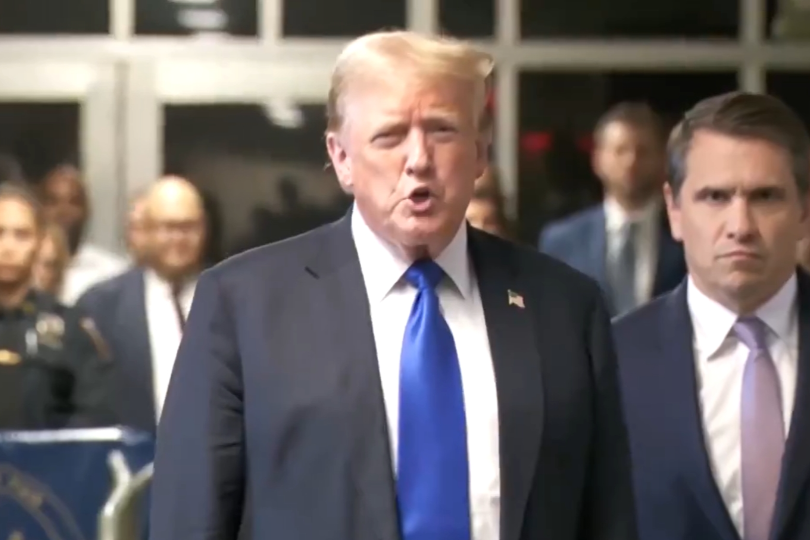
Following yesterday’s verdict against him, Trump spoke briefly to reporters gathered in a hallway outside the Manhattan courtroom about the outcome.
“This was a disgrace,” Trump said, clearly agitated as he talked. “This was a rigged trial by a conflicted judge who was corrupt.”
“The real verdict is going to be November 5, by the people,” he added, referring to election day this fall. “They know what happened here, and everybody knows what happened here.”
Later yesterday Trump and his campaign team sent out an emergency post-verdict appeal for campaign funds to his vast email list. With a heading featuring Trump screaming that “I AM A POLITICAL PRISONER!” he asked supporters to rally around him and dig deeply into their wallets for new campaign contributions.
Trump has scheduled a formal news conference tomorrow at which he will address the conviction, what it means for him and his candidacy, and what he plans to do about it.