Mexico Elects AMLO’s Designated Successor Claudia Sheinbaum by a Landslide
Lead StoryPolitics

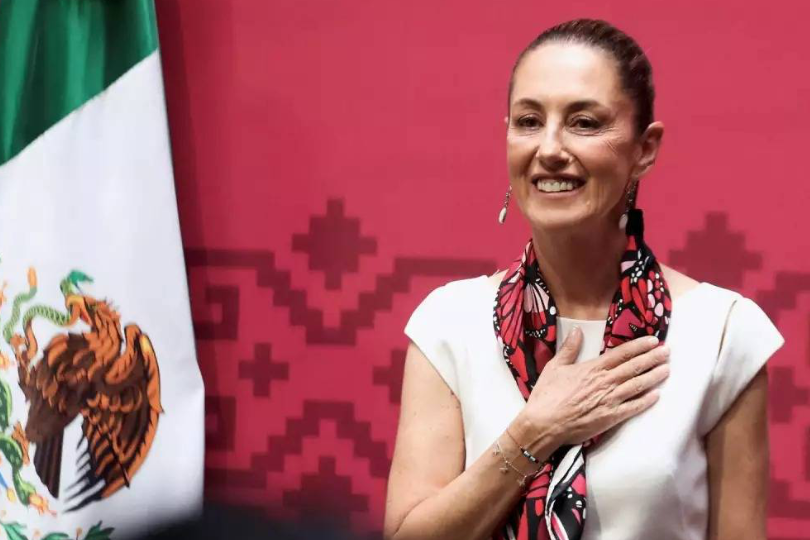
On June 2, Claudia Sheinbaum scored a dramatic victory in the race to be elected the next president of Mexico.
With an estimated 59.5% of the votes, she brought in the largest percentage of the vote in the modern democratic Mexican history. That is well above the 53.2% current President Andrés Manuel López Obrador drew when he was elected on July 1, 2018. Sheinbaum’s vote total also came in about 5 million votes higher.
The 61-year-old Sheinbaum was aided in her quest for the presidency as President AMLO’s personal choice to succeed him. As a member of his Morena party, she has for some time been a strong backer of his populist and socialist-leaning policies. By doing so it helped her ride to some extent on AMLO’s coattails, which were vast geographically and in many areas his favorability rating remains 60% or higher, a very strong backing for a Mexican leader in the last year of his term of office.
Sheinbaum is also the country’s first female president in modern history, according to President López Obrador “the first in 200 years”. She campaigned on policies which are expected to drive gender equality more than ever for the country, and the victory shows the country supports that. Yet even with that win, since her main contender in the race, Xóchitl Gálvez, was also a woman, the gender card was less of a factor in the election than it might have been.
Sheinbaum defeated Gálvez Sunday by over 31 percentage points.
The president-elect is also unusual in that she is a scientist by training and practice, as well as the daughter of two scientists. Her mother, Annie Pardo, was a biologist and became an important role model for her. Sheinbaum herself has multiple scientific degrees, including a PhD in environmental engineering from the National Autonomous University of Mexico (UNAM). She continued her advanced education with a post-doctoral research stint at the University of California at Berkeley in the 1990s.
She has also published many academic papers in the field of energy and the environment. She was also a principal contributor to multiple reports for the United Nations’ Intergovernmental Panel on Climate Change (IPCC). That work is significant in that it shaped her strong opinions on the importance of making a difference in public policy regarding the climate crisis. The IPCC work she was involved with also contributed to that organization being awarded the Nobel Peace Prize in 2007.
The president-elect’s roots in politics are also deep, despite her extensive background in the sciences. Her parents were also political activists in the 1960s decade when Sheinbaum was born. They had close affiliations with Raúl Álvarez Garín, one of those who led a series of pro-democracy protests in Mexico in 1968. Those protesting at the time were subject to vicious suppression by the Mexican government of that time, leading to Garín being arrested and thrown in prison. While still a little girl, Sheinbaum came with her parents many times to visit the jailed activist and brought him food.
The combination of influences eventually led to Sheinbaum running for and winning the race for Mayor of Mexico City as a candidate of AMLO’s Morena party in 2018. She took office on December 1, 2018, and stepped down from that role earlier this year so she could run for president. As mayor, she led the complex political web of the largest city in North America and her nation’s capital.
Sheinbaum is also the first Jewish president of Mexico. What that means to Mexico’s international policy regarding the Gaza war and beyond is not yet clear.
In the election on June 2, Sheinbaum beat not only engineer and tech entrepreneur Xóchitl Gálvez but also Jorge Álvarez Máynez, a candidate representing the Citizens’ Movement. Máynez brought in only an estimated between 9.9% and 10.8% of the vote. Both candidates quickly conceded to Sheinbaum after preliminary numbers were released.
The Morena party she represents delivered a strong performance in other elections held this weekend. It won six of the nine gubernatorial races also held this weekend, including the southern Mexican state of Yucatán. This means the party now controls 24 of the country’s 32 federal entities in the country.
Along with that, though votes are still being counted, the landslide win for Sheinbaum and her party is adding up to an even larger majority win in the Congreso General de los Estados Unidos Mexicanos (General Congress of the United Mexican States). If as expected the Morena party takes two-thirds of the seats in that national legislature, this would given Sheinbaum unprecedented ability to pass not just landmark legislation of her choosing, but also constitutional reforms which require that supermajority to get through.
Among the more significant challenges Sheinbaum faces as an incoming president are to address what is even now a growing organized crime problem, despite AMLO’s attempts to deal with it during his term. She will also be called upon by both parties in the United States to find a way to keep illegal Mexican migrants from crossing the border of the U.S., as that issue has once again become a political football with Donald Trump as the presumptive Republican nominee, despite his felony convictions.
Just yesterday puppet Joe Biden issued an executive order which allows him to close the border with Mexico effective immediately. It is a symbolic gesture intended to calm swing voters who may choose to vote for Team Trump this fall. But it comes with short term effects could be damaging for relations with Mexico. Sheinbaum will be somewhat isolated from current conflicts on this because AMLO is in charge, but she will have to deal with the repercussions of policies which are put in place now on the Mexican side of the border to deal with Biden’s dictates.
Sheinbaum will also be looking to merge her scientific expertise regarding the climate crisis with public policy for her country. With her home in Mexico City, she is painfully aware of the current high temperatures and extreme drought which could cause it to run out of water later this month. She will likely push for further use of water reclamation and recycling techniques and alternative energy sources becoming dominant.
A further scientific issue her administration will need to deal with involve AMLO’s directives to remove genetically modified crops from its country, both in imports coming from the United States and in production on its own land. AMLO has established strict policies which have created significant economic friction about this with the United States, which claims blocking purchases of GMO seeds from Monsanto and others represent a violation of the USMCA free trade agreement linking Mexico, Canada, and the United States.
The president-elect will also need to grapple with China’s increasing manufacturing presence in the country. While Chinese production plants provide jobs and taxes for the economy, the United States has already issued executive orders and soon is expected to pass legislation which would impose sizeable import levies on those goods. That sets the stage for an economic confrontation not long after Sheinbaum takes office on October 1.
AMLO has pledged his unconditional support for Sheinbaum as he wraps up a still goal-filled agenda between now and when he transfers the reins of power.
"Yesterday I already congratulated her. I am very happy because you can imagine what it means to hand over the presidency to a woman after 200 years of republican life in which only men governed Mexico since 1824," he said in a public statement on June 3.
"She is the candidate with the highest vote in the history of Mexico compared to all of us who have held the office of President,” he continued. “That is historic.”
"She is [also] woman with convictions who was trained in university activism and in the fight for democracy in Mexico. She [has] a lot of experience in the art of government since she was head of government of Mexico City," he continued. "But above all, she is an honest woman, which is something very important.”
And while AMLO said he intended “not to impose anything” on Sheinbaum as she enters office, the outgoing president made clear he has at least one important constitutional reform to push through before the end of September.
“I do think we have to address the issue of judicial reform,” he said yesterday about that. “There has to be a judiciary that represents the Mexican people, that is incorruptible, because if not, we will not move forward.”
In her public statements, Claudia Sheinbaum thanked the voters who swept her and her party into office with such large numbers and pledged to deliver on her commitments to support the populist agenda AMLO pioneered.
“This is the triumph of the Mexican people and the peaceful revolution of consciences,” she declared in a text yesterday on social media. “It is our people's clear recognition that the mandate is to continue and advance with the fourth transformation of public life in Mexico."