Zelensky Lands $50B from G7 and Signs 10-Year Security Pact with U.S.
Lead StoryGovernment

The latest Group of 7 (G7) summit is proving lucrative for Ukraine President Volodymyr Zelensky, at least in terms of new promises from the international community. Whether those promises will stick long term is still very much at risk.
Zelensky joined Prime Minister Justin Trudeau of Canada, French President Emmanuel Macron, German Chancellor Olaf Scholz, Prime Minister Fumio Kishida of Japan, Prime Minister Rishi Sunak of the United Kingdom, and Joe Biden of the United States, and summit head Georgia Meloni, Prime Minister of Italy, for the three-day event which began yesterday.
President Xi Jinping of China, the last of the G7 members, is not attending the summit at this time and did not provide a reason for not being able to go.
The event is being held at the Borgo Egnazia luxury resort in Apulia, Italy.
Though much will be discussed on the sidelines, there are two official topics on the agenda which will dominate the sessions. Those are what to do about Ukraine, to be addressed in a detailed planning session which President Zelensky was invited to attend, and how to deal with the out-of-control crisis in Gaza, where Israel is escalating its genocidal war daily.
Zelensky’s first “win” of the day yesterday came early, as Italian Prime Minister Meloni told the press that the G7 group would be releasing a massive incremental loan package to Ukraine.
“I confirm to you that we have reached political agreement to provide additional financial support to Ukraine of approximately $50 billion by the end of the year,” Italian Prime Minister Meloni announced.
European Commission President Ursula von der Leyen, who is also attending the summit, explained the unusual source where those funds were coming from.
“All G7 are contributing to this loan,” she explained. “It is the windfall profits from the Russian immobilized assets in Europe that will serve it.”
The $50 billion principal for the loan will come from an international loan syndicate to be paid for in part by each of the G7 nations. It will be managed by an international lending syndicate consisting of multiple lenders, mostly based out of the U.S. and the European Union, but not exclusively so.
The interest on the loan, and possibly all the reimbursement of the principal, is to be paid out of earnings made on Russian assets seized and frozen since the war began in February 2022. Those seizures were carried out mostly by the United States via its global financial network and the European Union.
Zelensky thanked the group for their continued commitment to support his country. He said this money would be used for “both defense and reconstruction”, while at the same time emphasizing again that his country will still require far more military support from the group in the future.
German Chancellor Olaf Scholz called the G7 action “a very historic step and a historic decision” in a post on the social media platform X.
“With the G7 states’ plan to mobilize $50 billion, … the foundation has been laid for Ukraine to be able to procure everything it needs in the near future, not only in terms of weapons, but also for reconstruction or energy infrastructure,” he continued.
“The next step will be just to create the technical conditions for implementation in the shortest possible time,” Scholz added.
The G7 group hopes to have the full $50 billion in Zelensky’s hands by the end of this year.
The $50 billion is coming to Ukraine in addition to existing outright grant outlays – in cash, weaponry, munitions, aircraft, training, and more – of many hundreds of billions of dollars the country has already received to defend itself against the Russian invasion. That previous backing includes over $175 billion in aid authorized by the U.S. in five separate bills passed by the U.S. Congress since the war began. Biden has also directly authorized other aid to Ukraine on multiple occasions without Congressional approval; some came in late 2023 and early 2024 when the House of Representatives was refusing passage of any bills – including aid to Ukraine – pending some agreements on how to provide a more secure border between the U.S. and Mexico.
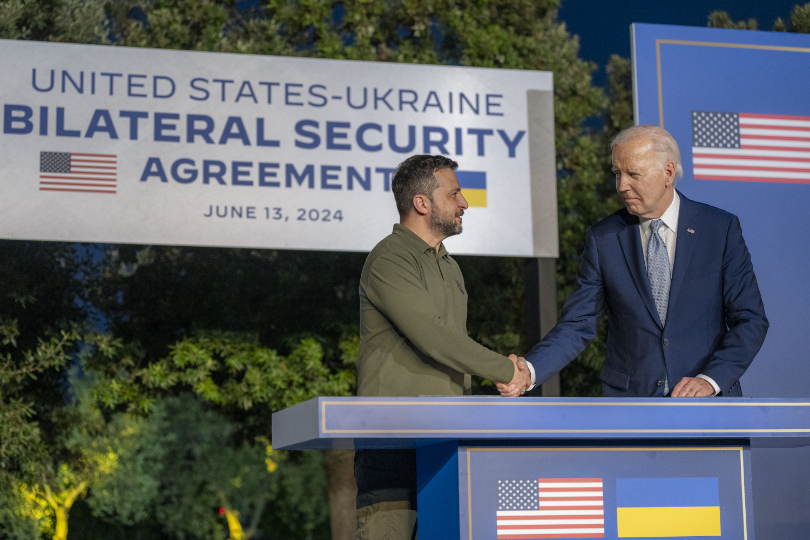
Besides the G7 loan agreement, Zelensky came away from yesterday’s meetings with a landmark 10-year security agreement with the U.S. that he and Joe Biden signed off on the sidelines of the summit.
This new “Joint Declaration of Support for Ukraine” is primarily about the U.S. pledging its ongoing support for Ukraine.
It begins by “affirming that the security of Ukraine is integral to the security of the Euro-Atlantic region”, and by “recognizing the need to preserve and promote Ukraine’s sovereignty, democracy, and capacity to deter and respond to current and future external threats.” It goes on to acknowledge the nations’ “desire to expand their defense and security cooperation and their trade and investment ties”, that they believe “Ukraine’s future is in the North Atlantic Treaty Organization (NATO)”, as a further means of protecting Ukraine from its enemies.
The agreement says the United States believes it is important to hold “Russia to account for its aggression against Ukraine, including by supporting Ukraine in seeking compensation for the damage, loss, and injury resulting from Russia’s aggression”. The U.S. promises to back organizations such as NATO and others which will hold “accountable those responsible for war crimes and other international crimes committed in or against Ukraine, consistent with international law”.
It then goes on to detail specifics covering how the U.S. will help Ukraine defend its nation. It includes a statement like the NATO treaty provision that an attack on one member state will be considered an attack on all. In the new agreement it stops just short of that, noting that, “Any future aggression or threat of aggression against the sovereignty, independence, and territorial integrity of either Party would be a matter of grave concern to the other Party.”
It further promises extensive joint military cooperation over the term of the Declaration, joint military exercises, training to assist Ukraine in its defense, and support for improved cybersecurity in the country.
The pact also includes measures tied to improving Ukraine’s long-standing problems with corruption and lack of transparency within the government. Among the efforts the U.S. says it will assist Ukraine with are:
“Strengthening Ukrainian justice sector reform to promote the independence and integrity of the judiciary;
“Strengthening all independent state anti-corruption institutions such as the Specialized Anti-Corruption Prosecutor and the National Anti-Corruption Bureau of Ukraine;
and
“Implementing reforms in law enforcement, security, tax, and customs institutions to resolve jurisdictional issues, and to improve transparency and accountability and strengthen the rule of law.”
After this new agreement and the $50 billion loan arrangement from the G7 were announced, Zelensky and Biden held a joint press conference about the greatly expanded new levels of support for Ukraine.
Declaring what just happened was proof that “democracies can deliver”, Biden added that, “We are putting our money to work for Ukraine, and giving another reminder to Putin that we are not backing down.”
Zelensky said the Joint Declaration of Support just signed with the U.S. was the “strongest agreement” made between the nations since Ukraine became independent in 1991.
“Today is a truly historic day,” he added.
While Zelensky may be correct that the words of support from the U.S. and the entire G7 were groundbreaking, there is also strong evidence that these offers could unravel at a moment’s notice.
The Joint Declaration, for example, is not a treat and is not “legally binding”, as Zelensky said it was. Just as with a similar joint security arrangement recently negotiated between Biden and the heads of Korea and Japan, this never went through the U.S. Senate for approval, as would be required to obligate the U.S. to deliver on the promises made within the document.
There is also an election coming up with Biden himself could lose to Donald Trump, and which also might involve flipping control of the entire Congress to the Republicans. Trump has already said he is not sure about delivering more of the country’s money to fight the war against the Russians. He has also defended Putin’s actions on multiple occasions, which could leave Ukraine in the lurch from U.S. support if he were to win this fall.
Even if Biden wins, the U.S. also may finally be facing the recession the U.S. has avoided falling into for the entire time he has been in office. If that happens, pressures are expected to rise within Congress for smaller military outlays sent out of the country, and more kept for the direct needs of the American people.
In Europe, elections are also an important issue which could upend the existing strong support from the G7 leaders present at this month’s summit. In the elections across the 27 nations of the European union which were just held, the far-right party members won many races. While they are mostly hawkish in support of defending the EU against outside threats, those same members are also nationalist in terms of the policies they stand for. That could mean a reduction in the $50 billion loan plan Meloni announced at the G7 summit, delay in rolling out its provisions, or both.
Three leaders at the summit are also up for reelection currently, with unclear outcomes for each race. Besides the Biden-Trump race which will be intensely fought, Prime Minister Rishi Sunak of the United Kingdom and President Emmanuel Macron are fighting to keep their positions in what already look like tough campaigns for them both.
Macron’s race has only just started, as he just called for a “snap election”. But he did so only after his political party lost substantial seats in this months’ parliamentary elections, and he believed the risk of calling an election to regain some power was the right choice.
Sunak is already well into his campaigning period, but it is not going well. A major poll taken on June 12 showed his party, the Conservatives, commanding only 22% of the electorate while the Labour Party has almost double that, at 43%.
If Macron were to lose his reelection campaign, the French leader, who is often regarded as the de facto political leader of the European Union, the impact on support for Ukraine and even the war in Israel could be serious. A loss by Sunak might seem less significant since he stands for the U.K. alone, but with Sunak being a member of NATO and one of the earliest to step up with munitions, fighter jets, and more for Ukraine, an opponent winning could tip the scales against Ukraine from whoever the next Prime Minister might be.
So, while Zelensky has reason to celebrate his new loan from the G7 and the 10-year vote of support from Biden, Ukraine’s fortunes on both of these might change even before the G7 loan payouts are supposed to begin in December 2024.