
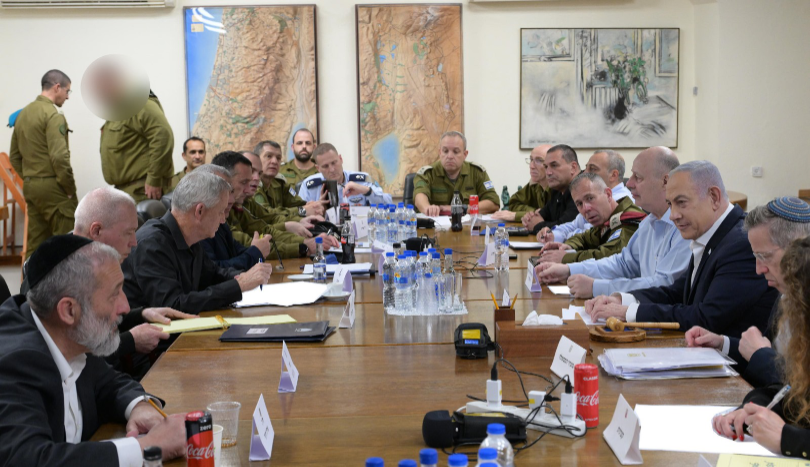
On October 11, just days after Hamas forces launched its October 7 attack on northern Israel, Prime Minister Benjamin Netanyahu created what he called his War Cabinet.
It consisted of three principal members, each with voting powers, plus advisors, to assist with guiding what has become the most devastating war of genocide on the Palestinian people in Gaza.
The principals in that Cabinet included Netanyahu and Defense Minister Yoav Gallant. It also included Benny Gantz, a former general in the Israeli military and, as leader of the political opposition, the head of the country’s centrist National Unity Party.
The advisors to the body were Gadi Eisenkot, former Chief of Staff of the Israeli Defense Forces; Aryeh Deri, head of the religious party Shas; and Ron Dermer, the current Strategic Affairs Minister from Netanyahu’s full Cabinet.
Yesterday Netanyahu shut down that War Cabinet.
The primary reason for doing so was not that the war is over. It is because opposition leader Gantz resigned on June 9.
Gantz was added to the War Cabinet precisely because he was the leader of the largest opposing political faction in the country. By putting him in there and giving him voting power regarding how the war in the Gaza Strip would be fought, Netanyahu sought to neutralize Gantz’s ability to criticize decisions, especially from outside of government. And even though he had voting power, the War Cabinet was stacked in favor of the war hawks, with Netanyahu and Gallant very much usually seeing eye-to-eye regarding the war effort and able to overrule what Gantz might have challenged.
As the fighting wore on, there were increasing high-level disagreements between Gantz and Netanyahu over what the endgame for the war might be. Netanyahu wanted the focus of the war to be about his cry for “total victory” against Hamas. He also wants a standing military presence in Gaza after the war is over, and with Israel still having dominance in decision-making regarding the region. Gantz was less specific about what he wanted to see happen, but comments he made suggested he wanted the military removed from Gaza soon after victory was declared. Gantz also sided with those who wanted a concrete plan, with deliverables and steps laid out for the eventual reconstruction and rehabilitation of Gaza.
On May 18, Benny Gantz made public his growing disagreements with the direction Netanyahu was taking the war in a rare public address to the nation. In it, he declared that, “Lately, something has gone wrong” with the way the government was deciding on each next step.
“Essential decisions were not made,” he explained. “Essential leadership decisions to ensure victory were not done.”
He also attacked the increasing influence that Minister of National Security Minister Itamar Ben Gvir, the head of the hard-right Otzma Yehudit party, was having on continuing the already bloody and catastrophically destructive war in Gaza.
“A small minority has taken over the command bridge of the Israeli ship of state and is steering her toward the rocks,” Gantz said, to a public who knew well who Gantz was referring to.
Gantz also attacked Netanyahu for continuing the war just to stay in power, delaying criminal trials where he is the defendant, when the better decision might have been to call an election as his ruling coalition was beginning to fall apart.
“Personal and political considerations have infiltrated the holy of holies of Israeli security,” he said.
Gantz then went on to outline a 6-point plan that he believed needed to be put together immediately, to allow plans to begin for “the day after” the war in Gaza is over, regardless of how far in the future might be. He also said he would resign on June 8 if Netanyahu’s government failed to create such a plan.
With no plan provided by June 8, Gantz resigned one day later. Advisor Gadi Eisenkot, the former IDF Chief of Staff who is also a centrist and aligned with Gantz on the issue of the need for a plan for what to do after the war, also resigned.
In the week since that time, two of the right-wing members of Netanyahu’s government, National Security Minister Ben Gvir and Finance Minister Bezalel Smotrich, both of whom were brought in to build the coalition government Netanyahu patched together after the fall 2022 national elections, pushed Netanyahu to bring in one or both to join the War Cabinet in Gantz’s absence.
The other pressure Netanyahu was dealing with in the previous week was the presence of a three-phase Gaza ceasefire resolution puppet Joe Biden had put forth supposedly on behalf of Netanyahu on May 31, and which the UN Security Council passed by a vote of 14-0 on June 10. Hamas said it accepted most tenets of the proposal, with the exception being that it would not accept a three-phase resolution which was supposed to lead to the end of the conflict, if Israel could opt out of Phases 2 and 3 just by refusing to negotiate the terms of that full shutdown of the war in Phase 2 of the plan, even if they backed the plan.
Israel has said little about the resolution and allowed the propagandists and others to make it look like Israel backed the plan, but instead it was Hamas who was preventing it from moving forward. This message is becoming the dominant media narrative despite that Netanyahu and his spokespeople also continue to say they will not stop the war until Hamas is no longer capable of fighting the IDF.
Netanyahu’s choice to dissolve the War Cabinet addresses these issues relatively easily. But keeping Ben Gvir and Smotrich out of the government avoids the tough confrontation Netanyahu would face from both. It might even force Netanyahu to publicly declare the ceasefire proposal dead on arrival and flip the story about Hamas being the ones blocking it on its head.
Not having Ben-Gvir and Smotrich in the small War Cabinet also prevents Netanyahu having to justify all details of the war to each of them in advance, going forward. The only upside of having them in the War Cabinet might be to avoid them making their counter opinions public, but they have already proven they will criticize from the sidelines anyway and would probably continue.
As an example of that, yesterday, after Netanyahu announced he would be allowing brief daily “pauses” in the fighting in Gaza to let a bit more humanitarian aid into the Strip, Minister Ben Gvir complained in a message on the social media platform X that this decision had not been brought up Israel’s “Security Cabinet”, a group separate from the War Cabinet with overlapping responsibilities and on which Ben Gvir serves. He went on to attack Netanyahu directly for this action, calling him someone who is “stupid and ignorant, who must not be allowed to continue in his position.”
In announcing the shutdown of the War Cabinet, Netanyahu said little about how he would manage the increasingly fierce discussions about what should happen next in the war, and beyond. Instead, he used a political trick to allow certain “Israeli officials”, speaking on the condition that they would not be identified for their comments, to get the word out that he would handle some of these discussions by convening “smaller forums for sensitive matters”.
Those “smaller forums” will focus on the war, according to those officials. They will include representatives such as Defense Minister Yoav Gallant, continuing the role he has played to date in the War Cabinet, and Strategic Affairs Minister Ron Dermer, who had a non-voting advisory role in that special body. Others who are understood to be part of this new set of gatherings are Aryeh Deri, the head of the ultra-Orthodox Shas party who was also advising the War Cabinet before, plus Tzachi Hanegbi, the head of Israel’s National Security Council. As needed, other current and former members of the military may also be asked to be a part of these gatherings.
These new forums will also continue to lock out Ben-Gvir and Smotrich.
Netanyahu is still apparently setting this up. He is expected to announce this next set of organizational changes publicly sometime soon.
Despite the grievances Ben Gvir and Smotrich have with Netanyahu about his not being tough enough on the Palestinians both in the West Bank and Gaza, they remain a minority that Netanyahu continues to manage despite the challenges they create for him.
Part of why that could be simply, from the perspective of much of fascist Israel, that the workings of the War Cabinet have already managed to achieve much of the destruction and mass murders both right-wing leaders had hoped for regarding the vicious war in Gaza.
As of this day, over 88% of all schools, 80% of buildings for business and industry, and 60% of residential buildings of all kinds. 267 mosques and other religious structures have also been obliterated. 130 ambulances have been damaged enough so they are no longer usable, as are 18 of the total of 35 major hospitals which had cared for the sick and injured in Gaza for many years. The remaining 17 are still in use but also badly damaged. Most medical care in the Strip – in the few places where it can still be found – is in tents or sheltered within the hollowed-out husks of badly-damaged buildings.
Just this past week, Israeli Defense Forces completed destruction of all water wells in northern Gaza, after having previously wrecked virtually all infrastructure for water transport and sewage systems. Most electrical and communications systems are also gone after eight months of pummeling from rocket fire and shelling from the air.
During the war, Israel has also murdered at least 37,347 civilians, with 15,000 children among those dead. Over 85,372 people have been injured. These counts come principally from the Palestinian Ministry of Health, the Palestinian Red Crescent Society, and data provided by Israeli Defense Forces.
The numbers come out of a total of around 2 million people in Gaza, most of whom have been forced to relocate to tent camps the Israelis have set up.
Famine is rampant since food, water, and other humanitarian aid is substantially blocked from entering by the Israeli government and IDF military.
The war is currently in its final stage in Gaza, with Israeli Defense Forces running their promised ground operations to wipe out Hamas – and anyone who the IDF thinks might be Hamas – in that ravaged city.