
The Congressional Budget Office (CBO) just issued its regular Update to the Budget and Economic Outlook: 2024 to 2034, with numbers which should push the White House and the U.S. Congress to some sort of action to protect the country from potential long-term default on its loans to pay the deficit and to reign in needless spending.
Though a detailed analysis is presented to back them up, the summary calculations the report presents are staggering.
As a starting point, the current National Debt, which is the accumulated borrowing the U.S. government has made over time to finance its ongoing deficit spending every year, plus payments for interests, is $34.4 trillion. That figure is equivalent to 100% of the current Gross Domestic Product (GDP) for the entire U.S.
In the government’s fiscal 2024, which ends in September 2024, government outlays of cash for spending will be $6.8 trillion, with revenues trailing far behind that at $4.9 trillion. The total incremental budget deficit for this fiscal year appears on track to hit $1.9 trillion. The percentage of debt held by the public, which we all effectively pay partially through taxes, is 99%.
Ten years from now, in 2034, the total national debt will soar to $50.7 trillion.That is up from a forecast by the CBO four months ago which pegged that value at $48.4 trillion.
In 2034 the national debt will amount to 122% of annual GDP.
The first major factor driving the increase in debt is the continued gap between incoming revenues and outlays. By 2034 revenues will have climbed from this year’s $4.89 trillion to $7.459 trillion. Outlays, on the other hand, will have grown from this year’s $6.880 trillion to $10.305 trillion.
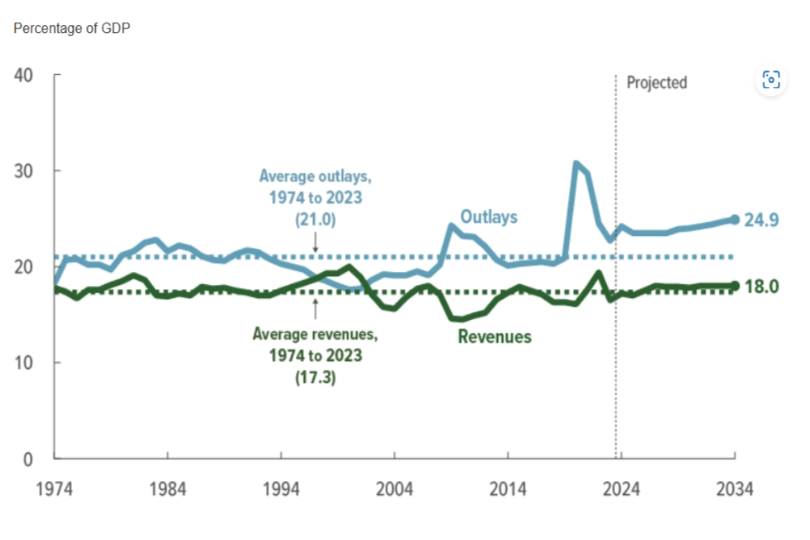
The revenues are growing, but adjusted for inflation and other factors, GDP growth in the U.S. is projected to remain around 2% per year over the next decade, without interruption. That of course assumes no substantial hits to the economy by a global recession, increased military spending beyond its already sizeable level (which would actually drive up GDP but via deficit spending again), or impacts of groups such as the BRICS group of nations shifting most trade away from the U.S. dollar. All three of those factors are expected to happen to some degree, but the CBO has not factored them in.
Another consideration in driving the national debt upwards is a far more rapid increase of mandatory spending components of the budget versus discretionary spending.
As the CBO graph above shows, mandatory spending will grow to 15.3% of all U.S. government outlays by 2034. Social Security payouts, the biggest single line item in this mandatory list, will rise from $1.452 trillion to $2.478 trillion during this time. Medicare, Medicaid, and related government medical programs will see outgoing funds increase from $1.654 trillion to $2.821 trillion. Other mandatory parts of spending will stay relatively flat during this time, from $1.086 trillion in 2024 to $1.037 trillion in 2034.
Net annual interest payments to service the debt will vary based on interest rates current at the time and the actual national debt. The CBO projects that this year’s annual interest payments, which are considered part of the mandatory list of outlays, will be $892 billion. That will effectively almost double by 2034, when the annual amount needed to service the debt will have risen to $1.710 trillion for the 2034 fiscal year.
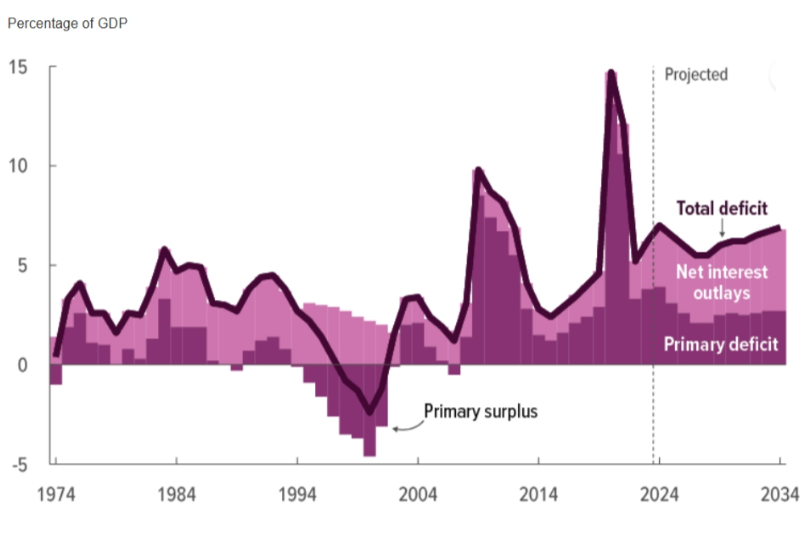
The graph above illustrates how those increased interest payments will continue to push up the national debt over time. Since the government will not have enough cash to pay the increased interest, that forces the Treasury to borrow more money just to pay for that interest. Ironically, the primary deficit will in fact go down between now and 2034, based on the CBO analysis of current spending, unemployment calculations, and tax collections for both individuals and government.
During this time discretionary spending is projected to rise to $2.259 trillion from its current value of $1.797 trillion. About half of both values come from military spending, and the other from all other projects.
One item which could make the national debt even worse would be if the Trump Team’s 2017 tax cuts which mostly benefit the wealthy continue. Those cuts added roughly $2 trillion to the country’s debt already. The bill has those cuts expiring in January 2025. The CBO calculations for what is about to happen to the national debt assumes those tax cuts are allowed to lapse. If they are extended, as would likely happen if Trump were elected president, there could be at least another $5 trillion added to the national debt by 2034.
Another item which the Biden administration which is of a similar nature could also make the debt soar further. Puppet Joe Biden plans to keep tax rates flat for those who earn less than $400,000, which because that covers most Americans would cause total deficits and debt to rise.
The White House also plans to implement additional social programs which it plans to “pay for” after having allowed the 2017 Trump tax cuts to lapse. That too will cause the debt to rise.
Put bluntly, even with the world somehow continuing to put up with rapidly rising U.S. borrowing to service its debt, the fiscal stress of the increased national debt will sometime push the debt – and the U.S. economy – to the breaking point.
CEO Michael A. Peterson of the nonpartisan Peter G. Peterson Foundation, a think tank which studies government budget issues, laid out the situation succinctly in a statement published yesterday after the new CBO debt estimates for 2034 were published.
“The harmful effects of higher interest rates fueling higher interest costs on a huge existing debt load are continuing, and leading to additional borrowing,” he said in a written statement. “It’s the definition of unsustainable.”