New UN Report Documents Further Evidence of Israeli War Crimes in Gaza
Lead StoryHuman Rights
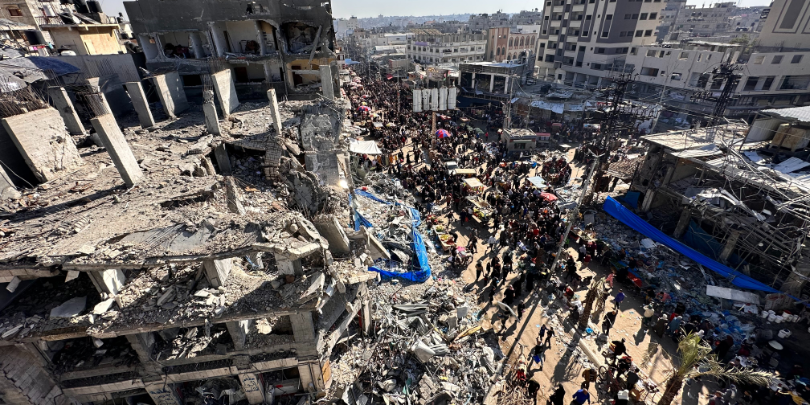
The report, prepared by the UN’s Office of the Human Rights Commissioner, “Indiscriminate and disproportionate attacks during the conflict in Gaza (October – December 2023)”, is the closest that office has come to date to leveling its own formal charges of war crimes Israel has committed during its assault on the Palestinian people on the Strip.
The UNHRC focused on Israel’s deliberate targeting of what they claimed where Hamas strongholds where dense populations of civilians also exist, and with the use of extremely powerful explosive weapons. It investigated and documented the reckless killing of ordinary Palestinian people and needless mass destruction of property which resulted.
Then it thoroughly compared the carnage Israel caused “complies with international humanitarian law (IHL), particularly in relation to the principles of distinction, proportionality and precautions in attack.”
To make its case, the UNHRC studied six of the bloodiest and destructive of individual attacks carried out by Israeli Defense Forces on Palestinian homelands between October 7 and December 2, 2023. The common threads connecting the selection of those six cases were the use of large munitions, such as the GBU-31 (a 2,000 pound bomb), GBU-32 (a 1,000 pound shell) and GBU-39 (with 250 pounds of explosive); the deliberate targeting of residential buildings, schools, refugee camps, and food markets which resulted in mass destruction of those sites; and the relatively large number of civilians who were killed in those attacks, totaling 218 among the six examples.
Most of these are versions of so-called “bunker busting” types of munitions. They are primarily used, the report explains, to blow through multiple levels of structures to reach intended targets hidden deep within wherever they hit. They are also of sufficient explosive force to destroy much of the areas around where they hit, deliberately causing extensive widespread collateral destruction and wrongful deaths.
The examples the Human Rights Office studied were:
Jabalya Market on October 9
In one of the first major military actions by Israeli Defense Forces on Gazans in this phase of the genocidal war, just two days after the Hamas invasion in northern Israel the IDF launched its first of many large-scale bombing runs on an area which large numbers of civilians are normally present and at a time when even more were drawn in. This aerial attack targeted the Jabalya food market, one of the biggest in northern Gaza, and its largest refugee camp. The shelling ran from approximately 10:30 AM to 11:30 AM, a time when many people commonly come to that market, using the largest of the bombing families listed – the GBU-31 bombs to do its damage. At least “42 people were killed, including 14 children and one woman”, the UNHRC determined; it also was given evidence of 18 more which probably should be included in the count, but they could not be verified. The IDF attack completely blew apart two multi-story buildings in the attack and caused extensive damage to many others.
Taj3 Tower, Gaza City, on October 25
This air raid blasted the relatively new Taj3 Tower, a residential building and other structures nearby and along Al Yarmouk Street. The report said the bombings, which also used the GBU-31 munitions, resulted in the complete “flattening” of an area covering 5,700 square meters (about 61,000 square feet). The Taj3 Tower was thoroughly shattered, as were several other structures nearby. The IDF murdered at least 105 people there that day, including 32 women and 47 children.
Jabalya Refugee Camp on October 31
The IDF returned to the scene of the October 9 attack on Jabalya Market this time. They claimed victory in the killing of their supposed intended target, Ibrahim Biari, the Commander of Hamas’ Central Jabaliya Battalion”, along with “a large number of terrorists who were with Biari” both above ground and supposedly in underground tunnel facilities. The UN confirmed that the attack also resulted in the deaths of 56 civilians, including 12 women and 23 children, with a possible additional 43 people who they received information about but once again were not able to verify. The assault blew apart 10 structures in a diagonal path 75 meters wide covering 2,500 square meters in total.
At least four GBU-32 shells, the ones carrying 1,000 pounds of explosive, were used in the attack.
Al Bureij Camp on November 2
This particularly vicious attack struck the Al Bureij Refugee Camp in one of the most densely populated areas in Middle Gaza. Using at least four GBU-39 bombs, the run wiped out 12 buildings and caused serious damage to 9 others over a span of 9,000 square meters. 15 people were killed this time, including 5 women and 9 children. The IDF has to date never admitted this incident ever happened.
Al Buraq School on November 10
This IDF terror assault occurred over a full month after October 7, and after Israeli military had already caused widespread destruction of homes and property across the region. That is relevant because this time the area hit was on and nearby the Al Buraq school in the Al Nasr area of Gaza City, a place where many Palestinian civilians were sheltering for safety. Using at least two GBU-39 bombs, Israeli Defense Forces destroyed a section of the ground floor and the next two floors up at the school. At least 34 were killed here. The IDF did acknowledge this attack, but once again said it was a hidden Hamas hideout. In its summary of this murderous attack, the official Israeli report on what happened said, “IDF aircraft struck Ahmed Siam, a company commander of the Naser Radwan Company of the Hamas terrorist organization… [with additional terrorists allegedly] hiding in the ‘al Buraq’ school.”
Ash Shujai’yeh neighborhood, Gaza City, on December 2
An IDF aerial mission using nine GBU-31 bombs shattered the Ash Shujai’yeh area in Gaza City starting at around 1:12 pm on December 2. According to Israeli military spokespersons, the raids, which lasted until the early evening, resulted in the death of Wissam Farhat, Al Qassam commander responsible for Ash Shujai’yeh Brigades. It also blew up at least 15 buildings and caused catastrophic damage to at least 14 others. The bombs resulted in the slaughter of at least 60 ordinary Palestinian people. The IDF has made no mention of the extensive collateral damage and death toll which it apparently considered fully justified to take out just one person, Wissam Farhat.
The data used by the UNHRC to study each of these sites of mass destruction and death was extensive.
“Information was gathered from multiple independent sources,” report says, “including through interviews carried out by OHCHR with witnesses, military and weapons experts; open-source information, including satellite imagery, videos and photos; information gathered by credible organizations and individuals; official and other documentation. The analysis of the information involved legal and weapons expertise, including from independent experts, and a “reasonable ground to believe” standard of proof was applied in reaching factual and legal conclusions.”
The report also notes that the IDF gave no advance warning in five of the six strikes analyzed in detail in this report, which is a requirement of international law when civilian centers might be hit.
In a press release summary of this detailed report, the UNHCR declared “that the series of Israeli strikes, exemplified by the six incidents, indicates that the IDF may have repeatedly violated fundamental principles of the laws of war.”
“In this connection,” it continues, “that unlawful targeting when committed as part of a widespread or systematic attack against a civilian population, in line with a State or organizational policy, may also implicate the commission of crimes against humanity.”
“Israel's choices of methods and means of conducting hostilities in Gaza since 7 October, including through the extensive use of explosive weapons with wide area effects in densely populated areas, have failed to ensure that they effectively distinguish between civilians and fighters,” the report adds.
“Civilian lives and infrastructure are protected under IHL [International Humanitarian Law],” it continues. “This law lays out the very clear obligations of parties to armed conflicts that make protection of civilians a priority.”
Ajith Sunghay, head of the Palestinian territories branch of the UNHCR, said during a press conference yesterday about this report that international law requires any nation involved in warfare to ensure proper care is used regarding “proportionality, distinction, precaution and necessity” in all conflicts.
“Our message here is, with these weapons in a densely populated area like Gaza, it would be extremely difficult, if not impossible, to follow those four principles,” Sunghay told the press.
And while the United Nations did acknowledge it was also wrong for Hamas to embed itself occasionally among civilian populations because of the exposure to danger it would cause, it was also far more criminal for the Israeli Defense Forces to use the excuse that those people might be present to attack an area with large and densely-packed civilian populations.
“The mere presence of one commander — or even several fighters, or of several distinct military objectives in one area — does not turn an entire neighborhood into a military objective,” said Jeremy Lawrence, another UN Human Rights spokesperson.
In releasing the report, Volker Türk, the UN High Commissioner for Human Rights, declared Israel to have been deliberately reckless and indiscriminate in the cited battlefield examples of the Gaza carnage.
“The requirement to select means and methods of warfare that avoid or at the very least minimize to every extent civilian harm appears to have been consistently violated in Israel’s bombing campaign," he said in a statement released alongside the report.
Israel responded quickly to the report. As expected, it issued a formal statement totally rejecting the findings of the report. It also refused to do anything about the UNHRC report’s demands that Israel conduct further investigations on these fundamental violations of the rules of war and potential war crimes it may have committed.
Meirav Eilon Shahar, Israel’s envoy to the United Nations in Geneva, was even more terse in his criticisms of the UNHRC report. He accused it and its authors of “spreading unfounded allegations”.