After European Commission officials announced on June 12 that it would be adding tariffs of up to 38.1% on Chinese-built electric vehicles being imported to Europe, on top of a 100% import duty puppet Joe Biden announced would soon be placed on similar cars of Chinese origin shipped into the United States, shock waves rippled through the Chinese EV industry.
In an equally surprising action but very different in nature, less than two weeks after the EC announced its substantial levies on imported Chinese EVs, it appears both China and the European Union will be working together starting this week on a mutually agreeable compromise to avoid this turning into an all-out trade war.
The reason these talks are so important for both sides is that as the climate crisis has worsened, most countries around the globe looked to electric vehicles as a solution to radically reducing greenhouse gas (GHG) emissions worldwide.
Globally carbon dioxide dumped into the atmosphere from fossil-fuel-powered cars and trucks accounts for approximately 12% of all annual emissions, second only to carbon dioxide exhausts from coal-fired power plants. In the U.S., the fraction is even higher, with gasoline- and diesel-powered vehicles contributing 28% of total GHG outputs. That fraction is larger than the global mean percentage of all CO2 emissions because the U.S. has already successfully switched much of its nationwide energy supply from coal and natural gas plants to renewable sources such as solar and wind energy.
The U.S. and the European Union responded to the opportunity to switch to green energy solutions for power generation and transport by providing incentives for, and investing in, domestic manufacturing of solar panels, wind turbine systems, electric vehicles, and battery technologies both for electric cars and trucks, and for storing excess solar and wind energy for government, industry, schools, and other types of enterprises.
China quickly reacted to the same opportunity, which it rightly saw as another chance for Chinese technology and marketing to dominate this highly lucrative surging market for all things “greentech”. Through tight coordination between manufacturers and supplies of components and subsystems, it rapidly moved to become the largest manufacturer of solar panels in the world, with an 80% worldwide market share encompassing not just the fully integrated solar panels themselves, but also all the way to these devices’ polysilicon material production, which it manufacturers at high yields and with equally powerful light-to-energy conversion efficiency.
The Beijing government groups which manage such investments ploughed large amounts of capital into core technologies and supply chains to support the EV and EV battery markets, and its China-based manufacturers who could leverage those investments into profitable and highly desirable products in the global marketplace.
It is an investment which paid off handsomely for the People’s Republic of China (PRC). The nation’s automakers currently account for 60% of all electric vehicles manufactured worldwide, with net projected annual fiscal sales of U.S. $306 billion in 2024. As demand increases for these products and global market outreach continues, the revenues generated by those products to almost double by 2029 to $674 billion.
Thanks to Chinese government backing and highly competitive engineering and marketing in this field, the largest EV manufacturer in the world now is BYD Company Ltd. Based in Shenzhen, Guangdong Province, the single most important technology center in China, the company holds a 19.4% share of the global EV market as of Q1 2024. With 624,000 unit sales in that quarter, BYD is on track in 2024 to becoming the first EV manufacturer to produce over 2 million such vehicles in a single year.
By comparison, previous market leader U.S.-based Tesla delivered over 1.8 million EVs worldwide last year via its various manufacturing operations, including in China. It saw a market surge last year, but sales are currently flattening or dropping, paving the way for BYD to grow far faster.
BYD and the other companies are winning their markets by providing a range of EV products often supplied at much lower prices than competitive offerings, and with innovative designs targeting a much broader range of customers than the equivalent offerings of Tesla and other automakers. Several of their EVs are offered at base prices under U.S. $15,000.
Chinese investments in EV technology also contributed to the rapid rise of electric vehicle battery maker Contemporary Amperex Technology Company, Ltd. (CATL), with headquarters in Ningde, Fujian province. It currently holds a commanding 34% global market share in 2023. The automaker BYD is in second place for EV battery-making, with 16%. Third place was held by South Korea’s LG Energy Solutions with 15%, and fourth place by Japan’s Panasonic, with 8%. CALB, Farasis Energy, Envision AESC, and Sunwoda, all of which are Chinese suppliers, provide another 7% in total market share.
This gives China a 57% global market share in EV battery technology. Technology innovations launched by CATL are also demonstrating far more rapid charging times and storage power capacities for EV batteries it expects to have on the market by next year. That, along with investments in EV battery manufacturing plants elsewhere in Asia, in Mexico, and in Europe, will likely push China’s market share of this critical component category even faster.
With such market power and with the EU having its own collective of companies such as Renault, Volkswagen AG, and Mercedes-Benz that it wishes to allow to keep competitive, in October 2023 the European Commission launched an open enquiry into how much the PRC may have subsidized its electric vehicle automakers. The goal was to determine if China’s EV makers, which the U.S. and Europe have categorized as having an “oversupply” of vehicles, may be illegally “dumping” EVs at lower prices than they might have been able to do otherwise.
The investigation was conducted openly, with the EC working directly with several Chinese EV makers and those which support its supply chain for a period of nine months. While still ongoing, it issued a preliminary report earlier this month which “provisionally concluded that the battery electric vehicles (BEV) value chain in China benefits from unfair subsidization, which is causing a threat of economic injury to EU BEV producers.”
Shortly after that, the European Commission announced a series of tariffs to be imposed on electric vehicles made in China and imported into the European Union. The tariffs were calculated based on estimates of how much China had subsidized its EV makers and with a consideration for how much cooperation those EV makers offered the European Commission investigation. The resulting tariffs were the highest for SAIC, a Chinese company which also owns British automaker MG, at 38.1% of the pricing of goods headed into Europe. Vehicles made by Geeley will be charged 20%, and market leader BYD 17.4%. These tariffs are all in addition to a 10% import tax for this category of goods brought into the EU.
These new provisional tariffs go into effect July 4. Final tariffs will be concluded this fall after the full analysis of Chinese EV auto subsidies is finished.
As part of the announcement of the new import levies, the European Commission opened the door to China working together with them to determine if there might be another way – with lower tariffs – to resolve the issues raised by the subsidy report.
In a surprise to the senior leadership of the European Commission, China has agreed to enter negotiations on this issue starting this week.
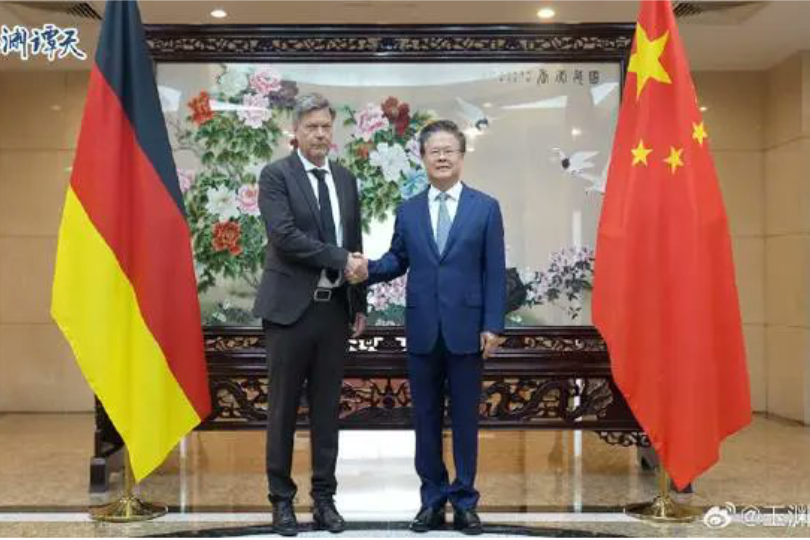
That these discussions are happening at all is a credit to open and frank discussions held in Shanghai this past week between German Economy and Climate Minister Robert Habeck and senior representatives of the Chinese Economy Ministry. The discussions were held on the sidelines of the first China-German High-Level Dialogue on Climate Change and Green Transition, part of which were held in Beijing and others in Shanghai.
During those meetings, Habeck emphasized to his Chinese counterparts that the tariffs the EU was about to impose were not punitive, unlike those often used by the United States, and to a lesser extent by Brazil and Turkey, in attempting to shift the balance of economies between countries.
“Europe does things differently,” Habeck said in comments after the Shanghai opening discussions were over on June 22.
Any tariff it decides to impose “is not a punishment”, he said, but instead based on the subsidies provided by the Chinese government.
The German Economy Minister explained further that he fully supports the concept of open markets, provided there is equality in how the companies competing in those markets are supported by the governments. Without directly pointing a finger at Beijing for having engaged in wrongful trade practices, Habeck went on to say that if there is solid proof of government subsidies which serve to help that country’s companies be more price competitive, that is unacceptable and corrective actions – including tariffs, if necessary – must be taken.
Habeck reached out to China’s Commerce Ministry to talk, as he said there is adequate time for the parties to meet to review the subsidy allegations, before the July 4 effective date of the current tariffs to take effect.
“This opens a phase where negotiations are possible, discussions are important and dialogue is needed,” he said during his remarks from Shanghai.
As part of the Shanghai talks, Chairman Zheng Shanjie of China’s National Development and Reform Commission, welcomed the opportunity for dialog on this topic.
He said the PRC can demonstrate that their country’s expanding market share in the electric vehicle business “is the result of competition, rather than subsidies, let alone unfair competition.”
During the meetings with Habeck, Zheng said he hoped that once all the evidence was on the table the EU “would do the right thing”, implying by that to decrease or scrub the planned import duty tariffs entirely.
If it did not, Zheng warned that, “We will do everything to protect Chinese companies.”
After the last meeting between Habeck and Zheng on June 22, Chinese Commerce Minister Wang Wentao told Habeck he would be reviewing the tariffs with EC Executive Vice-President and EU Trade Commissioner Valdis Dombrovkis in a video conference call that night.
Shortly after the call, Weng and Dombrovkis issued a joint statement that they would begin formal negotiation regarding the upcoming tariffs this week.
“This is new and surprising in that it has not been possible to enter into a concrete negotiation timetable in the last few weeks,” Habeck said from Shanghai after that news broke.
Calling the development just the first of many things the PRC and the EU will need to do to resolve their differences on this issue, Habeck expressed optimism that the talks could provide the basis for breakthrough on multiple trade issues between these two global powers.
“We are far from the end, but at least, it is a first step that was not possible before,” he told the press.